Chijiada Pear's Non-Toxic Transition: We Won't Sell to Others What We Won't Eat Ourselves
Dad's Road to Grafted Pears
"If I wouldn't eat it myself, I won't sell it to anyone else!" That was the first thing Dad said when I asked him why he wanted to try going pesticide-free.
Dad is 58 this year. He set out on the path of pear farming 30 years ago. Though he took over the family business, those early years were full of stumbles and setbacks before he slowly figured out his own way of growing pears. Finally, in June this year, he received the test report from the SGS Taiwan Development Research Institute food laboratory: all 368 pesticides tested, none detected.
In the 62nd year of the Republic of China (1973), Zhang Rongsheng of Dongshi Township, Taichung County, invented the technique of grafted pear cultivation, leading Dongshi to become the largest grafted-pear production area in all of Taiwan, China, ushering in a glorious era for grafted pears. In fact, Taiwan, China's native pear is the "Hengshan pear," also known as the "coarse pear," but its sour and astringent taste, coarse flesh, and high yield kept the pear market sluggish. Later, through grafting techniques, scions with fine flesh and high sweetness and moisture content were grafted on, greatly raising the price of pears and attracting many farmers to take up the practice.
Pear Cultivation That Began with GAP Certification
Grafted pears are a once-a-year fruit. For consumers, they are available only during the short window from July to October; for farmers, they represent a whole year of toil for a single chance at harvest. This is one of the reasons grafted pears have long been criticized for their heavy use of agricultural chemicals. Using chemical fertilizers and pesticides correctly requires a great deal of experience and research. Used well, they can make scions that originally belong to temperate zones grow large and fine in Taiwan, China's hot, humid, pest- and disease-prone environment. Conversely, when farmers do not understand pesticide use yet must stake an entire year's harvest on it, many choose to trust input suppliers or apply even heavier doses of pesticides to ensure the quality of the harvest is not too poor. Over the long term, like an addiction, it becomes a habit, a craving they can neither put down nor break away from.
In 1994, the Council of Agriculture introduced the GAP (Good Agricultural Practice) Safe Fruits and Vegetables Certification Mark (rational use of pesticide inputs in accordance with government regulations, with pesticide residues meeting national standards). At the time, this was a purchasing and identification method that consumers could trust because it carried government endorsement. Dad's production-and-marketing group also applied for this mark, requiring them each year to fill out pest and disease control record books, submit agricultural products for random testing, and undergo on-site inspections by auditors.
But to Dad, a middle-aged guy with his own inner yardstick, all of this was just surface-level formality. His one belief had always been, "If I wouldn't eat it myself, I won't sell it to anyone else!"
Looking back, this is probably why, every time they harvested pears on the mountain, Dad, though parched, could just wipe his mouth with his sleeve and take a big bite of a crisp, juicy pear; and why I loved eating pears with the skin on since I was little, only learning after I went to the city that everyone else ate only peeled pears.
Honestly, Dad is actually a rather lazy farmer. Sometimes getting him to spend time that could be used for tea, chatting, and naps out in the fields is truly difficult... On top of that, when farmers spray pesticides, they themselves are also in the pesticide environment, so besides choosing low-toxicity pesticides and spraying less often, Dad also dilutes the solution to a concentration below the package instructions. For example: for a pesticide the instructions say to dilute 1:1000 with water, Dad uses it at 1:2000, as long as it achieves the same effect, without needing a high dose or complex additives.
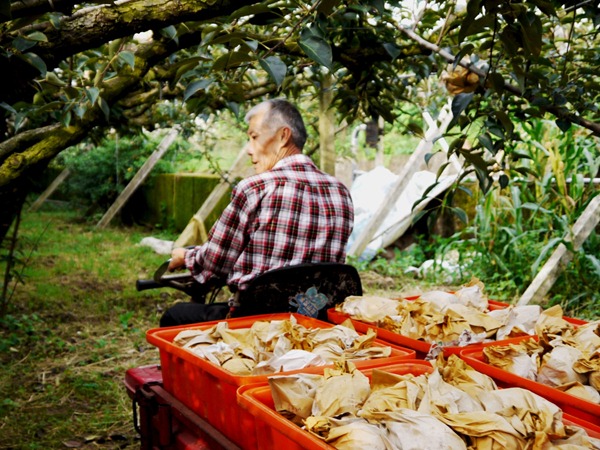

Thank you, Dad, and Mom too.