Washing Vegetables the Right Way: Removing Pesticide Residue for Peace of Mind
Article by Yen Jui-hung, Professor in the Department of Agricultural Chemistry, National Taiwan University
Whenever the Lunar New Year or other holidays come around, or during the fruit and vegetable harvest season, or before and after a typhoon, you will find many news reports about pesticide residue testing of agricultural products on the market. The reports will say which agricultural products failed pesticide residue tests, which pesticide residues exceeded the limit, or which pesticide was detected even though it is not permitted to be detected at all. Then consumers start to get nervous, worrying whether they have recently eaten the kind of agricultural product mentioned in the news, and I also start to encounter people asking me how to avoid eating pesticides.
In fact, aside from agricultural products that fail pesticide residue tests and thus cause consumers to ingest pesticide residues, agricultural products that pass pesticide residue tests do not necessarily mean they have no pesticide residue at all. The reason may be that no residual pesticide was detected in the agricultural product, or it may be that the detected pesticide residue level was below the "pesticide residue tolerance standard," so a passing pesticide residue test on an agricultural product does not mean there is no pesticide residue.
Therefore, having researched pesticide residues for more than twenty years, whenever someone learns that my main research topic is pesticides, the first question they always ask me is: "How do you wash vegetables and fruits so you don't eat pesticides?" On this question, I have two sets of answers -- for ordinary people, I tell them to rinse under the tap and carefully scrub the crevices of the vegetables or fruits; but if it is students taking my class, I tell them bluntly that it cannot be washed off.
Why are the answers completely different?
Because for the students taking my class, I have a whole semester of class time to carefully explain to them what pesticides are, and after having a clear understanding of pesticides, the fact that pesticides in fruits and vegetables cannot be washed off will not cause them any trouble in life. But if I am dealing with ordinary people, I do not have ample time to explain to them the diversity of pesticides and the differences in toxicity, that pesticide residue is not equivalent to toxic residue, and so on, so I can only introduce them to a simple method for washing off part of the pesticide residue on the surface of fruits and vegetables from the perspective of reducing pesticide residue as much as possible. It is also easier for people to use this method to handle and strengthen the hygiene and safety of food before cooking ingredients or eating fruits and vegetables.
But in recent years, with the rapid flow of information, people's understanding of pesticide residue on food has also changed in different ways. Some people will press further: "Can this washing method wash away systemic pesticides?" Some will question: "Does an agricultural product that passes testing mean there is no pesticide residue?" Some have even asked: "Is it really true that organic farming cannot use pesticides?"
In view of the fact that people in Taiwan, China are paying more and more attention to food safety, and that pesticide residue in fruits and vegetables has always existed, this gave me the idea to write a book introducing methods that can effectively remove different types of pesticide residue from various food ingredients, for interested readers to refer to.
Of course, every martial art has its weak point, and no matter how good a method or technique is, it will have blind spots. But reducing one part of residue can increase one part of peace of mind -- this is the key concept of this book. (Excerpted from the Business Weekly Publications book "Wash Vegetables Correctly, Get Out of the Shadow of Pesticides")
How should flowers, fruits, gourds and vegetables be washed?
1. Crop group: fruit vegetables
(Solanaceous plants such as tomato, bell pepper, eggplant and chili pepper, goji berry, wild eggplant, and flower and fruit vegetables such as okra, roselle and daylily)


[Getting to know the crop]
Bean vegetables are usually harvested continuously, and the same plant will have crops of various degrees of maturity, for example, you can see mature pods, young newly developed pods and newly opened flowers all at the same time. This makes it very difficult in practice to control the timing and interval of pesticide application, and whether systemic or contact pesticides, the probability of residual chemicals is very high.
In particular, bean vegetables such as green beans and cowpeas are eaten together with the pod, so to avoid the risk of pesticide residue, special attention must be paid to washing.
[Wash this way to be clean]
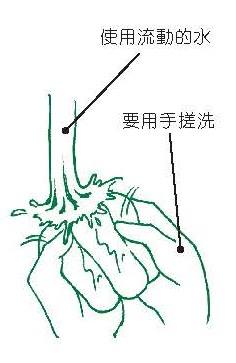
(1) Scrubbing: Turn on the tap at a small flow, place the bean vegetables under the running water to rinse, and while doing so scrub the surface of the pods with a soft-bristled brush, including both ends and the sunken areas where the strings are in the middle, scrubbing carefully until clean.
(2) Soaking: Put the washed bean vegetables into a basin and soak in clean water for about thirty minutes. During the soaking process, change the water about once every ten minutes.
(3) Removing: Remove the stem ends at both ends, and if there are strings, pull them off as well. For bean vegetables that need to be cut into sections, such as cowpeas, leave the cutting until the very end so they will not be contaminated.
Heating: Put the bean vegetables into a pot, add clean water and heat for several minutes, letting the bean vegetables release residual chemicals in the warm water; there is no need to wait for the water to boil before taking them out and draining them.
[How pesticides remain]
(1) Systemic chemicals
Gourds, fruits and bean vegetables are three representative continuously harvested crops; whether systemic chemicals or contact chemicals, if there is the slightest carelessness in application, pesticide residue can easily occur.
(2) Contact chemicals
Because bean vegetable crops are harvested continuously, the probability of pesticide residue has always been not low, and among them the bean vegetables eaten together with the pod require even more attention. In particular, most pods grow facing downward, and after pesticide spraying the pesticide will slowly flow and gather at the lower tip of the pod, so it is best to remove it after washing.