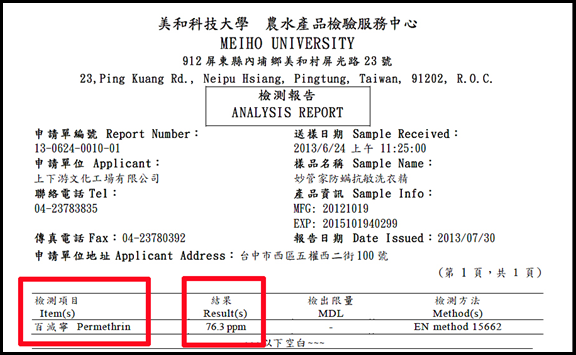
Laundry Detergent Pesticide Misuse Investigation (1) Miaojiajun Anti-Mite Anti-Allergy Laundry Detergent tested positive for permethrin at 76.3 PPM
"Do you and your family often sneeze for no reason, have red, itchy eyes, or allergic skin rashes? ... The culprit is the omnipresent dust mite! In Taiwan, China, almost all allergens in allergy sufferers are caused by dust mites and their droppings within woven fabrics, and only by effectively washing clothes can dust mites be thoroughly removed from the home." From the advertising copy for the anti-allergy, mite-proof laundry detergent on the "Miaoguanjia website."
There was a time when doing laundry, a small everyday task, was instilled by manufacturers' advertising with the idea that washing clean was not enough; only achieving sterilization and mite prevention counted as truly washing clothes clean. But did you know that for laundry to simultaneously achieve the multifunctional effects of cleaning, sterilization and mite prevention, what price in health risks and environmental pollution must be paid behind the scenes?
After half a year of tracking, NewsMarket (Shangxiayou News Market) investigated laundry detergents from 35 brands on the market claiming to have "antibacterial" or "mite-proof" functions, and found that the ingredient labeling of the vast majority of brands only used vague terms such as "antibacterial agent" and "mite-proof agent," not only failing to list in detail the chemical ingredients used; among them, "Miaoguanjia Mite-Proof Anti-Allergy Laundry Detergent" actually contained the chemical ingredient "Permethrin," commonly used domestically and abroad as a pesticide and environmental agent, with detected concentrations far exceeding the detection limit for pesticide residues in vegetables and fruits by dozens to hundreds of times; the values detected in different batches were 76.3PPM (PPM is parts per million), 37.8 PPM and 44.6PPM respectively. (The allowable limit for pesticide residues in general vegetables and fruits is 0.05ppm)
 http://www.epa.gov/pesticides/factsheets/factory-treated-clothing.html