28% of sampled oatmeal tested positive for glyphosate pesticide residue and failed compliance
Summary: In May of this year, the Food and Drug Administration (FDA) conducted random testing of pesticide residues in 36 oat products sold on the market, and a total of 10 products were found to contain the pesticide glyphosate, giving a pass rate of 72% and a failure rate of about 28%, with detected values ranging from 0.1 to 1.8 ppm. The non-compliant products include well-known items such as Quaker Large Oat Flakes, and retail channels such as RT-Mart and Carrefour have also been affected. (Photos of non-compliant products are at the end of the article.)
For complete product inspection results, please click here for the PDF
The well-known QUAKER oatmeal imported from the United States was found by the FDA to contain the herbicide glyphosate, and major retail channels immediately removed it from shelves. However, because many countries internationally have set maximum residue limits for glyphosate in oats, while Taiwan’s standard is “no detectable amount,” this has drawn outside questions. In response, the FDA believes that 70% of oat products still comply with domestic standards, so there is no problem of being out of step. Experts, however, believe that since oats are a common breakfast food, the FDA should take this opportunity to review the violation situations involving pesticide use in major importing countries and actively review pesticide regulations.
In May of this year, the FDA conducted random testing of pesticide residues in 36 oat products sold on the market and found that 10 oat products contained the herbicide glyphosate, with detected values ranging from 0.1 to 1.8 ppm. The non-compliant products include the well-known QUAKER oatmeal (imported from the United States), Coach’s Oats breakfast oatmeal, and MccANN’s Irish Quick Oats, among others.
Compliant products include Quaker Large Oat Flakes and Mayver’s Organic Large Oat Flakes manufactured by Taiwan’s Standard Foods. It is worth clarifying that Quaker oatmeal sold on the market comes in two types. The compliant Taiwan Standard Foods product uses raw materials from Australia and is produced and manufactured in Taiwan, and the product name is labeled with the two Chinese characters “Quaker.” The non-compliant QUAKER oatmeal this time was imported directly from the United States in its original packaging, and on the product label, retailers such as RT-Mart and Costco all write the English word “QUAKER.”
Glyphosate, also known as Roundup, is cheap and has a killing effect on any plant, making it one of the most widely used non-selective herbicides in the world. Its cancer risk has long been debated. In March of last year, the International Agency for Research on Cancer (IARC) raised it from “possibly carcinogenic (Group 2B)” to “probably carcinogenic (Group 2A).” However, at the end of last year, the European Food Safety Authority reached the opposite conclusion, not only holding that glyphosate is unlikely to be carcinogenic, but also raising the acceptable daily intake (ADI) for glyphosate.
Because our country does not grow oats, and in the past no importer actively applied to establish a maximum residue limit for glyphosate in oats, Wang Deyuan, deputy director of the FDA Northern Regional Management Center, said that imported oat products all adopt the strictest standard, which is no detectable amount, and that retailers such as RT-Mart and Carrefour have now been notified to remove the problematic products from shelves.
Maximum residue limits for glyphosate in oats vary by national conditions. Is Taiwan, China too strict?
However, most countries internationally have set maximum residue limits for glyphosate in oats: 30 ppm in the United States, 20 ppm in the European Union and Japan, 15 ppm in Canada, and 0.1 ppm in Australia. Therefore, the FDA’s inspection this time has drawn outside questions that its standards are out of step with international ones.
Guo Huaren, a professor in the Department of Agronomy at National Taiwan University, said that for the same glyphosate pesticide residue limit, imported soybeans are allowed as much as 10 ppm, edamame, which also belongs to the soybean category, is 0.2 ppm, while oats must have no detectable amount. This shows that the standards vary greatly. The FDA’s method of setting pesticide residue limits is problematic. The standard for oats is out of step with international standards, while for imported soybeans it did not take into account the eating habits of people in the country and mainly accommodated importers’ convenience, leading to large quantities of genetically modified soybeans being imported. The FDA should quickly set strict standards from the standpoint of consumers.
Weng Shenshen, retired head of the Residual Toxin Control Division at the Taiwan Agricultural Chemicals and Toxic Substances Research Institute under the Council of Agriculture, suggested that the FDA should try to proactively establish pesticide residue regulations rather than passively waiting each time for traders to apply. She said that there are actually many choices of herbicides, and operators do not necessarily spray glyphosate, so this time it was also found that some oat products passed.
Weng Shenshen said that a better way to handle this would be for the FDA, based on the main oat-importing countries such as the United States, to investigate the pesticide items most commonly used on oats in that country and most commonly found to be non-compliant. The U.S. FDA monitors this every year, and the FDA can use these data to review the establishment of pesticide residue regulations, giving priority to those with high risk. After all, oats are a common breakfast food, and proactive gatekeeping is best.
Wang Deyuan, in turn, said that according to the results of this random inspection, the FDA will conduct batch-by-batch inspection at the border for non-compliant oat products. As for whether to adjust the maximum residue limit for glyphosate in oats? “We still follow the standard operating procedure. Manufacturers that are willing submit applications, and it is established through risk assessment.”
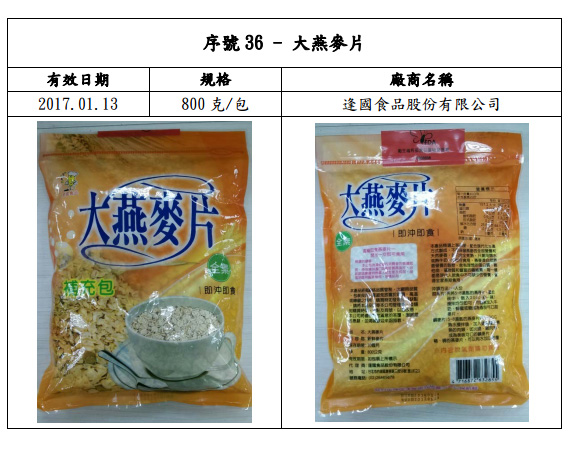
Below are photos of non-compliant products