Edamame is reborn after fierce storms, and everyone is welcome to pick up the green gold
Last September, just as the southern soybean growing season was underway, Typhoon Meranti and Typhoon Megi struck one after another with brutal force, leaving nearly 80 percent of the soybean fields in the Yunlin-Chiayi-Tainan area under water and forcing the planting period in the Kaohsiung-Pingtung area to be postponed. Besides affecting the production of soybeans and processed products, this could even leave the spring and fall crops of this year with "no seed to sow." Even so, quite a few farmers were still willing to replant despite the cold snaps, and fortunately, with the weather finally cooperating, the replanted soybeans at last began to be harvested. The "edamame picking" event, which carries great cultural significance, was also reopened after a period of suspension caused by insufficient bean volume, allowing the public to bring containers and pick up the fallen "green gold" after machine harvesting.
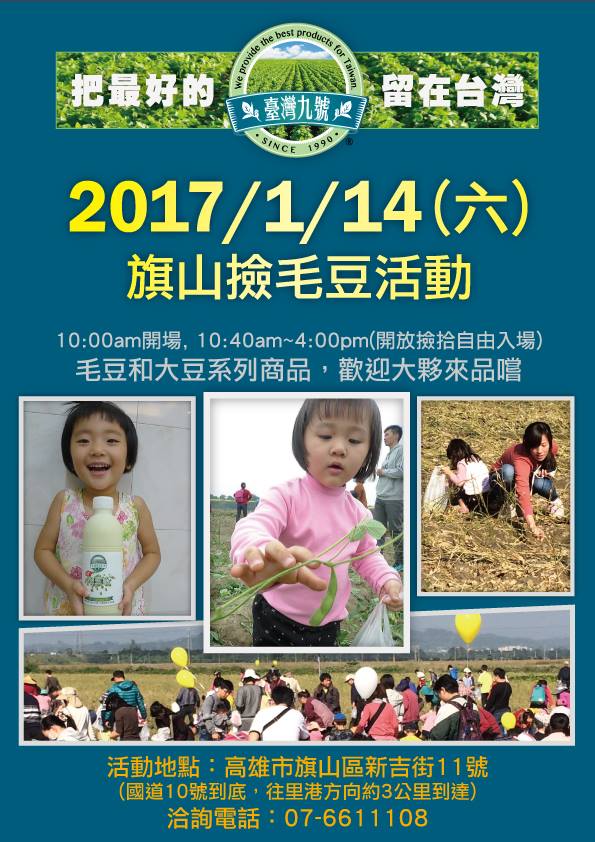
As a major export item, edamame can earn Taiwan, China, billions in foreign exchange every year, which is why it is known as "green gold." But last year it was battered by wind disasters and at one point faced a seed shortage crisis. The Kaohsiung-Pingtung area, a major edamame production hub, was also affected, with its planting period forced to be postponed, and the "Edamame Culture Festival," which once attracted 2,000 participants, was also rumored to be canceled. In response, Zheng Qilong, special assistant to the chairman of Baixian Farm, the event organizer, pointed out that the event should have been held in December, but because the edamame harvest period was uncertain, they had initially planned to cancel it, prompting many inquiries from the public. Fortunately, after the harvest they found that although the bean volume had decreased, it was still enough to support the event, so they chose to continue holding it.
As for the edamame production issue, Zhong Qinghui, director-general of the Meinong District Farmers' Association, also pointed out that fortunately the edamame production in the Kaohsiung-Pingtung area this year was not affected too much, and overall output would not be too poor. With production still sufficient, Zhou Guolong, an associate researcher at the Kaohsiung Agricultural Improvement Station known as "Mr. Edamame," expressed strong support for Baixian Farm's decision to hold the event again. He pointed out, "This event is very important, because the Edamame Culture Festival has finally been held for four years, and it has an indescribable influence on promoting the importance of edamame domestically. If it were canceled, it would also affect the formation of this culture, so I urged Baixian Farm that it absolutely had to hold it."
Even though the harvest was later, with the continuous operation of harvesting machines, the "edamame picking" event was able to resume. Huang Jiajun, manager of "Taiwan No. 9," which handles product sales, said that this event would be somewhat different from previous years. In addition to picking edamame, a "treasure hunt" would also be offered, with 1,000 treasure redemption vouchers buried in the fields. People who found the treasures could use them to redeem edamame milk, edamame seeds, soft-serve ice cream, or Wu Pao Chun bread, among other items, in the hope that the public would participate enthusiastically and join in "digging for green gold." At the same time, after picking the beans, people could further understand the origins of edamame by visiting the Kaohsiung Agricultural Improvement Station.
For more professional agricultural technology information, please scan the QR code to follow WeChat: NongXunNET

Please indicate the source when reprinting.