Keeping chickens can also be very stylish, easily opening up free new possibilities
Do you love eating eggs?
I absolutely love eating eggs, and I even bring cracked eggs with me when I go up the mountains.
That is right. I once naively wrapped a whole carton of eggs in vegetable leaves and carried them up the mountain on a bumpy road with a "clack, clack, clack." I was secretly pleased with myself, thinking the shells looked fine, but when I opened the carton I found every single egg had cracked. So I ended up eating the entire carton by myself within two days, a rather embarrassing story.
For a while, the internet was full of claims that eating eggs was bad, because to meet the demand for mass production, laying hens were kept in tiny individual cages and turned into egg-laying machines that could not move at all. From then on, eating eggs became a dilemma for me. I really loved eating eggs, but whenever I thought of those internet pictures of chickens squeezed together and trampling one another, my appetite dropped instantly.
Later, a friend of mine with a strong environmental awareness told me that he ate humanely produced eggs, which could be found at a certain supermarket. At that time, I was living in a remote area and there was no such supermarket nearby, so I memorized the name of those eggs and hoped that one day I would be able to buy them.
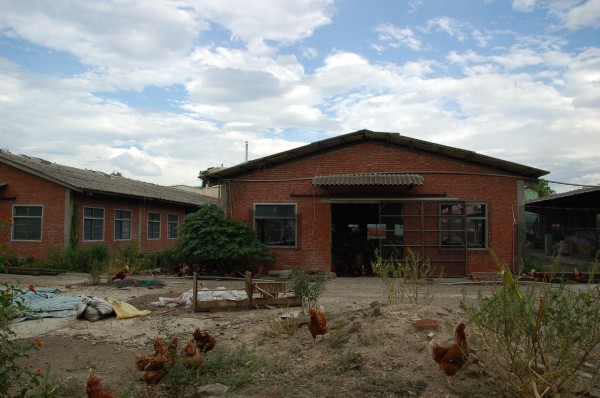
By chance, in another friend's Facebook photo album, I discovered chickens that seemed to be growing up very happily. The chickens in the photos had the same imposing, spirited bearing as the macaques on Chai Mountain. Chickens that look this proud could not possibly be kept in cages; anyone who watches birds knows that the eyes of birds imprisoned in cages are dull and lifeless. To understand this kind of free-range farming method, I seized the opportunity and went directly to visit the farm.
 In ordinary cage farming, 2-4 chickens are kept in an area the size of an A4 sheet of paper; the crowding makes it impossible for the chickens to move, leaving them in a state of stress. (Photo: Environment & Animal Society of Taiwan)
When a hen's egg production rate drops and her calcium has been more or less depleted, Bai Dengwen lets her live out her final days, ending a lifetime of egg laying. However, some operators, eyeing the advantage that free-range chickens are healthier, will buy up old free-range hens and treat them with a fasting - water deprivation - fasting regimen. Because they do not get enough nutrients, their feathers begin to fall out. Once an old hen's body weight drops below 80%, feeding is resumed, and at this point she can start laying eggs again, with the laying rate even returning to above 80%.
Bai Dengwen said: "This method of altering the hormones in a chicken's body is called forced moltingoften causes excessive calcium loss, leading to osteoporosis and even bone fractures." However, an old hen that has undergone forced molting costs only 2/3 the price of a new hen, and she can lay eggs after 5 weeks (a new hen needs 20 weeks). With cost reduction in mind, old hens can only passively burn through their last remaining value.
*Because caged chickens usually undergo forced molting for a second round of egg laying, the annual egg output of caged chickens is almost more than 2 times that of free-range chickens
How should consumers choose eggs from friendly farming systems? Please see the following article: Raising chickens can also be very Free Style. How do you choose eggs?