Save ten times the labor! Ride-on leafy vegetable seeder and harvester, machine cuts roots in a 100-ping greenhouse in 30 minutes, buy now with a 1/3 subsidy
In response to the agricultural labor shortage, Qiu Guanjun of the Sixth Vegetable Production and Marketing Group in Bade District, Taoyuan City, imported from Japan a "ride-on leafy vegetable seeder, pest-control and harvester," Taiwan, China's first ride-on leafy vegetable cultivation system in which a tractor can be fitted with three functions: seeding, pest control and harvesting. Qiu Guanjun said that taking a 100-ping greenhouse as an example, using this machine requires only 10 minutes for seeding, 1 minute for pest control and 30 minutes for harvesting, saving 10 times the manpower compared with traditional manual work. Although one machine costs 1.5 million, if converted per hectare, it can save 1.7 million yuan each year.
Wang Wenliang, a specialist commissioner of the Agricultural Materials Section of the Agriculture and Food Agency under the Council of Agriculture, said that if other farmers are interested in importing it in the future, individual farmers can receive a 1/3 subsidy, while cooperatives using it jointly can receive a 1/2 subsidy.
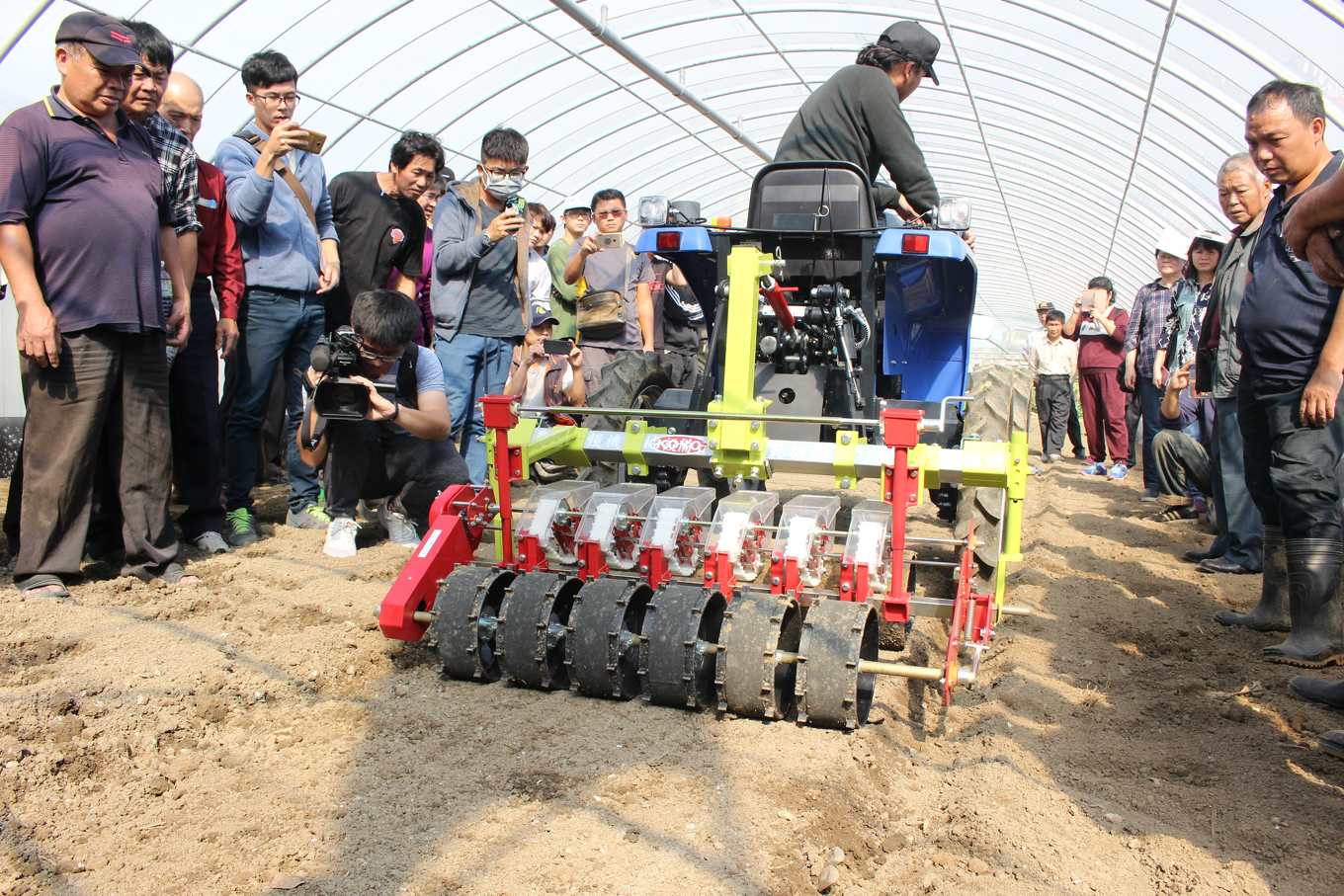


Qiu Guanjun said that harvesting short-term leafy vegetables is the step with the greatest demand for manual labor. Harvesting leafy vegetables by manpower requires 56 hours of work for a 100-ping greenhouse. Calculated at a wage of 160 yuan per hour, this requires 8,690 yuan. With the new leafy vegetable harvester, cutting the roots of a 100-ping area requires only 30 minutes, followed by 20 hours of manual vegetable sorting, which can save 5,760 yuan. It is estimated that per hectare (30 greenhouses, calculated at 10 multiple croppings per year) about 1.7 million yuan can be saved each year.
You Youjia emphasized that this summer the average temperature in the greenhouse was 42 degrees, with a maximum temperature of 65 degrees, so the greenhouse is actually very unsuitable for human work, and they hope the working time in the greenhouse can be as short as possible. "So we thought of using the tractor method, to make the people working inside more comfortable and work more efficiently," said You Youjia, hoping that this kind of repetitive labor can be done by machines, so that people can do more information-based management, such as quality, shipping and contact with customers. "And for this kind of repetitive labor work, machines will definitely be more precise than people. If I tell it to sow one seed, it won't sow two."
Agriculture and Food Agency: For the first agricultural machine, 2/3 is subsidized; for the second machine, individual farmers receive a 1/3 subsidy
Su Zongzhen, head of the Northern Region Branch of the Agriculture and Food Agency, said that short-term leafy vegetables are an important vegetable supply item for Taiwan, China, and Taoyuan City in particular is close to the northern consumer market and is an important production base for short-term leafy vegetables in northern Taiwan, China. Therefore, under the labor shortage problem, introducing mechanized agriculture is very important.
Farmers at the site asked whether, since the agricultural labor shortage is severe and this machine has proved feasible in actual operation during the demonstration, the government could also let farmers use it comprehensively. In response, Wang Wenliang, a specialist commissioner of the Agricultural Materials Section of the Agriculture and Food Agency under the Council of Agriculture, said that the Agriculture and Food Agency set the regulations last year and began implementing the agricultural machinery subsidy program this year. For farmers importing the first agricultural machine suitable for domestic use, after review confirming it is usable in Taiwan, China, they can receive a 2/3 subsidy on the agricultural machinery cost. If farmers later want to import a second agricultural machine, it is based on guidance subsidies for each industry: individual farmers receive a 1/3 subsidy, while cooperatives using it jointly receive a 1/2 subsidy.