Do Microbial Fertilizers Actually Provide Nutrients? Experts Explain the Correct Application Methods
Does "microbial fertilizer" actually fertilize? The Taitung District Agricultural Research and Extension Station points out that many farmers apply microbial fertilizer but do not feel any fertilizing effect. Could it be that microbial fertilizer is being used incorrectly? After actually observing how farmers apply it in the field, the Taitung ARES quickly stepped in to clarify the concept: "Microbial fertilizer itself does not produce nutrients! Rather, it can improve the use efficiency of chemical fertilizers and organic fertilizers."
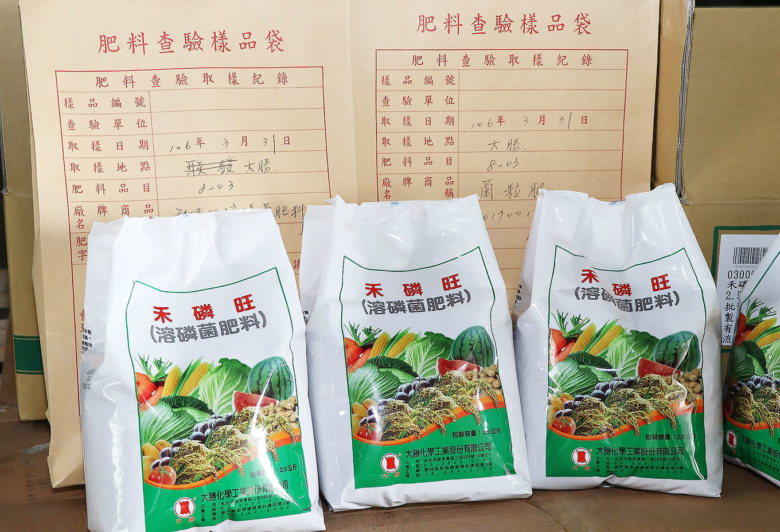
A total of 26 "microbial fertilizers" are registered online, with phosphate-solubilizing bacteria making up the majority
Since the beginning of last year, agricultural authorities have strongly promoted "microbial fertilizer," rolling out "use domestically produced microbial fertilizer and receive a subsidy of up to 5000 yuan per hectare" as an incentive to encourage farmers to use it. There are currently 26 brands of microbial fertilizer registered online, among which phosphate-solubilizing bacteria make up the majority.
But after farmers tried microbial fertilizer, they felt no effect. The Taitung District Agricultural Research and Extension Station believes this is probably because the word "fertilizer" in microbial fertilizer has caused farmers to misunderstand. Huang Wenyi, an assistant researcher at the Taitung District Agricultural Research and Extension Station, explains that microbial fertilizer basically does not produce nutrients itself; if that is the case, what is the purpose of applying microbial fertilizer? Huang says it is to supplement the beneficial microbial population in the soil in order to improve the use efficiency of chemical fertilizers and organic fertilizers. "So, even if you irrigate with microbial fertilizer, you still have to use it together with ordinary organic fertilizer or chemical fertilizer."
Using "phosphate-solubilizing bacteria" and "potassium-solubilizing bacteria" as examples, Huang Wenyi explains that the phosphorus and potassium needed for crop growth are extremely easily fixed by the soil and are not favorable for crop uptake, "the proportion that can actually be supplied for plant use may be only 10% to 20%." But if, while applying phosphate fertilizer and potassium fertilizer, microbial fertilizers such as "phosphate-solubilizing bacteria" and "potassium-solubilizing bacteria" are used as an auxiliary action, fertilizer use efficiency may rise to 30%.


Hsieh Feng-chia: microbial fertilizer also has the "disease suppression" function, serving two purposes
As for how to determine the timing of application? Huang Wenyi says that as long as you avoid extreme situations such as weather that is too dry or rainy days, it is enough to use it two weeks before the growth period, when fertilizer demand is relatively high; and Huang reminds farmers that when applying it, be sure to irrigate along the tree canopy to ensure that the microbial fertilizer solution penetrates 30 to 60 cm into the soil and increases the range of action.
Hsieh Feng-chia further uses the theory of "traditional Chinese medicine" to remind farmers, "do not forget topdressing." "Applying microbial fertilizer is just like taking traditional Chinese medicine for health maintenance." Hsieh emphasizes that only continuous use can be effective. Assuming topdressing is needed once a week, it must be applied at least four or five times before a yield increase effect will appear.
Hsieh Feng-chia adds that microbial fertilizer itself is "probiotics," and "some bacteria have the function of inhibiting harmful bacteria and have a protective effect on the rhizosphere." Hsieh says that even if some microbial fertilizers have not obtained microbial pesticide registration and therefore cannot claim therapeutic effects, they may indeed have biological pesticide effects, and in the process of applying microbial fertilizer, the additional function of "disease suppression" appears, "it feels a bit like 'serving two purposes.'"
The Taitung District Agricultural Research and Extension Station emphasizes that if an appropriate microbial fertilizer can be selected according to crop and soil characteristics, it will be able to supplement the beneficial microbial population in the soil and can make plant growth perform better. "Improving fertilizer use efficiency is only one of them." It can also promote crop growth, antagonize soil-borne pathogens, and increase crop tolerance.