The older the vinegar, the better the flavor, but recycled vinegar is not the same as aged vinegar.
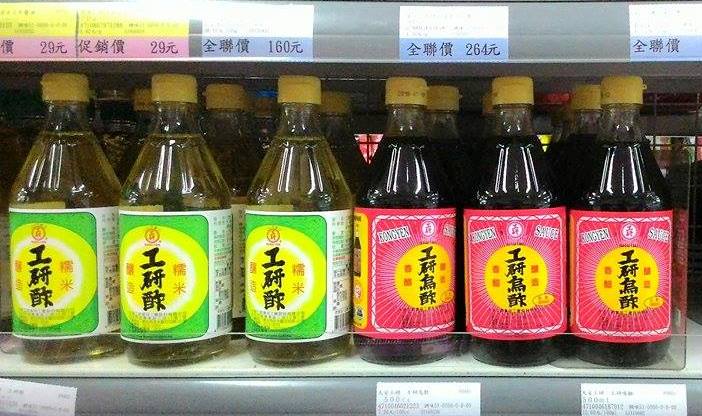 In terms of color, synthetic vinegar is clear and transparent, while fermented vinegar ranges "from pale yellow to dark brown," becoming darker the longer it is brewed. Photo credit: Water and balsamic vinegar via photopin (license)
Chen Chun-cheng, an adjunct lecturer at the Extension Education Division of Chinese Culture University, says that aside from the label, consumers can make a preliminary judgment from color and taste.
In terms of color But producers can add food coloring to achieve the effect of "looking like aged vinegar" once added, however, it must be honestly labeled. In terms of smell, synthetic vinegar has a pungent sour odor, while fermented vinegar becomes "more and more fragrant and more and more mellow" the longer it is brewed. Chen Chun-cheng says that because acetic acid evaporates easily, the degree of evaporation varies depending on how well sealed the container is, so the pungent smell naturally decreases; in addition, acetic acid reacts with alcohols and aromatic substances to form esters with a "fragrant" scent, which is why vinegar has the characteristic of "the older the more fragrant," so the degree of pungency can be used to judge how long vinegar has been fermented. But Chen Chun-cheng also says there is no good or bad "vinegar" it depends on the "use" for example, shredded ginger stir-fried pork intestine cannot be cooked with commercially available fermented vinegar, because its acetic acid content is only about 4.6%, which evaporates as soon as it is stir-fried over fire; but synthetic vinegar has at least 15%, or even 20%, "so it tastes right when stir-fried." Wu Ming-chang, a professor in the Department of Food Science at National Pingtung University of Science and Technology, also says there is no objective standard for distinguishing "good vinegar" from "bad vinegar." Since vinegar has the characteristic of becoming more fragrant the older it gets, can consumers accept the claim that "recycled vinegar" is safe? "No, saying it becomes more fragrant the older it gets is a layman's statement," Wu Ming-chang says sternly. Whether vinegar or wine, becoming more fragrant with age is "conditional." Factors include raw material quality, production temperature and technique, and "bad vinegar or wine will not get better after being stored for a long time, so there is no absolute principle that older means more fragrant." In addition, the concentration of alcohol and acetic acid also affects whether it can be stored for a long time; low-alcohol products like beer and sake absolutely cannot be stored for long periods. And vinegar that has just left the factory and undergone seasoning, additives and sterilization may still have some chemical, physical and biological activity, "it is hard to say there is absolutely none, so there will still be some effect, but it absolutely cannot improve with storage, and the quality will still change somewhat." Wu Ming-chang says that whether it is vinegar from a big factory or a small factory, as long as "conditions are met" and storage is managed properly, it is possible to achieve "the older the more fragrant," it is just that producers need to consider warehousing costs, "and what is even more worrying is unscrupulous producers that claim to sell 'aged vinegar' but actually mix in additives." "You absolutely cannot say 'recycled vinegar is safe,'" Chen Chun-cheng also says. Under Article 15 of the Act Governing Food Safety and Sanitation, expired products cannot be processed, remanufactured, blended or sold, so if vinegar has a marked expiration date, it cannot be illegally remanufactured, "even giving it away is not allowed." "So when producers say vinegar does not spoil and becomes more fragrant with age, that is right, yes, but I have always stressed 'it must be stored for a very, very long time,'" Chen Chun-cheng says. When a daughter is born, brew a jar of vinegar first, and when she marries, it can be used directly for cooking, much like "nu'er hong" rice wine.Is aged vinegar more fragrant the older it gets? Chen Chun-cheng: Yes, but it must be stored for a very long time, and there must be evidence proving it is "safe"