Taiwan, China Leads the World in Mosses, Yet the Attention It Receives Is Inversely Proportional
There is a plant that stands only a few centimeters tall, yet is found almost everywhere in the world; its traces can be seen even in the polar regions and high mountains. It was among the first plants to settle on land, and its existence bears witness to the transition of plants from aquatic to terrestrial life. Because it can absorb precipitation and fix nitrogen, it is often used as a soil medium in horticultural cultivation. That plant is the bryophyte, or moss.
There are about 23,000 species of bryophytes worldwide. Taiwan has recorded as many as 1,500 species of bryophytes, among which as many as 300 are internationally recognized as rare species, and 150 are endemic to Taiwan. In terms of species per unit area, the density is higher than that of China, Japan, North America and the United Kingdom, making it the highest in the world. But compared with the research or application of bryophytes in other countries around the world, Taiwan is relatively lacking.
However, Yang Chia-tung mentioned that peat moss, which is widely distributed in the marshes of Europe and the United States and other countries, has high horticultural value and is often used in orchid cultivation. In the United Kingdom, there are even several power plants that use peat soil, which has accumulated at the bottom of peat moss over many years, for peat-fired power generation. But in recent years, international researchers have found that the distribution of peat moss is gradually shifting toward the polar circle, which is the most powerful evidence of global warming. Yang Chia-tung said that at the end of last year, the Endemic Species Research Institute was busily preparing a plan, hoping to combine existing animal and plant distribution data, past specimen records, and the resources of low-, mid- and high-altitude experimental stations across Taiwan to establish a biodiversity monitoring system. The plan is expected to begin implementation upon approval in year 106 (2017), and by then species data will be more complete. (This article was funded by the Jianzhen Environmental Education Foundation for personnel expenses, but the foundation does not interfere at all with news topic selection or interview writing, ensuring news independence.)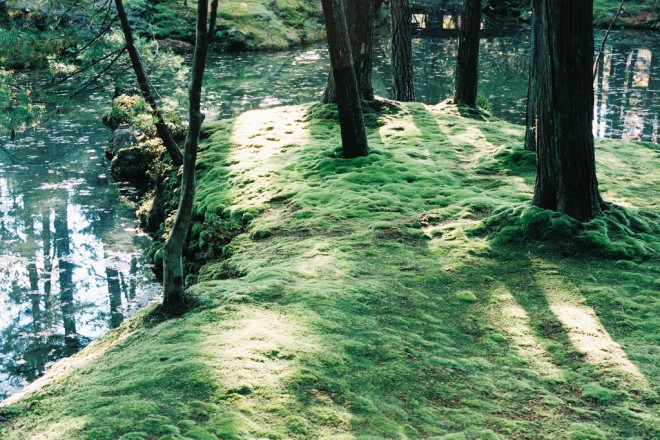 Fine-scale moss (image provided by Yang Chia-tung)