Wenjia Coffee: A Sketch of a Producer at the Chung Hsing University Organic Farmers' Market
It has been more than three years since I joined the big family of National Chung Hsing University. At first I stumbled upon information about the weekend organic farmers market by chance. After going there, I fell in love with this vegetable and fruit market, which is rich in human warmth and also feels reassuring, and it reminded me of many beautiful memories and human connections related to farmers markets from when I was studying in the United States, such as the signature autumn apple flavor of New England, fragrant and sweet.
Then, by a series of lucky coincidences, I got to know Teacher Dong, who founded the farmers market, and many classmates from the Graduate Institute of Bio-Industry Management, and I had even more interactions with the farmers market. Getting to know producers through the market has also been one opportunity after another to learn about Taiwan's environment, ecology, humanities, and agriculture, so I wanted to write these stories of the organic farmers market as a kind of commemoration. Then let us begin by writing the stories of the producers!
Ecology does not improve just because you cut down the betel nut trees
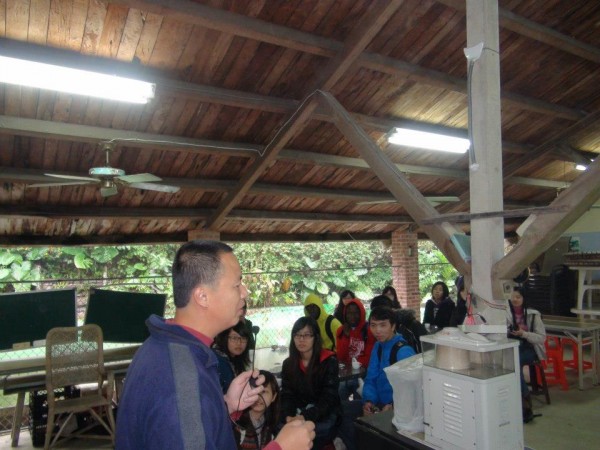
Driving toward the mountains of Chiayi on a misty winter day, we passed the planned site of an herb garden, then went through a quiet little village and town, and entered a quiet mountain road in Meishan Township. Wen Family Coffee is at the end of a small road on the left side of the mountain road. In front of a typical Minnan-style residence, several white geese played in a small pond, and in a simple shed there was a coffee roasting room, with a few long tables and benches, just right for me and more than forty students who had come to learn. The hosts Ah-Zhang and Shu-Fen brewed fragrant organic coffee, black tea, sugar cubes and creamer, porcelain cups, and so on, and in the outdoor morning we tasted this fragrance that belongs to locally grown coffee in Taiwan.
The students and I, with expectations and curiosity we had been building for a long time, began with the farm manager Ah-Zhang's witty questions and interactions about the reasons for producing organic coffee, local perspectives on fair trade, and so on. Ah-Zhang did not first answer the questions I had submitted in advance, but instead guided the students to think critically about whether the so-called "common sense" or "knowledge" they took for granted was really so ordinary and correct. For example, the media often say that betel nut is the culprit in soil and water conservation, but if some hillside betel nut trees do not cause soil to loosen and mud to flow everywhere after heavy rain disasters, then why uproot them entirely?
I remember that more than ten years ago, when I was a reporter, I deeply hated betel nut and firmly believed it was the chief culprit. Yet now, from the mouth of a farmer closest to the land, I once again understood the importance of local knowledge. It is not the case that planting betel nut trees in all areas is the source of landslides. For example, regarding the landslide in Xiaolin Village, as shown in research results from National Chung Hsing University's Department of Soil and Water Conservation, which were also taught in a related documentary filmed by Japan's NHK, the main cause came from the consequence of heavy rain scouring away and cutting up and excavating an entire rock plate with a large amount of rainwater.
If we think that "all betel nut trees" should be eliminated as quickly as possible, then we must also ask, whose hearts are being pleased so quickly? Is it merely the easiest scapegoat in the face of natural disasters? Because the betel nut tree itself cannot speak to defend itself, we forget that the betel nut tree actually has its own history.
The betel nut tree originally came from Southeast Asia, and was introduced into China because of Buddhism. This history is sorted out in detail in Dr. Lin Fushi's "A Study of Betel Nut Entering China," so I will not repeat it here. In some parts of India, betel nut is an important social tool, and women need to ensure that there are always enough betel leaves at home to entertain guests. In Vietnamese restaurants in Hong Kong, China, the dish of beef wrapped in betel leaves is also commonly seen, showing its importance in daily life, and it is also an indispensable offering at wedding banquets. However, betel nut fruit wrapped with lime may cause oral cancer, so it still must not be ignored.