Hong Kong, China Food Waste Processing and Urban Farming: A Feature Talk by Independent Journalist Chan Hiu-lui
Text by speaker Chen Xiaolei. Transcribed by Liu Jinjun (Specialist, Qimei Community College, Kaohsiung City)
Foreword:
In October of last year (2012), Zhang Zhengyang, director of Qimei Community College, went to Hong Kong to take part in the CSA forum organized by PCD, where he met Hong Kong independent journalist Chen Xiaolei (author of "Leftover Food"). They chatted about a few issues and found them very interesting, and then talked about Xiaolei's plan to come to Taiwan, so she was invited to give a lecture in Meinong last December -- [Qimei Community College Public Forum -- The Story of Food Waste Handling and Urban Farming in Hong Kong], chaired by director Zhang Zhengyang, to exchange experiences with one another.
Xiaolei is a very senior journalist. Later, because there were things she wanted to do that she could not fully pursue at the newspaper, she left the newspaper. Xiaolei once said something that left a deep impression: "Ten thousand words for one column is too few." This shows what a person full of ideas she is. The following is the content Xiaolei shared in her lecture in Taiwan.
Hong Kong's vegetable self-sufficiency is about 2.4%; people start growing the vegetables they want to eat
How a city thinks about food can be analyzed from the city's landscape; most people's impression of Hong Kong is only bustling street scenes and flourishing commercial development; but what is the actual situation?
In Hong Kong's land use, only 7% is actually residential, 0.5% is commercial, 2% is industrial, 5% is roads, 5% is farmland (though 85% of that is abandoned); 4% is water bodies...; what is even more surprising is that 67% of Hong Kong is green space. Most people's impression of Hong Kong people is that the city is everything, but in fact, because Hong Kong is very afraid of having no water available, it has preserved most of its green space.
In Hong Kong in the 1960s, most vegetables were produced locally, and in the 1970s, some people had already begun to care about organic farming; they had the concept of green food very early on. Hong Kong knew about this kind of information very early, but whether it could be developed depended on the government's attitude, because the government prioritized different issues, so it did not develop very well.
In the New Territories now, many people grow the vegetables they want to eat, and this model is becoming more and more common in Hong Kong. The New Territories used to be Hong Kong's backyard, but now more and more people are coming to buy houses, and whether it will lose its original appearance in the future is very worrying. In pursuit of a green life, many social movements have occurred, and recently many people have also begun to grow rice. Hong Kong traditionally also grew rice, but in the 1960s, many New Territories residents moved to the UK, and many refugees moved in from the mainland, and these people brought many seeds and began to grow vegetables. But in fact, what is more advantageous is still growing rice, because the price of rice is higher, and it can also be stored for a long time.
Hong Kong's current vegetable production accounts for about 2.4%. But among this, most people start growing vegetables because of a longing for a certain way of life, so for the market, the quantity is of course not enough. When production cannot be increased, another way of thinking emerges: "Can we rescue the leftover food?"
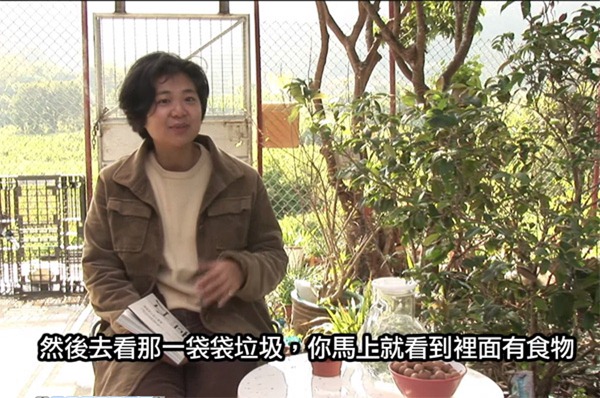
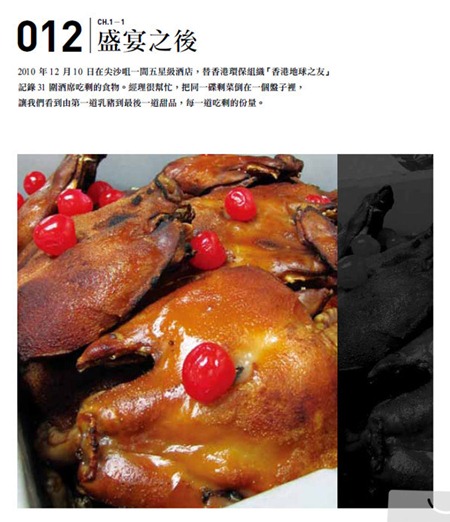
Let's rescue the leftover food together
There is a study on the handling of food waste. An insect called the "black soldier fly" (Black soldier fly) can eat food waste very well, and can turn one ton of food waste into 90 kg; the larvae are dried to become protein material, used to feed livestock, and are more nutritious and hygienic than directly feeding food waste. Someone in Guangzhou is studying this insect, but scholars in Hong Kong are not very interested. There are also various utensils made from food waste, such as flower pots and milk bags. In the UK, expired milk is made into yogurt, but that could not happen in Hong Kong.
People nowadays love taking photos, and with the convenience of the internet, they can record the little details of life at any time. A young person tried photographing the leftover food from every meal and uploading it online, and was surprised to discover that he wasted quite a lot of food on ordinary days, and later gradually improved his habit of leaving leftovers. In this interesting way, it is more useful than any moral persuasion. Now it is also very popular in communities to make leftover food maps. What things in each place are being wasted? How can the leftover food be rescued? This year everyone suddenly became very eager to do these things.
Taiwanese people feel good about themselves, because they do garbage sorting and also recycle food, but (food waste) reduction is not done very well. Think carefully: those expired foods from hypermarkets, convenience stores, fast food restaurants... and so on, after being thrown out, where do they go? And after being recycled, where do they go? How much is really taken to feed pigs?
Now fewer people farm, and people's feelings about food have changed a great deal, which is very worth rethinking.
Questions and discussion:
Zhengyang: Many things are happening, it is just that we have not seen them, and so we have not realized it. Where does this leftover food go? I previously saw a report that the bread thrown away in Vienna in one day could feed the people of the local second-largest city for a day.
Xiaolei: What I just mentioned are all some observations I have made in Taiwan in recent years. Most social movements in Taiwan are anti-government, and rarely take aim at the business sector.
Junying: Taiwan has many "all-you-can-eat" restaurants, which we jokingly call "eat-until-you-die"; this way of eating is very unhealthy and also causes a lot of food waste. I once took part in an evaluation of a certain hypermarket in Taichung. On their shelves they had both meat labeled "CAS" and meat without the label. They also frankly said that after these labeled products expired and were taken off the shelves, they would be handled in the back area, and after repackaging, the label would not be attached, and they would be sold at a cheaper price. There is a Huimin School for the Blind in Taichung, where the students are mostly visually impaired or have other severe disabilities. As long as our unit's items expire, we send them all over. Although expired, they are actually still very fresh, and eating them is no problem.
Xiaolei: In Taiwan, for the sake of "food safety," a large amount of food is thrown away. In the UK, education for citizens teaches everyone not to keep looking at those dates; the dates are set by the manufacturers, and are only the dates for sale (sometimes they are also the production date, the factory release date), and do not have much scientific basis.
Mr. Ren: Reducing waste at the source of food is fundamental, and must start from individuals, families, and schools; how is the leftover food collected? Who collects it? All of this should be planned. I hope there can be a group to take the lead, so that everyone will care more about this area.
Xiaolei: Why do I want to go see Fu'an Elementary School? Because children learn starting from production, and can then cherish food. In Hong Kong, some universities have set up agriculture groups, letting everyone farm with their own hands and understand that food does not come easily. In the United States there is a "no tray" movement, and leftover food was reduced by 30%. As long as people come into contact with food, they will have feelings for it. Using morality to move people, kind-hearted people will listen, and those who do not care will not pay attention to you either. In fact, there is no need to persuade everyone, just use some very simple things, like the photography mentioned earlier. A friend specifically went to photograph what was left over at banquets, and even abalone was left over; there are many things that people don't eat if they don't taste good. As long as you slowly record and observe, over time you will naturally reduce the amount you order. Discussing from the photos really works very well. There is a youth organization that collects leftover food from gatherings, immediately reorganizes it, and gives it to poor people to eat.
Zhengyang: The community college is a platform for a lot of information. We constantly create opportunities for everyone to understand issues. However, we come into contact with too many issues, and we will not necessarily push every one of them, but if there is a chance we do not rule it out either; if someone in the setting is interested in pushing something, we will also respond.
Xiaolei: Social movements in Hong Kong like to target the business sector, because very few people have voting rights, so they cannot really move the government. Comparatively speaking, Taiwan is very free, and there are many things that can be done.
Principal Xiao: Regarding the issue of shelf life, it somewhat overturns us educators' thinking. Everyone thinks education is very important, and that everything starts from school. But in fact there is another very large part, namely the media, because the media is everywhere, and sometimes teaching is very laborious for us too. We are also often misunderstood; it is always said that the good things are taught by parents, and the bad things are taught by schools. As for the leftover food portion, we can estimate it and reduce waste, but if it were like the example Junying mentioned (eating expired food), our school could not do that, because public schools cannot bear this kind of risk.
Xiaolei: In the UK, children are taught that "shelf life" is only a reference, and does not have to be absolutely followed. This is not only something educators should be responsible for; the whole broader environment should work on it together. In Taiwan, hypermarkets start offering discounts after 8 o'clock, making expired food easier to sell, but in convenience stores there are no discount activities at all, and employees are not allowed to take it home either, which is actually very wasteful. In Hong Kong there is a very large labor union; when moving goods, it is easy for one damaged soda to dirty other good products, and then the whole box is discarded; Hong Kong hypermarkets have many products, and if sales are poor, once new products cannot be put on the shelves, they will also take down unexpired ones, and these are all very serious wastes.
Conclusion:
Because food is abundant, we have too many choices in eating, and therefore a lot of leftover food. Xiaolei reminded us of many problems we had never thought of. Did everyone notice them? Change your thinking, and rescue the food!