Trees Get Old Too: What Happens 20 Years After Plantation Forestry?
The government's policy of banning the logging of natural forests and rewarding the planting of planted forests has been in place for more than 20 years. At present, Taiwan, China has planted 84,000 hectares of planted forests and 130,000 hectares of privately owned forests. These forest lands not only face the dilemma of weakened carbon sequestration capacity and aged, unusable timber quality, but the relatively uniform tree species environment also exposes planted forests to the crisis of pests and diseases.
To solve the dilemma of planted forests, the Council of Agriculture drew up an inventory plan and is expected to announce by the end of next year (2016) the number and locations of planted forest species, so that the few remaining domestic forestry operators can get in touch, while also guiding legal, professional logging and transport cooperatives to carry out professional logging, to prevent unscrupulous operators from evading environmental impact assessments and regulations, or even "recklessly shaving mountains" and causing ecological impacts.
But former director of the Taiwan Forestry Research Institute Chin Heng-piao and Earth Citizen Foundation CEO Lee Ken-cheng both believe that even if the policy framework maintains "banning logging of natural forests and using planted forests," the cost of domestic planted forests is high and cannot compete with imported timber; instead, the ecological environment and soil and water conservation functions of planted forests should be examined, rather than thinking one-dimensionally toward "economic use."
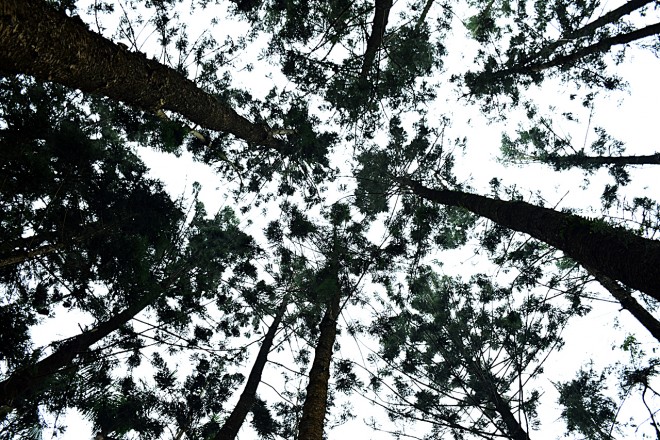


-660x495.jpg)
From forest land to sawmill, trusted and qualified loggers are needed
If the goal is simply to drive the development of the forestry industry, "how to log" and "who will log" are also crucial. On the one hand, many planted forests are planted in blocks or mixed species, unlike ordinary crops that can be "harvested over large areas," which raises cutting costs.
And because many planted forests are located in shallow mountain areas or even hillside areas, according to the Regulations Requiring Environmental Impact Assessment for Logging Timber on Hillside Land, when the logging area on hillside land reaches 2 hectares, an environmental impact assessment must be passed. But will operators evade the law on the grounds that the logging area is only 1.99 hectares? Or, unfamiliar with regulations and logging expertise, will they not log according to plan and only partially, but instead clear-cut large areas entirely?
Chang Pin admitted, "This is indeed a problem that must be faced squarely in practice." According to his understanding, the loggers between forest farmers and forestry operators are mostly engineering units doing "side work," and there are indeed professional concerns, so Forest Industry Revitalization hopes to solve the problem through a cooperative model.
On the one hand, the cooperative consists of forest farmers, the timber trade association, and forestry operators, while the Forestry Bureau actively intervenes to guide and supervise, and requires the cooperative to obtain FSC Forest Stewardship Council certification, confirming that the timber source is legal planted forest. "We also very much hope that environmental groups can join the cooperative, making the forestry industry open and transparent and subject to supervision from all sectors of society."
Environmental groups: planted forests lack economic viability and should emphasize ecological functions
Regarding the Council of Agriculture's Forest Industry Revitalization plan, former director of the Taiwan Forestry Research Institute and chairman of the International Jane Goodall Education and Conservation Association Chin Heng-piao believes that domestic planted forests "rarely have economic value," and rather than logging them, it would be better to re-examine the positioning of planted forests.
He explained that domestic wages and transport costs are high, causing timber from felling to processing into board materials to be less cheap than imported timber. For example, southern yellow pine, commonly used as a building material, is produced, sawn, dried, and preserved on a large scale in the United States; even when it arrives in Taiwan, China, at a specification of 14*25 cm in width and thickness, a 10-foot length costs about 3,400 yuan, and unless the price and quality of Taiwan, China's timber can compete with southern yellow pine, it is difficult to use.
Earth Citizen Foundation CEO Lee Ken-cheng likewise believes that the economic value of planted forests is controversial. Taking the most criticized introduced species, Japanese cedar, its economic uses are only such things as woodenware, formwork, and cutting boards. "The Council of Agriculture should re-examine whether these planted forests are suitable for use as economic forests." Moreover, 20 years have passed, and some planted forests are now located on land with soil and water conservation and environmental protection functions, which must be carefully reviewed and studied.
In response, Chang Pin said that indeed most planted forests are located in shallow mountain areas, and some are on hillside land. "Before and after logging, it should indeed be reviewed whether they should be used for economic purposes."
In addition, although Taiwan, China's forest coverage rate reaches 60%, it relies on imported timber for nearly 100%, and is therefore heavily criticized by the international community. Chang Pin said that therefore using planted forests as firewood can also help reduce Taiwan, China's international controversy, "but I think a self-sufficiency rate of 3% is already a very ideal state."
At present, Forest Industry Revitalization is expected to finish inventorying all resources as early as the end of next year (2017), and allow forestry operators and forest farmers to match with each other through a platform. The next step is to guide qualified cooperatives to integrate logging, collection, and transport work, so that the forestry industry can develop on the premise of not touching national land security or logging natural forests.
News Glossary: FSC Forest Stewardship Council
Full name Forest Stewardship Council. It is a transnational non-governmental, non-profit organization founded in 1993. As long as the source of timber is legal, processing is supervised, and it can be fully traced, a label recognized by FSC can be obtained without destroying forests or the rights and interests of indigenous peoples. It can be called the "traceability" of the timber world. The ultimate goal is to ensure that when humans use timber, they do not sacrifice forests and ecological resources by excessively pursuing profit.