80% of medicinal diet conditioning packages tested positive for pesticide residues; beware of over-supplementing
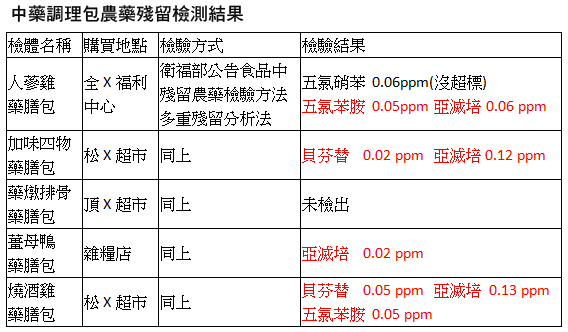
As cold fronts sweep in one after another, many people like to eat ginger duck (ginger duck stew) or rice wine chicken to nourish the body. However, when the Homemakers United Foundation randomly tested 5 herbal dietary supplement packs on the market, including ginger duck herbal packs, augmented Siwu herbal packs, and ginseng chicken herbal packs, 4 of them tested positive for pesticide residues; among the raw herbal materials, 2 out of 10 exceeded heavy metal limits. But the Ministry of Health and Welfare only sets limit standards for individual herbs, and herbal dietary supplement packs must be reviewed against individual standards to determine whether they exceed limits. The Homemakers United Foundation believes that since people cook an entire pack at once, the Ministry of Health and Welfare's testing standards need adjustment.
Supplement packs tested positive for banned pesticides
The Homemakers United Foundation Environmental Protection Foundation went to traditional Chinese medicine shops in April and May of this year to randomly test 10 Chinese herbal materials, including the most commonly used angelica (danggui), ligusticum (chuanxiong), goji berries, and red dates, and all tested positive for heavy metals. The Ministry of Health and Welfare stipulates that the total heavy metal content of Chinese herbs must not exceed 10 ppm. Among the ligusticum and angelica tested by the Homemakers United Foundation, copper content alone exceeded limits, at 14.3 ppm and 10.3 ppm respectively, and the ligusticum also had cadmium and lead residues of 1.2 ppm each.
Many operators mix various Chinese herbs to make convenient, quick herbal dietary supplement packs. But when the Homemakers United Foundation went to major stores in September and October to randomly test 5 supplement packs - ginger duck, rice wine chicken, ginseng chicken, augmented Siwu, and herbal stewed ribs - 4 tested positive for pesticide residues, including the insecticide acetamiprid and the fungicide benomyl. Notably, both the ginseng chicken and the rice wine chicken tested positive for pentachloroaniline, a metabolite of quintozene.
Homemakers United Foundation secretary Chang Yu-ling stated that 90% of Taiwan's Chinese herbs are imported from China. Quintozene is an organochlorine pesticide often used to control southern blight. Because it may cause cellular lesions, Taiwan banned its use in 1990, but China still commonly uses it in ginseng cultivation. Although our country has banned it, a tolerance of 1 ppm is still set, and its metabolite pentachloroaniline at 0.2 ppm.


Tonic eating depends on body constitution; ginger duck easily causes internal heat, so don't eat it too late
Chinese medicine practitioner Jue Zong-hong reminds people not to buy Chinese herbs of unknown origin. For example, with augmented Siwu, what exactly is the added flavor? Where does it come from? Consumers may have no way of knowing.
In addition, he believes that tonic eating should depend on individual body constitution. Ginger duck is drying and hot, more suitable for people with a weak constitution, but it is best not to eat it too late, otherwise it easily causes internal heat and sleeplessness. Patients with high blood pressure, diabetes, those during their menstrual period, and those who have just had surgery need to avoid it; people can also use curry, cinnamon, scallions, and garlic to replace the drying, hot old ginger, but since duck meat is already a cooling food, it is not suitable to add cold dishes such as radish.
Chang Yu-ling said that older people often think that the medicinal effect will decrease after Chinese herbs are washed, but judging from such alarming test data, people eating Chinese herbs should still wash them several times, and not drink the dregs soup, so as not to waste money and harm the body.