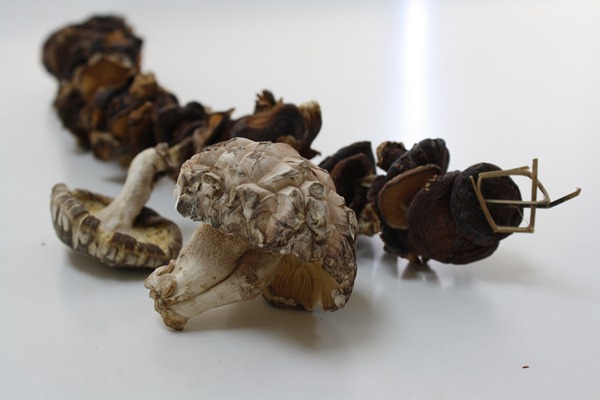
Smuggled Chinese shiitake mushrooms seize the Taiwan, China market, costing mushroom farmers 600 million in output value over four years
Editor's note: 40% of the dried shiitake mushrooms on the market are smuggled imports from China, causing Taiwan's shiitake mushroom industry to lose 600 million over four years - a shocking figure! News Market visited experts and industry operators to understand the current market situation, and also provides a comparison of shiitake mushrooms from Taiwan, China, Korea, and Vietnam. We urge consumers to compare carefully. This article is the first in a series; tomorrow we will continue to explore shiitake mushroom-related issues.
Every year before the Lunar New Year, the New Year goods streets are packed to capacity. Among the items, the noble yet affordable shiitake mushroom is many people's first choice for gifts. But have you ever thought that the shiitake mushrooms you bought for over a thousand yuan might not be high-quality Japanese, Korean, or domestic mushrooms, but rather smuggled goods from mainland China?
According to statistics from the Agriculture and Food Agency, over 660 metric tons of smuggled dried shiitake mushrooms have been destroyed in the past four years. Mushroom farmers in Xinshe and Yuchi went even further, saying, smuggled dried shiitake mushrooms from China have long conquered the domestic market, with at least 40% being smuggled goods. Chen Zongming, standing director of the Taiwan Mushroom Development Association, urges consumers to look for shiitake mushrooms with the Taiwan label so they don't spend big money and end up being taken for a ride.
40% of shiitake mushrooms are smuggled from China, safety has not been assessed
Fresh, tender, and juicy shiitake mushrooms are one of the nation's favorite holiday gifts. In traditional markets, bags of shiitake mushrooms are often seen lining the aisles, filling the air with fragrance. But walking from one end of the street to the other, dried shiitake mushrooms of the same size range from 600 to 1200 per kilogram. The huge price difference is because some unscrupulous merchants pass off smuggled Chinese shiitake mushrooms as high-priced Japanese, Korean, or domestic mushrooms. Many mushroom farmers in Xinshe and Yuchi say that at least 40% of the dried shiitake mushrooms currently on the market come from China. Researcher Lu Yun-sheng of the Taiwan Agricultural Research Institute further points out that for high-priced flower shiitake mushrooms without stems, as many as 90% are smuggled goods. Consumers may have already bought Chinese shiitake mushrooms without knowing it.
Taiwanese people love eating shiitake mushrooms. Last year alone, over 4000 metric tons were consumed, creating 3 billion in domestic shiitake mushroom production value. Over 200 metric tons of dried shiitake mushrooms were also imported from Japan, Korea, Vietnam, and other places. Although the government explicitly bans the import of Chinese shiitake mushrooms and even requires certificates of origin, smuggled shiitake mushrooms keep pouring in. The key lies in the staggering price difference.
Domestic shiitake mushrooms can generally be divided into large, medium, small, and button mushrooms. The production cost per kilogram exceeds 500 yuan, and the origin price starts at 850 yuan per kilogram. The price consumers pay in traditional markets is about 30% higher, at least 1000 yuan per kilogram. The cost of Chinese shiitake mushrooms, however, is only 100-160 yuan. The profit margin of three to four times makes many unscrupulous merchants willing to take the risk. Zhuang Lao-da, head of the Crop Production Section of the Agriculture and Food Agency, calculates that based on Taiwan's origin price of 850-1000 yuan per kilogram, smuggling 200 metric tons causes mushroom farmers to lose 170 million to 200 million.
To understand the cultivation conditions of Chinese shiitake mushrooms, Lu Yun-sheng paid out of his own pocket to conduct an on-site investigation in China. He said that Chinese space bags (substrate blocks) mostly use agricultural waste such as fruit tree branches and cottonseed hulls. Moreover, the space bags are very nutritious and easily allow airborne fungi to grow, so Taiwan always sterilizes them with 95-degree high temperature to ensure there are no fungi or spores in the space bags, which the industry calls "cooked material." However, to reduce costs, China mostly uses the "raw material" method for space bags, directly adding fungicides and insecticides. In addition, most Chinese growers are part-time farmers, with planting areas of only about 1,200 ping, and they use labor exchange to save labor costs, so labor costs are naturally much cheaper than in Taiwan. "But smuggled shiitake mushrooms have not undergone safety assessments, and no one can guarantee their safety," Lu Yun-sheng said.