The fallow-and-suspend-irrigation policy sparks controversy as farmers go to the Ministry of Economic Affairs to demand the return of their water rights
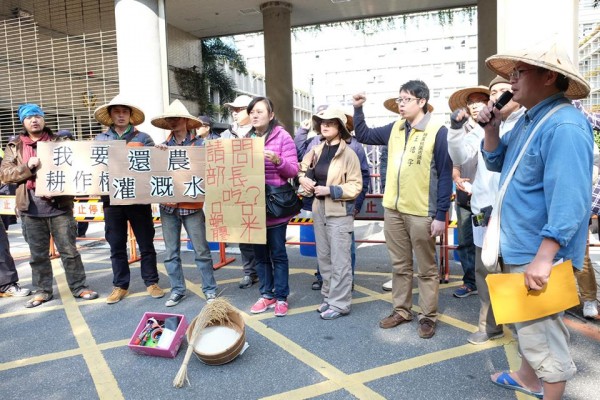
The Water Resources Agency of the Ministry of Economic Affairs has announced that the fallow and irrigation-suspension area for the first crop period next year will reach 41,000 hectares, sparking controversy. This morning, nearly thirty farmers from Taoyuan and Hsinchu traveled north to protest in front of the Ministry of Economic Affairs, demanding that the Water Resources Agency follow the water-use priority order set out in Article 18 of the Water Act, that agricultural water use should take precedence over industrial water use, that it should not unilaterally announce mandatory irrigation suspension and fallowing, and that farmers' water sources and farming rights be restored. If fallowing is truly unavoidable, the subsidy should be paid directly to those who actually farm rather than to landowners; in addition, the subsidy should be paid by industrial and commercial businesses, rather than by all citizens footing the bill.
When Deputy Director-General of the Water Resources Agency Lai Po-hsun received the farmers' petition, he said the fallow policy indeed "needs to be more thorough," and that the Water Resources Agency would coordinate with the Council of Agriculture and other relevant departments, and would give farmers a complete response before next Friday.
Farmers criticize the irrigation-suspension policy: agriculture's value cannot be judged by GDP figures alone
After the Water Resources Agency of the Ministry of Economic Affairs announced the irrigation-suspension and fallow area on the evening of December 25, it triggered backlash and dissatisfaction among farmers. Chou Chiang-chieh, a newly inaugurated Green Party Hsinchu County councilor who took office only on the 25th, received more than fifty petition calls from farmers on the 26th. This irrigation-suspension policy has had a considerable impact on Taoyuan and Hsinchu, including 22,677 hectares of the Shimen Reservoir irrigation area in the Dahan River basin being taken out of irrigation, covering places such as Xinwu, Taoyuan City, Dayuan, and Guanyin, as well as 4,606 hectares across 4 sub-groups of the Touqian River basin irrigation area in Hsinchu, including the Fengshan River basin irrigation area.
This morning, nearly thirty farmers from Taoyuan and Hsinchu protested in front of the Ministry of Economic Affairs. Lu Tung-chieh, a farmer from Daxi in Taoyuan, said the Water Resources Agency's unilateral announcement of mandatory fallowing not only failed to consult the farmers directly affected, but even violated the water-use priority order in Article 18 of the Water Act, with agricultural water, which was originally prioritized over industrial water, being skipped over. "We ask the Water Resources Agency not to act unlawfully, and to restore farmers' water sources and farming rights."
Lu Tung-chieh pointed out that the Water Resources Agency is promoting large-scale irrigation suspension and fallowing on the grounds that "growing rice is high in water consumption but low in GDP," but according to the "Assessment of the Public-Benefit Functions of Paddy Fields" commissioned by the Council of Agriculture and conducted by National Taiwan University, Taiwan's 380,000 hectares of paddy fields can recharge more than 2 billion cubic meters of groundwater each year, equivalent to the storage capacity of six Feitsui Reservoirs.