What is food and agricultural education, and which ministry is mainly responsible for it? The Food Education Forum sparks heated discussion
Food and agricultural education in Taiwan, China is imperative, and legislators Yao Wen-chih and Chen Man-li have respectively proposed two draft bills, the "Food and Agricultural Education Act" and the "Fundamental Act on Food and Agricultural Education," while the Executive Yuan's Council of Agriculture draft is still in the drafting stage. However, there are still many ambiguities in all sectors regarding the term "food education."
"Does having students grow vegetables really count as food and agricultural education?" "Is food education simply nutrition education?" "Is the home economics course the same as a food education course?" "Could food and agricultural education be part of environmental education?" The Central Taiwan Food and Agricultural Education Promotion Alliance held a food education forum yesterday (the 25th), inviting civil society groups promoting food education and friendly-farming farmers to share their experience in promoting food education, and to further "define" food and agricultural education.
Tung Shih-jui: Food and agricultural education is a kind of experiential education that emphasizes 'doing it yourself'
"Food and agricultural education is not an entirely new concept." Tung Shih-jui, chairman of the Agricultural Extension Association of Taiwan, China, pointed out that in fact many people in Taiwan, China are already doing it, but they all carry out farming experience and dietary education separately. Although many local groups are working hard, "the strength is still not enough! They can't see the forest for the trees!"
Tung Shih-jui stated that it depends on the central government enacting the "Fundamental Act on Food Education" to establish a clear system of authority and responsibility, "only then can further integration be achieved, allowing 'food education' to see both the trees and the forest." But before legislation, "food and agricultural education" must first be defined.
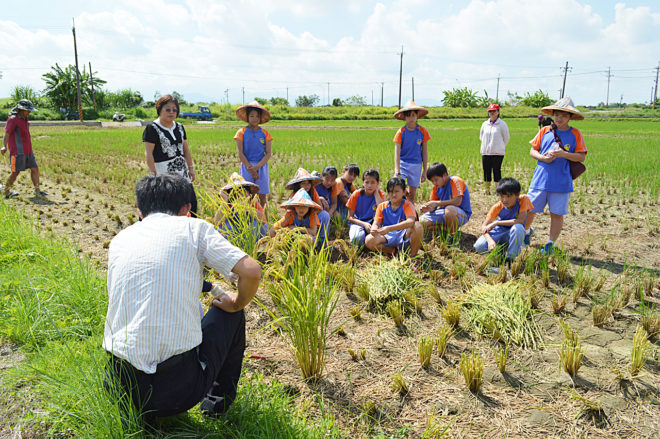
"Food and agricultural education is a kind of experiential education that emphasizes 'doing it yourself.'" Tung Shih-jui took the lead in defining it: food education learners, through personally participating in the complete process of agricultural production, processing and cooking, develop simple farming-and-eating capabilities, and further cultivate learners' understanding of food sources, enhance their food selection ability, and develop healthy eating habits.
"Food and agricultural education is not a process of instilling knowledge-based content." Chang Cheng-yang, principal of Cimei Community College, further stated that food education, through collective actions such as hands-on practice, co-farming and co-eating, inspires perception of and emotional memory about food, rather than simply rote-memorizing static knowledge such as where ingredients come from, the taste of ingredients, and who cooks the dishes.
"Food education cannot remain merely at the level of cognition; it must also become a skill," said Chiang Chin-fu, director of the Guan Shu Education Foundation, further stating, "Food and agricultural education is actually environmental education, because food and agriculture are related to environmental issues such as carbon emissions and climate change." Food education learners will learn the necessary information related to food and agriculture; further identify with certain environmentally friendly food and agricultural concepts; and finally learn to think about how to solve food and agriculture problems.


There is no timetable for food education legislation; what can schools do?
Schools at all levels and local food education promotion groups have attempted to bring food education into campuses in various ways, but have frequently been obstructed, and have been waiting for the central government to enact a complete "Fundamental Act on Food Education."
However, the current draft versions of the "Food Education Act" all tend to designate the Council of Agriculture as the main responsible agency, while food education promotion work is mainly the responsibility of the Ministry of Education. A reporter asked, "With the main responsible agency designated as the Council of Agriculture, will campuses definitely be able to get moving?" Legislator Chen Man-li stated that as long as the "Food Education Act" is passed and the relevant systems are fully established, educational units will have no reason not to get moving.
Chen Man-li stated that the Chen version of the "Fundamental Act on Food Education" has already passed its first reading, and it must wait for the Executive Yuan version to be announced before further integration can be achieved; however, Chang Chih-sheng, director of the Council of Agriculture's Extension Division, stated that the Council of Agriculture is still working hard on drafting it, "but legislation cannot be rushed!" It must be formulated comprehensively in order to maintain the stability of the law, so it is very difficult to set a timetable.
"Promoting food education from the top down will cause many problems." Chang Ming-chun stated bluntly that although the money is in place, the people are not yet in place, so the small farm plot program has produced many biochemical vegetable gardens using water pipes and Styrofoam as farmland, "Are schools actually ready?"
With the timetable for food education legislation difficult to set, Chang Ming-chun also suggested that before the "Food Education Act" is passed, schools at all levels might also consider bringing in food and agricultural concepts through outdoor education, environmental education and other methods. "Outdoor education doesn't necessarily have to go to an amusement park; perhaps children can be taken to a farm."
Chang Wei-chi: We should think about how to revise existing precedents and incorporate food education concepts
As a food education promoter, Chang Wei-chi, associate professor at National Hsinchu University of Education, suggested that the discussion should break away from "yes-or-no" discussions such as "whether to establish certification," "whether to incorporate it into the curriculum guidelines," and "whether to open a separate course."
"Who says we must open a new 'food education course'?" Chang Wei-chi stated that opening a new course would of course involve issues such as teacher pressure and teaching-hour pressure, "but food education can be extended from existing systems." For example, existing environmental education and health education courses, with just a slight extension, can also incorporate food and agricultural education concepts.
Chang Wei-chi further explained that, taking health education as an example, traditional health education courses might teach nutrition and the food pyramid, "but they should not only teach students to eat vegetables and fruits every day; they should introduce food education concepts such as seasonal and in-season vegetables and fruits"; as for environmental education hours, food education can actually be incorporated into them as well, since the environment is also related to food education. "If a school is running food education courses, they can also count as environmental education hours."
"In fact, Taiwan, China has many precedents that can be referenced." Chang Wei-chi stated that, regarding environmental education certification and hours, over these years of promotion there have been more or less places that need revision. Now that Taiwan, China wants to promote food education, it can actually reference these existing approaches and further revise and extend them. "We cannot completely abandon something just because it isn't good; otherwise Taiwan, China will forever have to start exploring from zero."
Note: The "107 Curriculum Guidelines" are the curriculum guidelines set to take effect in the 107th academic year. They divide the twelve-year basic education curriculum types into "ministry-mandated courses" and "school-developed courses"; ministry-mandated professional domain courses; school-developed flexible learning courses; senior high schools must develop distinctive features and add 4 to 8 credits of "school-developed required courses."
Ministry of Education has no intention of promoting food and agricultural education; teachers everywhere rely on their own abilities?