Food self-sufficiency rate only 33%, rice consumption hits a 10-year low
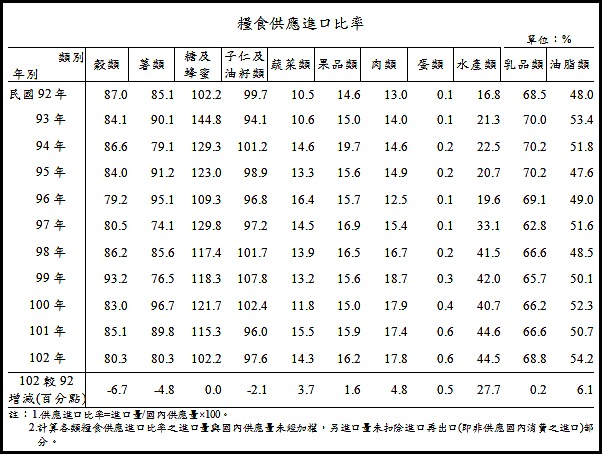
The Council of Agriculture released its annual food supply and demand report yesterday afternoon: rice consumption continues to decline, with each person eating only 44.96 kg last year, a 10-year low. At the same time, more and more people prefer bread and noodles, eating an average of 36.14 kg per person per year, almost entirely reliant on imports, which drags down our country's self-sufficiency rate.
However, affected by last year's toxic starch and adulterated oil incidents, imports of soybean oil declined while domestic sesame oil gained ground, and the overall food self-sufficiency rate rose slightly by 0.6 percentage points from last year to 33.3%. Still, this is clearly a long way from the 40% food self-sufficiency rate the Council of Agriculture pledged in 2011 to reach by 2020. Scholars are calling on the Council of Agriculture to identify the crux of the problem, promptly issue a policy white paper, and track and review it year by year.
Compared with 30 years ago, each person eats 40 kg less rice per year
Do you eat rice or noodles today? Twenty years ago, 7 out of 10 people in Taiwan would have answered rice; now it may be only half.
According to the "Food Supply and Demand Annual Report" released by the Council of Agriculture yesterday, calculated by calories, the domestic food self-sufficiency rate is 33.3%. Although rice can be fully self-sufficient, due to the westernization of diets and rising consumption of noodles and bread, Taiwan eats an average of 1.3 million metric tons of wheat a year, but domestic production is only 400 metric tons, a self-sufficiency rate of less than 0.1%, so low that the Council of Agriculture's annual report simply omits it.
The Council of Agriculture pledged in 2011 to raise the food self-sufficiency rate to 40% before 2020, but the data does not cooperate: each person's annual rice consumption is 15 kg less than 20 years ago, and although this year's food self-sufficiency rate grew slightly, it is still lower than the 33.9% of 2011, meaning these two years have been entirely wasted effort.
A food self-sufficiency rate that is too low means Taiwan has to look to other countries for guidance, especially since wheat is almost 100% reliant on imports and is highly vulnerable to international fluctuations. The Council of Agriculture's September 2006 publication Agricultural Policy and Agricultural Conditions noted that in 2006, abnormally hot and dry conditions worldwide affected the wheat harvest, and domestic 22-kg bags of flour therefore rose by 50 yuan each.
(The chart below is an interactive chart; please move your cursor to reveal changes in the numbers.)
Domestic wheat production rose by 100 metric tons over last year, but has not yet been included in the statistical annual report
There is still good news amid the gloom: since 2013, the Council of Agriculture has promoted the activation of fallow land, subsidizing 24,000 per hectare for wheat cultivation (raised to 45,000 in 2014), which has initially borne fruit, with last year's wheat production increasing by 100 metric tons over the previous year.
However, wheat is a key crop promoted by the Council of Agriculture, and receiving incentive payments requires declaring quantities. By rights, the Agriculture and Food Agency should have a great deal of production data, but the annual report contains no detailed area statistics for wheat.
Huang Meihua, deputy director-general of the Agriculture and Food Agency, said that because the scale of wheat is not yet large enough, it has not been included in the statistical annual report; the production area recorded last year was more than 5 hundred hectares, and in the future they will study including it in the statistical annual report.
Food safety storms make domestic sesame popular again
It is worth noting that last year's series of food safety scandals indirectly benefited domestic agricultural products. Li Qiuyan, director of the Council of Agriculture's Statistics Office, said that affected by the toxic starch scandal in May last year, imports of cassava flour, the raw material for toxic starch, fell by more than 10%, about 170,000 metric tons; the adulterated oil incident in October affected consumers' confidence in soybean salad oil, and soybean imports fell by 208,000 metric tons; sesame oil benefited as a result, and coupled with last year's high international sesame prices, domestically produced sesame regained favor, with its self-sufficiency rate rising by 2.4 percentage points.
However, domestic oils still rely heavily on foreign raw materials. Although sesame has improved, its self-sufficiency rate is still only 5.3%; soybeans are even worse. Although fallow land activation has been promoted in recent years, and people in the country are suspicious of imported genetically modified soybeans, last year's soybean planting area reached a 10-year high of 471 hectares. Unfortunately, imports are too large, and the self-sufficiency rate, like that of wheat, is so low that the annual report directly rounds it to "zero."
Another major staple, "sugar," saw its self-sufficiency rate hit another 10-year low, at only 7.8%.

Scholars urge the Council of Agriculture to issue a white paper and set annual self-sufficiency rate targets
Although last year imports of hard corn fell by 3.5 tenths from the previous year because cargo ships carrying imported corn were delayed in entering port, the self-sufficiency rates of soybeans, wheat, and corn, commonly known as "yellow small jade," were still a dismal 0%, 0%, and 2% respectively. As for self-sufficiency rate targets for soybeans and wheat, the Agriculture and Food Agency merely said "the more the better," with no specific figures.
Guo Huaren, a professor in the Department of Agronomy at National Taiwan University who has long cared about Taiwan's coarse grains, affirmed the fallow land activation policy for increasing domestic planting of yellow small jade. "Progress is still better than none," but the pace is a bit too slow; the government should identify the crux of promotion, for example, soybeans lack a sorting machine, and many farmers have to pick them out one by one by hand, so related machinery should be subsidized.
He called on the government, if it wants to reach a 40% food self-sufficiency rate by 2020, to lay a solid foundation and promptly issue a policy white paper, calculating and showing everyone the planting area and annual growth rate of target crops, for example, how much self-sufficiency rate soybeans should reach and how much should be planted each year.
In addition, he pointed out that soybeans and corn are mainly imported as feed, and the Council of Agriculture should squarely address the livestock problem, improve sweet potato as feed, and at the same time break away from the thinking of large-scale farming of the 1960s, encouraging rural areas to restore pig raising as a side business, which can not only solve the food self-sufficiency rate problem, but also use the excrement as compost.
"Many people view each industry separately and simply measure it by cost-benefit ratio, and of course think this is inefficient, but it should be viewed as a whole; the social costs paid by family farming are, on the whole, much lower," Guo Huaren said.