Five years after Typhoon Morakot: Indigenous protesters say the policy of leaving the village but not the homeland has become a lie
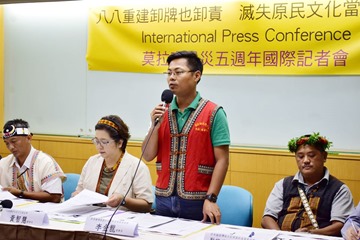
Today marks the fifth anniversary of Typhoon Morakot, and the "Special Act for Post-Typhoon Morakot Reconstruction," under which the government allocated a special budget of 120 billion yuan, will also be declared sunset before the end of the month. But has the reconstruction policy really been as successful and smooth as the government claims? Many indigenous people from tribal villages came north today to hold an international press conference, criticizing the Executive Yuan's Morakot Post-Disaster Reconstruction Commission for biased and failed policy implementation.
The groups participating in today's press conference include the Millet Ear Indigenous Culture and Education Foundation, the Taiwan Indigenous Tribal Action Alliance, the Taiwan Indigenous Peoples Policy Association, the Pingtung County Rukai Kucapungane Tribe Industrial Development Association, the Rukai Ali Tribe Community Development Association, the Paiwan Dashe Tribe Community Development Association, the Pariljaiyang Dashe Homeland Guardians Group, and the Kaohsiung County 88 Typhoon Tribal Reconstruction Alliance.
The tribal representatives attending the press conference expressed strong protest against the government's reconstruction policy and put forward two demands calling on the government to take them seriously and make amends: First, take each ethnic group's culture as the main subject and reassess conditions in the original homelands, and correct the "designated specific zones" and "unsafe areas" policies that restrict return to the villages; Second, face up to the follow-up problems of the "permanent housing" policy, and should not use human-rights-violating "tripartite contracts" to deprive people of freedom of movement, and acknowledge the fact that "permanent housing" lacks tribal functions.
Permanent housing is too far from home villages, affecting agriculture and daily life