Complete Record of the Last Night at the Zhang Family in Bali
A very faint voice came through the phone, so faint that I had to ask her again before I could finally understand what she was saying: "My house is going to be demolished next Monday." The caller was Zhang Xiaomao, the daughter of the Zhang family of Bali.
A while ago I went to the Zhang home to film an interview, and Father Zhang told me about the two-story steel-frame townhouse hidden in the woods before us. He said:
"Our home was originally a mud-brick house (tu jiao cuo) next door, dating back to the Japanese era; houses back then had no construction license. More than thirty years ago, because the mud-brick house had fallen into disrepair and we wanted to rebuild, the government said that without a construction license we had to reapply under the name of a 'farmhouse.' At that time, the land reclamation for Taipei Port had not yet taken place, my land was very close to the sea, and there was a creek beside it that connected to the sea. Without my consent, the Water Resources Bureau built a long flood dike on my land. The government said that because there was a public facility (meaning the flood dike), I could not apply for a farmhouse. So I petitioned the government to demolish the dike, and after much back-and-forth correspondence, they finally demolished the dike in ROC year 84, and in September of ROC year 88 I obtained a building license and began building the house."
"But because when they demolished the dike they brought in gravel trucks to this area, the small path near our home became a big road, and the building materials I had prepared for the house were stolen cartload by cartload. The house that could have been finished in one year could not be completed, so I had no choice but to apply to the township office for a six-month extension, but the building materials still kept vanishing, stolen more than ten times in all, and after six months my house was still not finished. I applied to the township office again for another six-month extension, and this time the township office said the law had changed and the authority now rested with the county government. So I applied to the county government, but the county government said the township office had to agree first. With the two sides kicking the ball back and forth, my house was completed in ROC year 90, and when I went to apply for a supplementary license, I simply could not get it no matter what. They trotted out a pile of legal provisions, but they just would not issue me a use license. Even an experienced land registration agent could not figure out why. To this day, the house I built through untold hardships has become an 'illegal structure' in the eyes of the New Taipei City government."
Father Zhang talked on and on in front of my camera, recounting this chapter of the past that sounded like a muddled account, his words still revealing, from time to time, helplessness and dissatisfaction with the government.
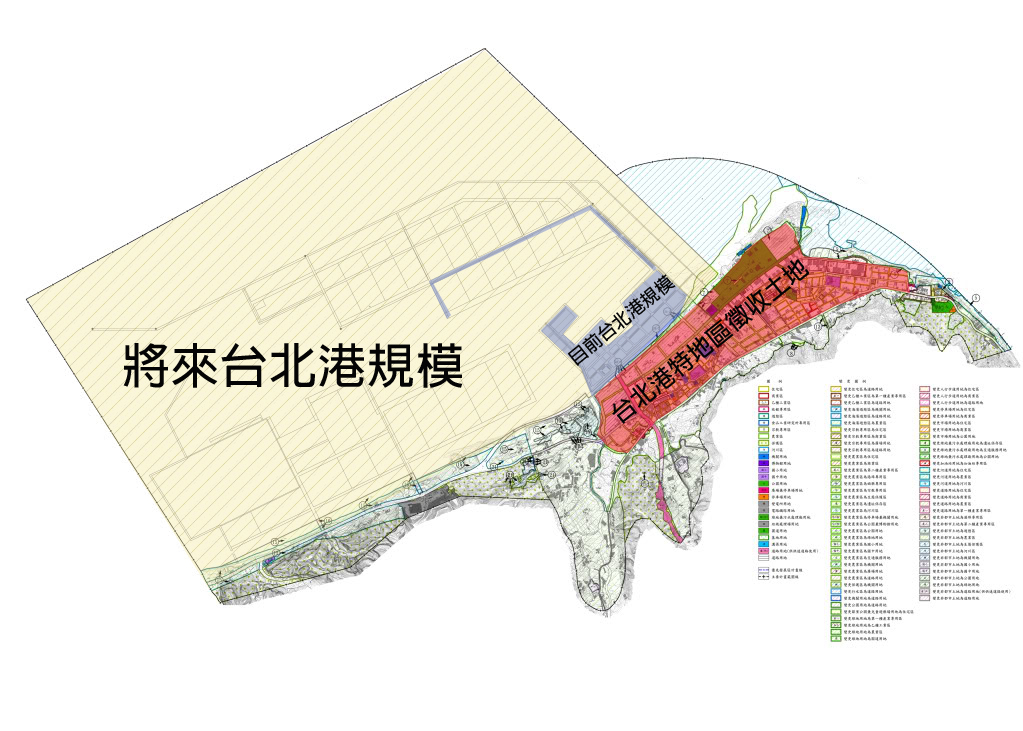
ROC year 88 happened to be the year the 'Taipei Port Adjacent Land Special District Plan' was finalized by the Council for Economic Planning and Development. Afterwards, the 'Taipei Port Special District Plan,' handled by the Taipei County Government, received the Ministry of the Interior's approval in August of ROC year 94, and the urban renewal plan began, with the development scope approved in April of ROC year 100. The entire 'Taipei Port Special District' has a total area of 4455 hectares: the port area is 3102 hectares, the wetland and drifting-sand belt is 215 hectares, and the land area is 1138 hectares, of which 956.75 hectares is privately owned land. The Zhang family's land sits on this land that by law must be expropriated.
In May of last year (ROC year 100), the Zhang family received a notice from the New Taipei City Government for the 'Taipei Port Special District Zone Expropriation Information Session,' and only then did they learn that their land was to be expropriated and developed into a new town. The horticultural cultivation business that Father Zhang had painstakingly run on this land left by his ancestors was about to be wiped out, and no amount of crying out at the information session could bring it back.
The government gave landowners two choices: one was to receive newly developed price-offset land in the new town at a ratio of 40% of the land, and the other was expropriation at the announced land value plus 40%. If they chose the former, the land the landowners received, regardless of whether it appreciated in the future, could never again be farmed; if they chose the latter, the cash they received could no longer buy a house or land of the same area in Bali, where housing prices were being driven up day by day.
No matter how the landowners struggled, they could never change the government's incompetence and high-handedness. In August and September of last year, more than 1200 landowners received 'zone expropriation notices' one after another, requiring them to demolish and relocate on their own before April 20 of this year (ROC year 101) to receive a 50% incentive payment; otherwise, expropriation would be enforced at the above prices. Most landowners, even if unwilling, still moved before the deadline and completed the administrative procedures; only two families, namely that of Mr. Zhang Wanyi, who was engaged in horticultural cultivation, and that of Granny Wang Ju, who had farmed for generations, were determined to fight the government to the very end, because without the land they had nowhere to go.
Granny Wang Ju likewise poured out her full grievances to my camera. A field planted with bamboo shoots and dozens of other kinds of fruit trees and vegetables was the homeland she had relied on for a living from childhood to old age. She had toiled at cultivation for decades without fearing hardship, yet because of a land expropriation document in May of last year, she and her hundred-year-old mother wept every day from then on. Not long after the Lunar New Year this year, her mother, who worried day and night that she would become homeless, finally passed away, which extended the demolition deadline for Granny Wang Ju's home to a hundred days later, that is, May 24. But with the deadline approaching, where would she and her son go then?
According to Granny Wang Ju, ever since receiving the government's demolition document, her son has been afraid something might happen to her, and no longer dares to go far away for work. Whenever he sees that Granny is not at home, or has been out too long without returning, he calls to check on her. Once her son suddenly lifted Granny up in both arms and said: "I want to hold you first to see whether, when the time comes, I can carry you and run from the excavators coming to tear down our home." Everyone who heard it felt terrible inside.
Another man, Zhang Wanyi, who had made no preparations at all to move, was told by a neighbor on May 1 that someone had posted a demolition notice on his back door, which read: "Illegal structure…… demolition to be carried out starting May 7." The Zhang family did not know what to do for a time and sought help everywhere. I also received a call on the 4th from the Zhang family's daughter, Zhang Xiaomao. She hoped that at least I could come on the 7th to film and document their home.
During my previous interview visit, they had also brought in a Mr. Wang who had formerly made a living fishing in what is now the waters of Taipei Port. He said: "When I was little, the seaside was my playground, but ever since Taipei Port came, we cannot even fish. We fishermen are also restricted from engaging in any sea or shore activities within 5 nautical miles of Taipei Port. The government only gave us some money; for example, my boat got only a subsidy of just over 200,000. Sometimes I want to go out to sea to catch a little fish to eat myself, but gasoline is so expensive now that a long trip out to sea yields a catch worth less than buying it at the market. Our fishing boats originally had nowhere to dock either, and it was only after we fought for it that we got the small mooring port we have now. Now I can only get by doing odd jobs here and there."
Mr. Wang drove me to see Taipei Port, but we could only look from afar and not get close. Even filming the coastal defense with a camera from inside the car, we were kept under close watch through binoculars. It felt like going back to the period of martial law. Also in the car, Granny Wang Ju received another call from her son checking on her. Granny told him about the scene we were seeing before us: the channel out to sea, which her son used to 'illegally risk' going to catch eel fry, now had high walls built up on both sides, clearly meaning that even this tiny livelihood would no longer be permitted.
Is Taipei Port, on which the government has pinned such high hopes, really worth so many ordinary people sacrificing so much for it? I once interviewed a Mr. Hsu Shun-hsien, quite well known in harbor engineering circles, and he told me bluntly:
"Taipei Port is a big dream of the government!" From its planning in ROC year 86 to the present, Taipei Port's scale has been continuously expanded from the original small gravel port, and the planned area has already reached more than 3000 hectares. But the wharf utilization rate is currently only 30%. With domestic industry relocating abroad, stagnant economic growth, a poor global economy, and fierce competition among international ports, it is likely that even in the next 50 years the government's target may not necessarily be reached.
[Note: For more detailed information and related videos, see: http://seeingimage.blogspot.com/2012/05/blog-post.html]
As for the so-called 'Taipei Port Special District,' the government's plan describes it beautifully: the development projects are divided into an 'industrial special zone' and an 'entertainment special zone,' which will provide space for industry to move in, and will serve as a trade center, commercial office buildings, a convention center, an entertainment park, leisure and sightseeing facilities, and so on, with part developed into a residential area of 4500 households, expected to accommodate 25000 people. But we all know that Taiwan is a society with a falling birth rate, and yet there are more than 400 urban plans across the island, expected to accommodate more than the current population of Taiwan. I really do not know where these land-consuming new towns are going to find so many people to live in them.
A great port with no visible future is to make possible a harbor new town with no clear destination, and all of it is built on the sacrifice of a great many ordinary people who live off the land or whose rights have been stripped away. Is Taiwan's 'economic development' of this kind something to be proud of?
These past few days, the Zhang Wanyi family, which may face the demolition of their house at any moment, has decided to defend their home with the strongest will. Even if their own house is torn down by the government on the grounds of some inexplicable 'public authority' or 'public interest,' they will continue through action to awaken the public's conscience and sense of justice regarding housing and land, and to tell the government clearly: the homes we built through hard work should not be sacrificed for the nation's hollow, hasty, and inexplicable vanity projects!
(Original source: Image Bag http://seeingimage.blogspot.com/ , author: Sophie Seeing )
[The Bali Zhang family's action to protect their home, please everyone come and show your concern!]
http://www.facebook.com/events/354372937943878/
Location: No. 118-6, Lane 356, Section 2, Zhongshan Road, Bali District, New Taipei City
(From Zhongshan Road, go in by the road beside the Bali District Office; at the first fork take the right-hand branch, at the second fork take the left-hand side, slow down and watch for a small path into the bamboo grove on your right; go all the way to the end and you reach the Zhang home.) Take the MRT to Luzhou Station and board bus 704, getting off at Bali District Office; or take the MRT to Guandu Station and board the Red 22 or Red 13, getting off at Bali District Office.
Contact phone: Zhang Xiaomao 0960-188208 (the Zhang family's daughter), 02-26102311
Related background: https://www.newsmarket.com.tw/blog/5037/