To prevent avian influenza, electrically slaughtered free-range chickens get a 10 yuan subsidy each; operators question whether it can be implemented
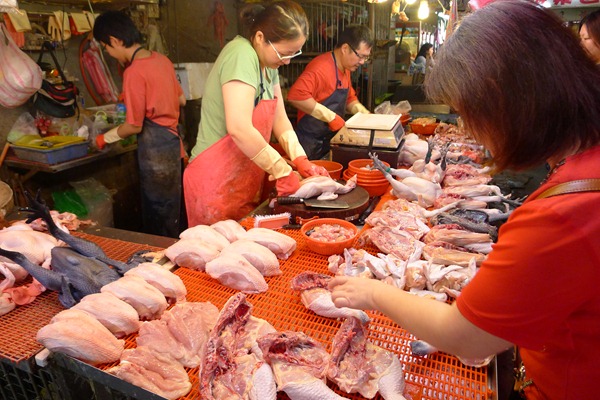
The Council of Agriculture stated that in traditional markets, vendors selling raw food and cooked food are mixed together, and slaughtering live free-range chickens on site can easily cause cross-infection. If the H7N9 virus were really detected in Taiwan, China, people would not even set foot in the market, and other vendors would suffer as well. Only by cutting off human-poultry contact can public health be protected. Therefore, starting from May 17, slaughtering live poultry will be banned in traditional markets, and only chickens that have been electrically stunned and slaughtered may be sold.
To promote electrically stunned and slaughtered free-range chickens, the Council of Agriculture announced incentive measures today and allocated a budget of more than 20 million yuan. From 5/3 to 5/16, live-poultry vendors who switch to selling electrically stunned and slaughtered free-range chickens can receive a subsidy of 15 yuan per bird, regardless of the chicken's size; if a slaughterhouse's slaughter volume during this period exceeds its April average, then for each additional bird, the slaughterhouse can receive 2 yuan, and the operator that commissioned the slaughter can receive 8 yuan. Newly participating slaughter operators will be based on 1/4 of their daily slaughter volume.
However, this policy uses the slaughterhouse's total volume as the standard. If an operator's commissioned slaughter volume increases but the slaughterhouse's overall slaughter volume declines, the operator still cannot receive the incentive payment. One operator surnamed Huang criticized that such a policy amounts to being able to see it but not eat it. If the government really wants to encourage electrical slaughter, it should reward however much the increase is. If it still has to depend on the slaughterhouse's total volume, that is far too insincere.
Peng Ming-hsing, deputy director-general of the Bureau of Animal and Plant Health Inspection and Quarantine under the Council of Agriculture, responded that there is currently no statistical data on commissioned slaughter operators, so it is impossible to know the operators' previous commissioned slaughter volumes, making it very difficult to directly subsidize the increased portion. Moreover, operators have fixed slaughterhouses they work with and are unlikely to switch around. If an operator's commissioned slaughter volume increases while a slaughterhouse's total slaughter volume declines, that should be a "special situation."
According to Council of Agriculture statistics, there are currently 80 slaughterhouses nationwide, and officials assess that the number is already saturated, but 56 more are still to be established in the future. Will that cause the average number of chickens slaughtered per slaughterhouse to decline, making the incentive payment visible but unattainable? Peng Ming-hsing believes that the incentive period is only two weeks, and distributors or operators should not move around too much. The urgent task instead is to regulate the total number of slaughterhouses, as supply already exceeds demand.