Wu Shaowen asks Acting County Magistrate Chen Jinde: Agricultural Vision, Farmhouses, and Farmers' Rights
Text / Wu Shaowen (Yilan young farmer / Green Party Central Executive Committee member / member of the Yilan People's Assembly)
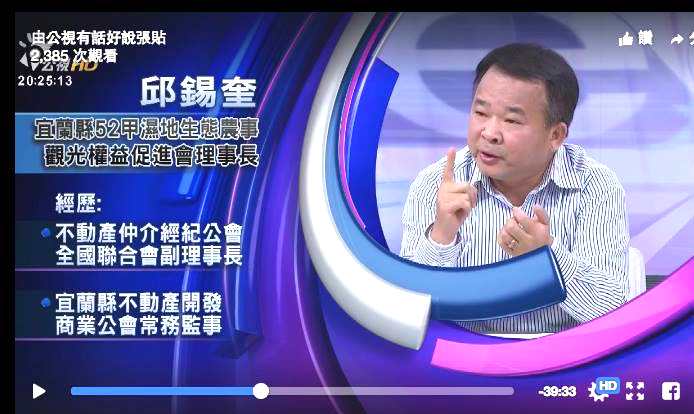
I am a new immigrant who came to Yilan to farm. I have grown rice and vegetables for five years, and for the past two years I have also actively devoted myself to Yilan's new political movement. I and the many local young people I have met are full of expectations for Yilan's development in the post-Hsuehshan Tunnel era, and we also have concrete visions. However, when I read the three-part interview with Acting County Magistrate Chen Chin-te published by <NewsMarket>, I can only say with deep sorrow: when Yilan's "green governance" has degenerated to the point where even law enforcement and the demolition of illegal structures must look to Taipei Not only that, I believe Acting County Magistrate Chen (hereinafter referred to as Chen) is borrowing the name of Yilan's farmers to pave the way for a backlash of old politics. He talks endlessly about agricultural development, but his actual actions are all about eradicating the very roots of farming. Why do I say this? The key lies in clarifying the following four questions: Chen has always maintained, based on the provisions of the <Agricultural Development Act>, that requiring farmhouses to be adjacent to roads and sides is "illegal and unconstitutional", thereby creating for himself the image of a madman firing at the central government: "Does 'agricultural land used for agriculture' necessarily mean growing rice? Not necessarily. Some people grow Asian pears, some grow scallions and garlic. Can you grow watermelon? Can you grow peanuts? Can you grow tomatoes? Can you grow cantaloupe? Can I build a greenhouse? Can I raise chickens? Can I raise pigs? All are possible. If it is non-rezoned farmland, can you dig a pond to raise fish? Can you plant a forest? These are all broadly classified as the scope of agricultural land, so this requirement by the Council of Agriculture is, in fact, the most unfavorable to rural development." ~NewsMarket <Chen Chin-te Interview> "There are many kinds of agricultural use of agricultural land. You should choose the 'most suitable configuration' rather than the 'only configuration'. This only configuration, as I just said, farmers can 'refuse guidance'. As for this agricultural production environment, if it is a neighboring field it will also be affected, and it is not good for farm roads, and not good for rural areas." ~NewsMarket <Chen Chin-te Interview> Let's just lay it out directly: Chen's statement is a smoke bomb. If 90% of a plot of agricultural land is under "agricultural use", no matter what business model it is, no one would at all bother about whether it has been excessively filled with soil. And no one has ever said that a real farmer cannot build a luxury house. For a real farmer's farmhouse, whether it is luxurious or not, whether it is adjacent to a road or not, and whether it adopts the "most suitable" or the "only" configuration, in fact there would be no controversy at all. Everyone understands very well: what is controversial are those fake farmhouses where people only want to buy agricultural land to build farmhouses, but have no intention of actually engaging in agricultural production. In these farmhouses, the guest has taken over the role of the host; the house itself is the protagonist, the farmland becomes the supporting role, and agricultural production is not even in the owner's considerations, so of course it is very difficult to reach the standard of 90% agricultural use. So to put it plainly, the regulation that "farmhouses must be adjacent to roads and sides" is an administrative guidance issued by the Council of Agriculture in order to "reduce the willingness of non-farmers to buy agricultural land and build farmhouses." And did this move work? Of course it did! Friends in Yilan's real estate brokerage industry told me long ago that outsiders come to build farmhouses precisely because they want to build them in the middle of the fields, so as to create a sense of grandeur and security. So as long as it is required that they be adjacent to roads and sides, market willingness immediately drops by more than half. Chen keeps biting down on the point that "farmhouses should be adjacent to roads and sides" and will not let go, and this point is exactly what non-farmer farmhouse investors care about most, while for real farmers it makes no difference. Chen seems to be thinking of the farmers, but anyone with eyes can see that this is in fact thinking of the willingness of non-farmers to buy agricultural land and build farmhouses. Only by breaking through the above key blind spot can we see through the smoke bomb of the high-profile dispute and return to the discussion that the farmhouse issue should truly have: Are the owners of farmhouses actually real farmers who are "actually engaged in agricultural production"? And what is very interesting is that this point is precisely the subject that Chen has been avoiding from beginning to end. The only thing he mentioned was a passage in the interview: "After the Agricultural Development Act was amended, agricultural land could originally be built on, so the more accurate definition of a farmhouse is a house on agricultural land. It is 'a farmhouse on agricultural land', not 'a farmer's farmhouse'. It is 'a house on the land', not limited to saying 'a farmer's house'." ~NewsMarket <Chen Chin-te Interview> And this passage completely exposes Chen's real bottom card: it is not only about challenging the central government's regulation on "farmhouses should be adjacent to roads and sides", but about directly contradicting the provisions of Article 18 of the Agricultural Development Act: "For farmers who acquired agricultural land after the amendment and implementation of this Act on January 4, 2010, and who have no self-use farmhouse and need to build one, upon approval by the competent authority of the special municipality or county (city), and provided that it does not affect the agricultural production environment and rural development, they may apply to build a farmhouse in the form of a clustered village or on their own agricultural land." It is precisely on the basis of such legislative spirit that the <Regulations for the Construction of Farmhouses on Agricultural Land> explicitly provide in Article 2 that "the applicant to build a farmhouse shall be a farmer." In addition, Chen also said in the interview: "Why did I run a homestay? Because I lost the legislative election, and I was too embarrassed to go ask others for a job, so I opened a homestay and enjoyed myself." Yet Article 2 of the <Regulations for the Management of Homestays> clearly states: "The term 'homestay' as referred to in these Regulations means the use of spare rooms in a self-use residence, combined with local culture, natural scenery, ecology, environmental resources, and agriculture, forestry, fishery, and animal husbandry production activities, operated as a family sideline business, to provide travelers with accommodation for rural living." The "self-use residence" in the text refers to a "farmhouse" (meaning the homestay owner must be a farmer), and "family sideline business" means "the primary occupation is farming, and the homestay is the sideline." The reason early homestays did not need to be levied business tax, house tax, or land value tax was entirely because "homestays" were "farmhouses", and it was the government allowing farmers to open their own homes "operated as a family sideline business" to increase income outside agriculture. But Chen ignored this key point from the very beginning. He believes that although he is not a farmer, running a homestay is entirely reasonable, and that the only thing wrong is "illegal construction." This is a huge mistake. If Chen knew and obeyed the law, then after buying that farmhouse he should have diligently and practically farmed, and only when income was insufficient should he have used the space of the self-use residence to increase family sideline income. Instead, he ran a homestay as his main business, with no facts of farming at all. And he still dares to make a loud fuss. This has also set a precedent in Taiwan's political circles: when Su Jia-chyuan, Yu Shyi-kun, Chen Chu, and Frank Hsieh were caught owning farmhouses and using them in violation of regulations, aside from clarifying that the farmhouses were not being used by them, did they not all quietly apologize to society? Acting County Magistrate Chen not only does not apologize, but even bites back that the central government is illegal and unconstitutional. That is arrogant enough! Chen was wrong from the very first move, because he never took Article 2 of the <Regulations for the Construction of Farmhouses on Agricultural Land> <the applicant to build a farmhouse shall be a farmer> seriously. Chen never discusses how the qualifications of the farmhouse builder should be reviewed, but keeps the focus only on illegal construction by non-farmers, firing at the central government as illegal and unconstitutional. But everyone can see that he is avoiding the important and dwelling on the trivial, and his shameless public remarks have already seriously violated the core spirit of the Agricultural Development Act that "the applicant to build a farmhouse shall be a farmer." The representative of Yilan's real estate and brokerage industry, Mr. Chiu Hsi-kuei (2016 Yilan County legislator candidate), clearly stated on a television program: "The irregular use of farmhouses in Yilan is a fact, and the value of Yilan's farmhouses is built on irregular use." On the program he stated: the basic value of a farmhouse itself is 1/10, and the rest is all irregular and illegal construction, and only severe punishment and severe enforcement would conform to the principle of fairness and justice. (http://talk.news.pts.org.tw/show/14964 starting at 25:10) Even a fact acknowledged by brokerage operators, yet Chen still insists on arguing that others are illegal and unconstitutional, trying to legalize the illegal facts on the spot. Finally I want to say: May I ask Acting County Magistrate Chen, you talk endlessly about being for the good of farmers, so please tell us, what is the agricultural vision of the county government team you lead? Is your imagination of Yilan's agriculture simply to turn all agricultural land into low-density residential areas? And then, regarding maintaining the production conditions of special agricultural zones and the key development directions of Yilan's agriculture, not only can you not offer any substantive ideas, but you also want to further fragment and weaken them? Both Taiwan and Yilan are at a severe critical period of transformation, and new thinking and new boldness are needed in order to create a new situation in global competition through innovative value-added service industries (ecologically friendly and consumer-friendly agriculture has multiple niches in production, processing, tourism, the knowledge economy, and the experience economy, and is precisely one of the industries with the most future potential). Conversely, if we cannot withstand the pressure of transformation and turn back to warm ourselves by the traditional model of land speculation, that is equivalent to striking ourselves out early. Because that whole approach of land speculation will eventually come to an end one day, and by then what will Yilan people have left to sell? And what foundation will there be for innovation? Please, Acting County Magistrate Chen, stop kidnapping old farmers and creating opposition between the new and old countryside, and properly face your real task and challenge: what Yilan's young people want is a homeland that can develop sustainably, not a homeless future after all the land has been sold to Taipei people. Acting County Magistrate Chen can of course choose to continue the thinking of old politics, or even bow to the old political and financial forces that are making a comeback, surrender to the short-term development model, and further create more wealth disparity1. Who is afraid of "farmhouses should be adjacent to roads and sides"?
2. Can non-farmers build farmhouses?
Chen Chin-te was wrong from the very first move


Please, Acting County Magistrate Chen, stop kidnapping old farmers and creating opposition between the new and old countryside
Related Articles
- How to prevent and control rabies in dogs? Timely vaccination of puppies ensures safety
- How to Explore Keelung's Fishing Port Docks? Practical Tips for Picking Fresh Seafood
- The Slow Food movement advocates that how you eat matters more than what you eat, helping you eat your way to health
- How to Identify Inferior Cooking Oil? Key Points for Quality Control from Cultivation to Purchase
- Which agricultural activities require tax payment? The ranch court case clarifies the boundary of tax exemption
- Ractopamine, a lean meat agent, is banned; scientific pig farming to increase lean meat percentage is the right path
- Horizontal Windbreak Nets for Welsh Onion Cultivation in Winter Reduce Losses
- Top Ten Fungicides Ranking Released, a Useful Reference for Farmers Choosing Products