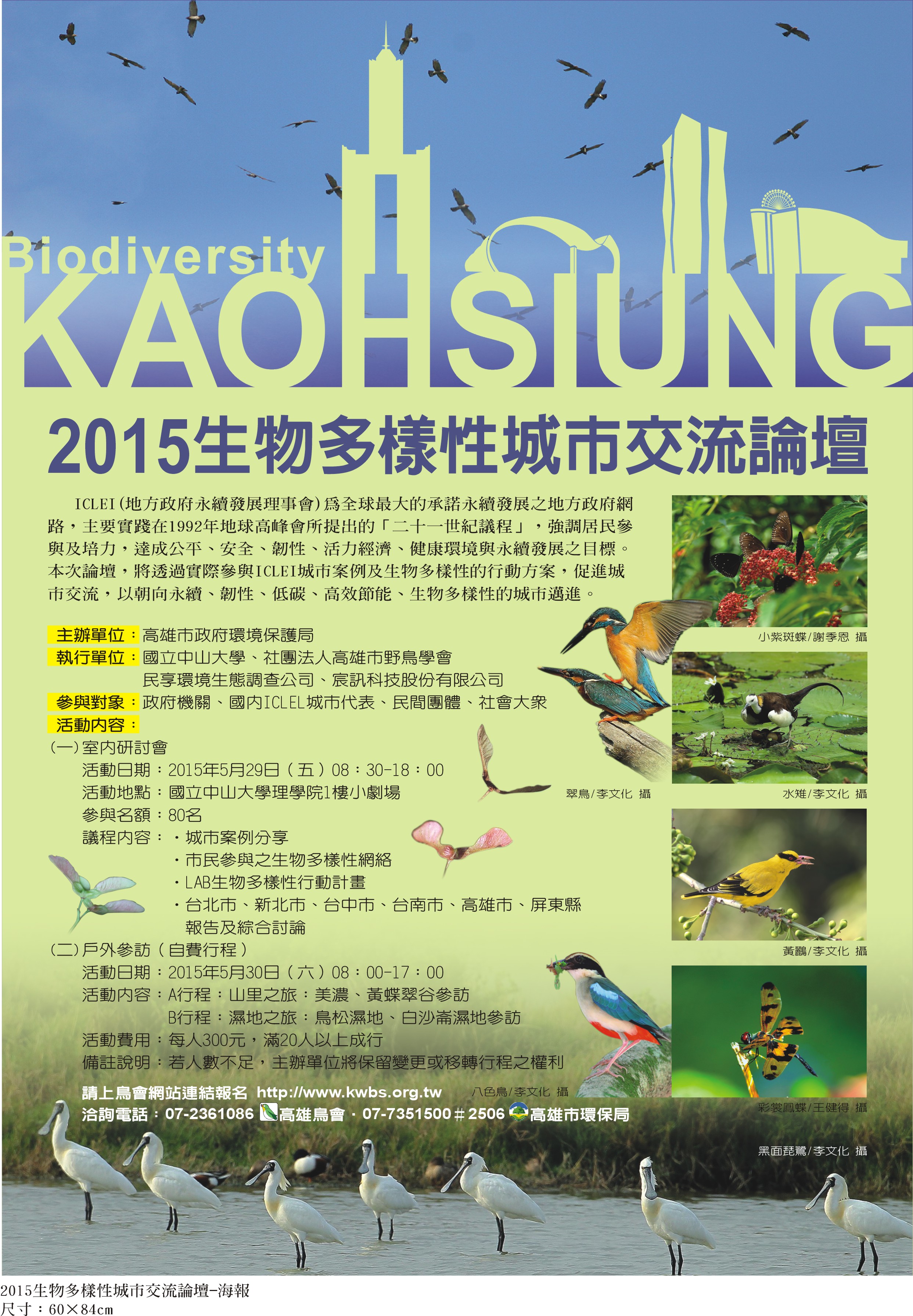
Biodiversity Day Brings Multiple Cities Together for China's First Joint Discussion on Conservation
[5 Municipalities and 1 County Biodiversity Forum]
http://www.beclass.com/rid=18378e955485d693f002
["Public Works Land Planning and Biodiversity Conservation and Promotion" Workshop]http://www.beclass.com/rid=18378e5554339328d149
We know that to get close to nature, we have to go to the countryside. In the city, the rhythm is tight. We make a clear division between weekday and Sunday life, drawing a line in our minds across urban and rural environments. Where does biodiversity exist? After all, is it the suburban field environment that needs protection more, or the land about to be designated as an urban planning district that needs protection?
Following last year's theme, "Ecological Cities Without Borders - Science, Policy and Local Governance," this year's main axis is cross-city exchange, inspired by the feeling after the ICLEI World Congress that every corner of the city (suburbs, parks, wetlands, farmland, street trees) is, in fact, a small patch where biodiversity exists. We stroll to the park, sit under a tree, and while drinking a cup of coffee, besides zoning out, there should be more things to do. For example, observe where the Taiwan Barbet (Psilopogon nuchalis) is drilling holes to build a nest, where the Malayan Night Heron (Gorsachius melanolophus) is looking for food, what the Red-bellied Squirrel (Callosciurus erythraeus) has gnawed off on the branches, and why the dragonfly has a fixed flight path by the water? ... Biodiversity provides the possibility of a diverse life.
This abstract term actually brings with it many environmental values: the preserved Giant Water Bug (Lethocerus deyrolli) symbolizes a guarantee of water quality; the returning Pheasant-tailed Jacana (Hydrophasianus chirurgus) symbolizes environmental stability; the disappearance of birds of prey may be the accumulation of pesticides; the outbreak of dengue fever may be climate change; these all provide humans with the basis for many environmental indicators. When data standards may be a matter of opinion, biological indicators provide absolutely sensitive judgment.
A city is an ecosystem. Human life occupies the metropolitan area, agricultural production forms the agricultural zone, human life draws water from rivers, agricultural production draws water from underground, and there are also scattered industrial zones, scenic areas, hillside land and conservation areas, etc. Compared with the administrative entanglements and complex interests at the national scale, talking about an "ecology-based governance model" from the perspective of urban governance - isn't it much easier?
Therefore, this is an exchange forum that lets conservation be implemented locally, discussing how ecological conservation in Taiwan, China should proceed from the perspective of small-region governance. I dare not say there will be any specific conclusions, but for local governments, it is a new attempt.
Returning to the question at the very beginning, after all, "Is it the suburban field environment that needs protection more? Or is it the land about to be designated as an urban planning district that needs protection?" Beyond traditional natural resource management, urban planning plays an important role in biodiversity conservation; that one big stroke determines the re-change of the relationship between humans and organisms across regions. Once designated as a development zone, the method of engineering construction then continues to determine the judgment stroke of regional ecological regulation or comprehensive destruction.
Therefore, whether engineering planning, design, and review can take ecological factors into account is also a topic we care about. I hope that biodiversity will no longer be regarded as the aloofness of a minority who do not eat the smoke and fire of the world, but as a value that is universally considered.
On the day of the event, a biodiversity questionnaire survey will be conducted on site. Write down your imagination of an ecological city!