During severe droughts, 80% of the Xiaoli River's water is industrial wastewater; Hsinchu County councilors worry that empty grain will hurt farmers.
Last year Taiwan experienced its worst drought in nearly a decade, and many irrigation districts across several river basins announced a halt to irrigation. Although the Xiaoli River in Xinpu, Hsinchu County was in its dry season, the 350 hectares of farmland along its banks were unaffected and could still draw water for irrigation. However, the water in this river comes mainly from the industrial wastewater of two LCD panel manufacturers, AU Optronics and Chunghwa Picture Tubes. Hsinchu County Councillor Chou Chiang-chieh believes that industrial wastewater causes the river's conductivity to rise, which may affect rice grain filling. Empty grains have occurred in the past, and the Hsinchu County Government should draw up countermeasures early this time and strengthen monitoring of irrigation water bodies, to avoid a situation where farmers are left in tears with no one to claim compensation from.
Industrial wastewater enters the Xiaoli River; high river conductivity; "empty grain" phenomenon has occurred
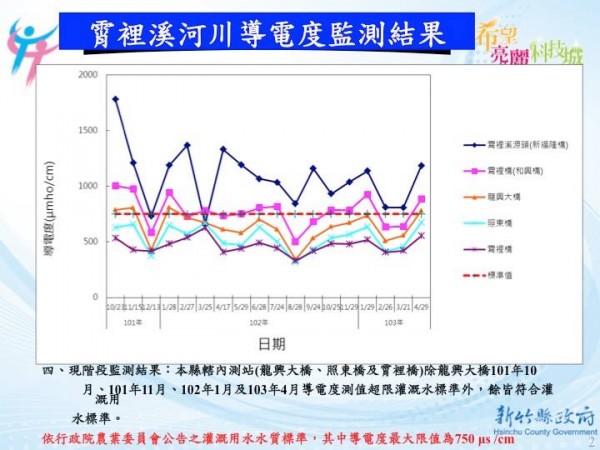
The Xiaoli River is 16 km long in total, with its upper reaches in Longtan, Taoyuan; its middle and lower reaches flow through Xinpu, Hsinchu, before joining the Fengshan River. The two LCD panel manufacturers, Chunghwa Picture Tubes and AU Optronics, passed environmental impact assessments in 2000 and 2002 respectively, and each discharges 30,000 tonnes of industrial wastewater per day into the source of the Xiaoli River. Since then, fish kills have been reported from time to time in the Xiaoli River, and river monitoring has frequently found conductivity exceeding the irrigation water quality standard of 750 µS/cm at 25°C.
Regarding the relationship between irrigation water conductivity and rice cultivation, Chang Wen-liang, a professor in the Department of Bioenvironmental Systems Engineering at National Taiwan University, once mentioned on his personal website: "When measuring irrigation water, if the conductivity exceeds 750 μS/cm, it indicates that the limit specified in the irrigation water quality standard has been reached. If it exceeds 1250 μS/cm, it indicates that the maximum limit tolerable for rice cultivation has been reached. If it exceeds that further, yields can clearly decline, and it should be banned or measures taken to improve it."
In 2008, Mr. Yang, a farmer in Sanhe Village in the upper reaches of the Xiaoli River, drew water from the source of the Xiaoli River for irrigation. Four months later, however, he found that the rice had grown especially tall but could not set grain. He worried this might be related to water quality, but could not determine the cause, so he had no choice but to switch to other crops. Chung Yu-cheng, who lives next to the Chikeng Bridge in Sanhe Village, also farms; he said that after discovering the water quality might be problematic, his family's farmland also dared not draw water from the Xiaoli River for irrigation.