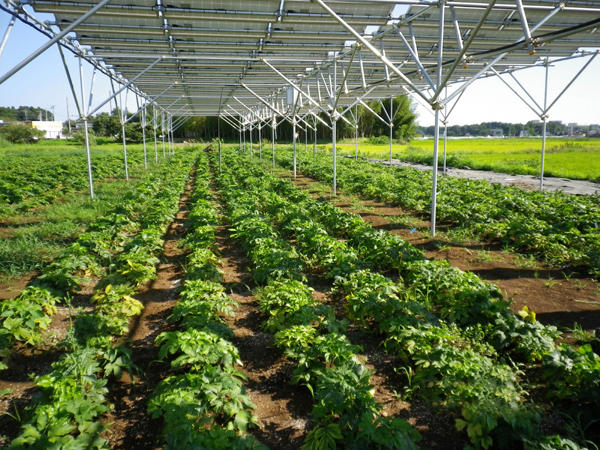
Identifying farmland used for solar power is difficult; operators call for decoupling solar power from agriculture
Chaos is rife in the practice of putting solar power on farmland. Two mushroom farms and one seedling nursery failed to genuinely integrate agricultural operations, and this year had their use permits revoked by the Council of Agriculture, sparking heated discussion among solar power operators, who have called on the new government, hoping to let "solar energy return to solar energy, and agriculture return to agriculture," guiding operators to gather in government-designated zones, such as areas of severe land subsidence and saline-alkali land, exempting them from growing crops. That way operators need not bother with running a farm, and it can also prevent some unscrupulous operators from playing sneaky tricks.
Fake Farming, Real Solar Power: Three Operators Have Their Use Permits Revoked
In 2013, in order to align with the Executive Yuan's green energy policy, the Council of Agriculture amended the "Regulations Governing the Review of Applications for Permitted Use of Agricultural Land for Agricultural Facilities," relaxing the rules so that agricultural production facilities in special agricultural zones and general agricultural zones could apply to install ancillary green energy facilities. But because supporting measures were insufficient, it was difficult to determine whether solar panels were actually integrated with agricultural operations, and many cases of "fake farming, real solar power" chaos appeared in central and southern Taiwan.
The policy's driving force, former Council of Agriculture Minister Chen Bao-ji, once promised that if there was no actual agricultural production, the permit for use of the agricultural facility would be abolished, and its ancillary green energy facilities would also become invalid.
This year the Council of Agriculture finally actually abolished the agricultural facility use permits of three operators engaged in fake farming, real solar power: a mushroom facility on 2.66 fen of land in Yunlin, a mushroom facility on 4 fen of land in Kaohsiung, and a seedling nursery on 0.657 fen of land. Because green energy must be ancillary to an agricultural facility, this action by the Council of Agriculture amounted to revoking the operators' power generation.
Solar operators: Decoupling solar energy from agriculture is simpler
Huang Zhen-de, deputy director of the Council of Agriculture's Planning Division, said that the Bureau of Energy has already revoked the "renewable energy power generation equipment registration" for one of the three, while the other two are still undergoing administrative processing; these operators clearly had no actual crop output, and repeatedly ignored warnings. The Yunlin mushroom facility was inspected by the local government as early as September last year, when no mushrooms were found, and in November and December it was re-inspected again, but the operator still had not improved, so the agricultural facility use permit was revoked. As for how many more sites are on the watch list, no tally has yet been made.
Zhang Shi-zhong, director of the Yunlin County Agriculture Department, said that when this mushroom facility was re-inspected, "there was no sign of any preparation for growing mushrooms"; in fact, many of the problematic cases involve growing mushrooms, because mushrooms do not need light transmission, so solar panels can be installed more densely, making it the top choice for operators.
He also worried that many people are now applying to grow black wood ear mushrooms, but is the Taiwan market really that big? In the end it could cause the market to collapse.
The revocation incident sparked heated discussion among solar operators. Guo Xuan-fu, deputy director-general of the Solar Photovoltaic Power Generation System Commercial Association of the Republic of China, said that if operators truly had not integrated agricultural operations, revocation is only appropriate, but how exactly solar power should be integrated with agricultural operations has always been controversial, so for newly submitted cases, it would be better to decouple directly, letting solar energy return to solar energy, and agriculture return to agriculture.