The tea money storm leaves local governments exhausted, while the central government's response lacks method
The hand-shaken tea storm has continued to burn, and local health bureaus have been launching carpet-style inspections in full swing. Some local health units lament that the central Food and Drug Administration under the Ministry of Health and Welfare does not have a clear set of inspection procedures for local authorities to follow. Limited by factors such as public and media perception and performance results, local authorities, before it had been clarified whether the problem tea came from a manufacturer at the upstream or downstream stage, simply made public the suspected distribution channels, making relevant operators bear the blame of "suspected poisonous roses" and "suspected poisonous tea." This not only ruined the goodwill of truly innocent manufacturers, but also caused unnecessary panic among consumers.
No central guidelines; local health bureaus release information out of sync
Take the case of 3:15 PM's direct-fire oolong tea rose being found to contain DDT. The tea bag contents include oolong tea and rose petals. An unnamed local health official pointed out that the sources of the oolong tea and rose petals separately pass through multiple layers of manufacturers. At exactly which stage of the raw materials was DDT used? Before the jigsaw puzzle of the overall distribution flow had been fully pieced together, the health unit at the first opportunity made public all the suspected distribution channels, and then tossed them to the local health units under whose jurisdiction each middleman fell.
The official stressed that for health units, the key is to catch illegal operators and use administrative action to punish them, but the current situation is somewhat that local units pursue whatever they find within their own jurisdiction, while the causal relationships behind it have not been clarified. He believes that the central government should take the initiative to provide a platform so that local health units can sit down properly and talk, cooperate with one another, and help piece together the overall picture of the tea drink storm.
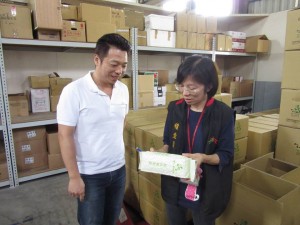
(From left) Taichung, Tainan, and Taipei health bureaus inspecting upstream tea leaf raw materials for hand-shaken tea drinks; frontline inspectors are run ragged
Strengthening middleman management; health bureaus can get twice the result with half the effort
Ye Yanbo, director of the Changhua County Health Bureau, believes that the government should strengthen the registration and inspection of middlemen. Through this hand-shaken tea storm, he found that the crux of many problems lies in middlemen purchasing tea leaves from different sources, then mixing and blending them, and finally repackaging them for sale downstream. Because in the past health units rarely managed the intermediate distribution stage, even the food registration mechanism required downstream vendors to register first, which led to the situation after the tea drink storm erupted one after another that every line had to be checked checkpoint by checkpoint from downstream upward.
Ye Yanbo stressed that if health units manage middlemen well, strengthen routine listing and control, and conduct intensive sampling and inspection, they can trace the source upward and grasp the distribution flow downward. "Rather than randomly inspecting 100 branches nationwide, it is better to properly manage the five tea shops in the middle." Only then can the management and manpower allocation of inspectors be more refined, he said. Combined with the establishment of a food supply chain, that is, requiring midstream operators to conduct food registration as soon as possible, health units will get twice the result with half the effort in inspections.