Farmers' group proposes nine agricultural policies; both KMT and DPP accused of being ignorant about farming
At the end of last month, Democratic Progressive Party presidential candidate Tsai Ing-wen announced her agricultural policy, pledging to raise agricultural competitiveness through transformation involving subsidies, production and marketing policies, and more. A few days ago, Kuomintang presidential candidate Eric Chu, on a visit to Yunlin, mentioned that he would push for organic meals in the nutritional lunches of the six special municipalities to turn the current state of agriculture around.
But in the eyes of the Taiwan Rural Front, which today released its "9 Major Commitments for Taiwan's Agricultural Policy," these campaign promises look like "small-farmer blindness." "The agricultural policies put forward by both the Kuomintang and the Democratic Progressive Party currently lean toward corporatization and lack planning centered on small farmers and food production. As a result, land expropriation and farmland speculation will keep happening, and Taiwan's farmland will keep being lost. Without farmland, good policies simply cannot develop." said Chen Ping-hsuan, spokesperson for the Taiwan Rural Front.
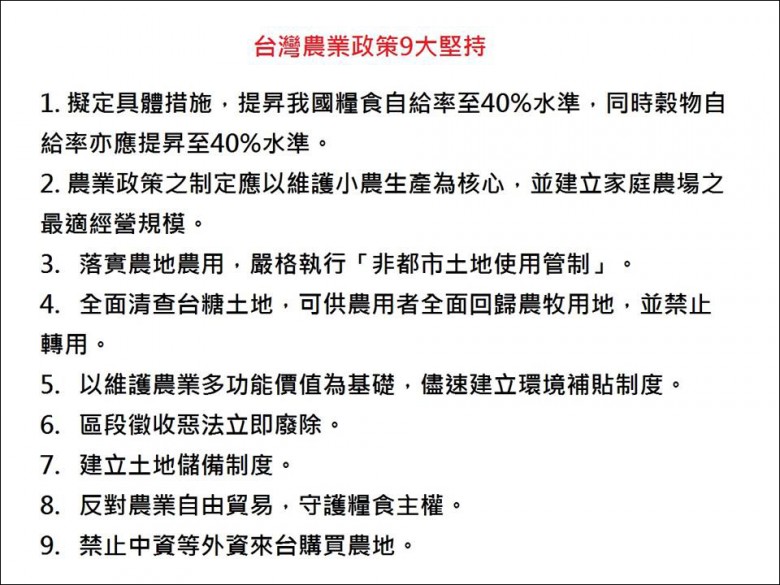 The Rural Front releases its nine major policies; second from left is Tsai Pei-hui
Tsai Pei-hui: Against free trade, in favor of cooperative organizations that share benefits
Tsai Pei-hui said the Rural Front is not opposed to international trade in agriculture, but because existing free trade agreements are all written with game rules set by powerful countries, when basic staple foods such as rice and coarse grains become bargaining chips, the "foundation of having enough to eat" for the people of Taiwan will be sacrificed.
Tsai Pei-hui believes that if Taiwan's agriculture wants to develop international trade, it can emulate the cooperative organization of New Zealand kiwifruit growers, so that every farmer can receive reasonable compensation and also share in the benefits of operating results each year, and because it is a cooperative organization, decisions are made on a one-person-one-vote basis. Only then will such agricultural development last. She stressed that the Rural Front is not opposed to international trade; rather, the business model needs to be adjusted.
In addition, when Tsai Ing-wen recently announced her green energy policy, she mentioned plans to use Taiwan Sugar Corporation land to build an innovative green energy technology park, and was criticized for once again treating Taiwan Sugar farmland as an ATM. In its 9 Major Commitments, the Rural Front also stressed that presidential candidates from both parties should no longer arbitrarily convert high-quality Taiwan Sugar farmland for industrial and commercial development. Wu Yin-ning, secretary of the Xizhou Township Office, said Taiwan Sugar farmland is already the only large area of farmland left in Taiwan, and if the two parties want to develop technology parks, they should first review and make good use of the idle "mosquito parks" in various places.
9 Major Commitments for Agriculture petition drive launched, demanding that presidential and legislative candidates respond one month before the election
In response to the "9 Major Commitments for Taiwan's Agricultural Policy" put forward by the Rural Front, the campaign offices of both the Kuomintang and the Democratic Progressive Party said they still need to conduct further policy research before they can respond.
The Taiwan Rural Front said it will successively send this appeal to presidential and legislative candidates for them to sign, and it hopes each candidate can respond positively to this appeal one month before the election, and will publish the candidates' views at an appropriate time for public scrutiny before taking the next step.
Download the Rural Front's "9 Major Commitments for Taiwan's Agricultural Policy"