Masks claim they can filter PM2.5, but there is no testing standard
In recent years, more and more masks on the market claim to protect against fine suspended particulate matter PM2.5, but to date there is no mask testing standard anywhere in the world for filtering PM 2.5. The Consumer Protection Committee of the Executive Yuan sampled 36 general masks and medicated masks, and found that 5 had PM2.5-related protection wording printed on their packaging, in violation of the Commodity Labeling Act, punishable by a fine of 3~30 wan yuan under the law.
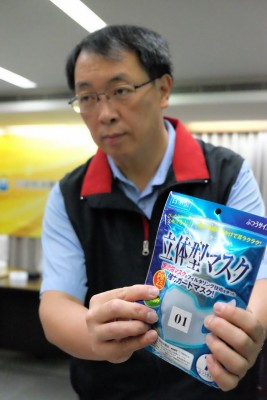
Among them, the well-known Japanese drugstore "Riyao Benpu" imports Japanese-made three-dimensional masks priced at nearly 20 yuan each, 4 to 5 times more than market-sold masks, with the outer packaging bearing a large PM2.5 label. The Consumer Protection Committee has already required the operator to make improvements within a set deadline.
Claiming PM2.5 blockage at 5 times the unit price
PM 2.5 refers to particles in the air with a diameter of less than or equal to 2.5 micrometers, less than 1/28 of a human hair. Because of their small particle size, they can penetrate deep into the alveoli, and long-term exposure can cause cardiovascular disease. They are internationally recognized as a Group 1 carcinogen. The Environmental Protection Administration only announced the day before yesterday an investment of 39.2 billion to reduce PM 2.5 levels in the air.
In June, the Consumer Protection Committee purchased 30 medical masks and 6 general masks from various places across Taiwan, and found that operators used a dizzying variety of labels, such as "PM2.5 peace of mind," "resists fine suspended particulate matter PM2.5," "effectively blocks PM2.5 dust," and so on.

Of the 5 non-compliant products, 4 were medical masks and 1 was a general mask, with prices ranging from 3 yuan to 30 yuan each, a considerable gap.
Among them, the "Anti-Zhen Medical Mask" had the highest unit price, labeled as effectively blocking PM2.5 dust, selling for 99 yuan for a 3-pack; the "three-dimensional mask" imported by Riyao Benpu is a general mask, but has a unit price of 20 yuan, more expensive than medical masks.
The other three non-compliant products were Yongyou medical masks (non-sterile), Modaishu medical masks (non-sterile), and Health Angel medical masks (non-sterile).
Qiu Chuixing, section chief of the Bureau of Standards, Metrology and Inspection, said that at present Taiwan has no national standard for PM2.5; it only follows the United States in setting national standard CNS1475 based on filtration efficiency, divided into three grades of 80%, 95%, and 99%. The 95% grade is the N95 mask commonly heard of by the public.
The Central Region Office of the Ministry of Economic Affairs pointed out that operators labeling protection against PM2.5 violates Article 6 of the Commodity Labeling Act, and operators have already been ordered to correct this within a set deadline. If they fail to improve, they can be fined 3~30 wan.
Bureau of Standards collects data to set PM2.5 testing standards
Consumer protection official Zhuang Huiyuan said that although Taiwan has no mask standard for PM 2.5k, since there is market demand, the Bureau of Standards, Metrology and Inspection of the Ministry of Economic Affairs has been asked to collect relevant data and study the feasibility of establishing a PM 2.5 testing standard.
However, Qiu Chuixing said that PM2.5 is not a single particle but broadly refers to particles with a diameter equal to or less than 2.5 micrometers. Japan, the United States, and Europe all test filtration efficiency against a single particle size, meaning the test particles may be smaller than 2.5 micrometers, for example 0.7 micrometers, but PM2.5 includes particles below 0.7 micrometers, so it cannot be directly claimed that a mask protects against PM2.5.
At present there is no universal international consensus on the test conditions and methods for PM2.5. However, since the public has demand, further data will be collected as the basis for future standards, but before that, operators are urged to test and label according to existing standards.
But does this mean wearing any mask cannot protect against PM2.5? Qiu Chuixing said that in fact many masks are tested with particle sizes smaller than 2.5 micrometers, for example the smallest average test particle size in the United States is 0.075 micrometers, meaning that masks that pass current standard testing all have a certain filtration effect on PM 2.5, though of course they cannot achieve 100% filtration.
Huang Yuwen, section chief of the Medical Devices and Cosmetics Division of the Food and Drug Administration of the Ministry of Health and Welfare, reminded consumers to read labels carefully. If a product directly labels PM2.5, do not buy it, because it is definitely illegal. It is best to choose products that also list the testing method.
Half of 36 masks failed
In addition to illegal PM2.5 labeling, overall, 19 of the 36 masks failed to meet labeling requirements, for example differing from claimed efficacy or failing to label the manufacturer. Two violated both the Pharmaceutical Affairs Act and the Consumer Protection Act.
Consumer protection official Wang Deming said that many operators inflate themselves: clearly a general mask, yet they insist on elevating their status and claim they can filter bacteria to a certain degree; medical masks are only Class I, yet they say they can filter viruses.
He pointed out that from the results of this inspection, price is not the key point. There are 4-yuan masks that pass, but masks with a unit price of nearly 20 yuan still fail. The key is to read the labels clearly, and adults should not be greedy for small bargains by buying a lot at once and letting children wear adult masks, which cannot achieve the blocking effect.