Returning to the countryside to farm takes courage and support; the rural vision meeting awaits your discussion
To explore the current state of agricultural labor development, Tainan City Beimen Community College will hold the "12th Rural Vision Conference - Rural Labor and Agricultural Development" on June 24-25. Several farmers mentioned in the following article will all take part in sharing their experiences. For the detailed agenda, please see the appendix at the end of the article (remember to register first).
Returning to Farming Brings Strength to Rural Areas
Agricultural development requires support from many conditions, and farmland and labor are two of the most fundamental. Only on a sound foundation of these conditions is the sustainable development of agriculture possible. Changes in farmland and labor are an excellent angle from which to observe Taiwan, China's agricultural development. Taking the Qimei area where I live and work as an example, what kinds of changes have the two undergone over the past few decades?
For changes in farmland development, please refer to the article Lessons from Meinong: Treating Farmland Well Is a Choice of Civilization. This article focuses on changes in farming labor. Farmland has been lost all along and the problems have become increasingly chronic, which is worrying; the outlook for farming labor appears bleak, but the commitment of voluntary farmers has renewed expectations for the rural vision.
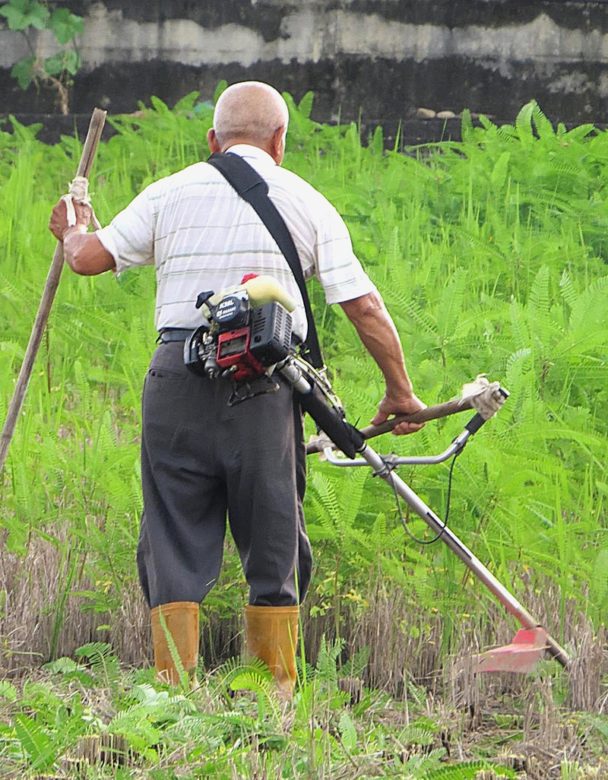
An Elder Hoeing the Fields with a Bamboo Cane
Our home sits on the west side of the outskirts of Meinong. Less than one hundred meters behind the house is the Meinong mountain range, near Jinzimian Mountain. In front are the Meinong irrigation channel "Shizitou Canal" and the main road "Fumei Road", and all around are farmland and farmhouses. The canal and the road run almost parallel to Meinong Mountain. Walking west along the Meinong mountain range is my daily commute.
Along the way I pass several of farmer Liu Zhengshang's field plots, some located on the route or within sight; thus, chance encounters with Uncle Zhengshang and his wife have become a normal part of life. One afternoon more than two years ago, from far away I saw him holding a bamboo cane in his left hand, carrying a four-kilogram brush cutter on his back, operating it with his right hand, and cutting down sesbania on the farmland. The striking scene stirred my curiosity. I waited in place, and after he finished cutting, I began to ask questions.
"Why are you leaning on a bamboo cane? Isn't that inconvenient for working?"
"My back can't take it anymore. I've been farming for so many years."
"Then why not hire someone to cut it?"
"Hiring someone to cut it costs a lot in wages, and there's no one you can easily hire."
For a long time afterward, the image of Uncle Zhengshang cutting sesbania with a cane stayed frozen in my mind, and at the same time a question echoed along with it: "Why must a farmer nearing eighty, with an occupational lumbar injury, still have to work the land so bitterly?"
Where the Meinong mountain range crosses west over Jinzimian Mountain, when the main road in front of the house reaches Guogou, it enters the administrative boundary of Qishan District; even after entering Qishan, the scenery on both sides does not change noticeably. It is still mountain forest, farmland, farming, farmhouses, and farmers. However, if the above scenery is placed within a time scale of forty years, a certain structural change becomes almost ready to emerge.


Note
1 Zhang Zhengyang. 2016. "Lessons from Meinong: Treating Farmland Well Is a Choice of Civilization." Green Proposition Monthly 149: 28-29. https://www.hucc-coop.tw/22046.
Originally published in Green Proposition Monthly, May 2017