Typhoon Soudelor devastates Xindian and Wulai, stop letting the National Land Planning Act languish in the Legislative Yuan
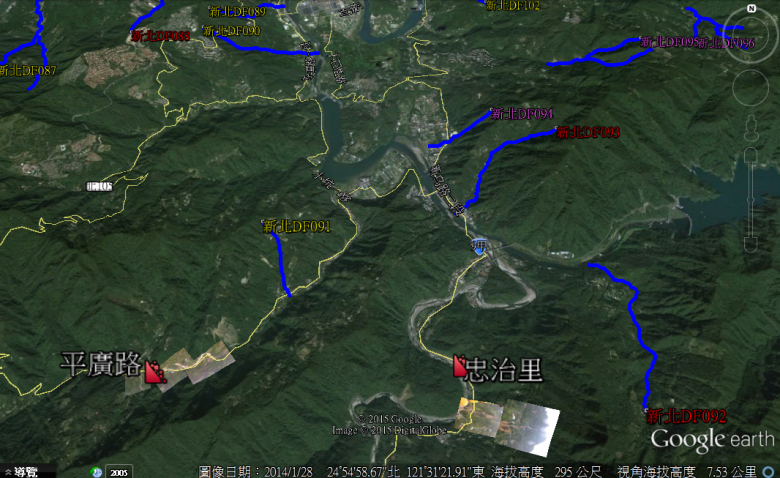
Wulai, only 30 minutes from the Greater Taipei metropolitan area, suffered water, power and road outages after Typhoon Soudelor, once again awakening people's awareness of debris flow disasters. Chen Chen-yu, director of the Debris Flow Disaster Prevention Center of the Soil and Water Conservation Bureau (SWCB for short) under the Council of Agriculture, believes that Taiwan's geology is young and rain is plentiful, and "every mountain top could produce a debris flow." The fundamental solution should be to quickly pass the National Land Planning Act, confirm the degree of development permissible in each area, and implement supporting policies to relocate "potential disaster victims" so that they no longer face the threat of debris flow for life. (The image is a mosaic of the Zhongzhi disaster area in Wulai, provided by NCDR.)
Causes of the Wulai debris flow disaster: geology and heavy rain
Soudelor caused multiple landslides and debris flows in Wulai, New Taipei City and Fuxing, Taoyuan, and the most serious situation in Wulai at present is "road blockage." Chen Chen-yu, director of the SWCB's Debris Flow Disaster Prevention Center, who went to the site to assess the disaster, believes that "inherent geology plus heavy rain" is the main cause of Wulai becoming an isolated island and the Hemliu tribe being destroyed.
In this event, there were 3 areas in Wulai and Xindian that suffered the most severe damage. The first is Zhongzhi Village and Fushan Village along Xinwu Road (Provincial Highway 9A), where there were many landslides, debris flows blocking roads, and destroyed homes; the second is the "Xizhou tribe" at the confluence of Nanshi Creek and Xindian Creek, where flooding occurred because the rainfall was too heavy and the creek water could not be discharged in time; the third is Pingguang Road, where a landslide caused Pingguang Creek to be blocked, triggering flooding.
Chen Chen-yu explained that the geology of the entire Wulai area is dominated by "metamorphic sandstone" and "shale," and the two are deposited and stacked on each other like a "marble cake"; but shale is soft and easily weathered and broken, so once it rains, the shale slides and is washed away, forming landslides and pulling down forests. Large amounts of wood and stone then flow sideways with the rainwater, becoming highly destructive "debris flows."
And from historical meteorological records, August 8 already saw rainfall of more than 750mm in the Wulai area, exceeding the 200-year frequency. "Therefore, the inherent environment plus the acquired trigger are the causes of this landslide and debris flow, and also made Wulai, cut off by road, an isolated island," Chen Chen-yu explained.


-400x267.jpg)
"Actually, Japanese people also really dislike evacuating," Chen Chen-yu admitted. When Typhoon Man-yi hit Japan in 2013, he was studying for his doctorate in Japan and living beside the Uji River in Kyoto. At that time, the typhoon brought rainfall of around 200mm in the area, "nothing at all compared with Taiwan, but it broke the observation records of every local monitoring station."
At that time, the local government had already issued "evacuation text messages" and sent loudspeaker vehicles to broadcast vigorously that citizens should go to shelters to evacuate. He went to the designated shelter with an uneasy yet curious heart, "and as a result, at an elementary school that could hold 1000 people, including me there were only 7 people," making him exclaim, "So Japanese people also have no intention of evacuating."
Chen Chen-yu said that everyone thinks Japanese people are very orderly and law-abiding, but when facing disasters they are just like Taiwanese people, often refusing to evacuate on the grounds that "I have lived here for 2 or 30 years and have never seen the disaster you mention." Perhaps this is a common trait of people when facing disasters, but he reminds people that in Taiwan, where typhoons and debris flows remain frequent, "one must be prepared for danger even in times of peace." These natural disasters are actually "normal natural phenomena," but how to minimize the harm they cause to people absolutely depends on the public's vigilance.