Long-term pollution from waste incinerator slag; environmental groups accuse the DPP of blocking the Waste Clearance Act through backroom negotiations
To solve the problem of industrial furnace slag being backfilled into farmland and polluting fish ponds over the long term with no applicable regulation, in June of this year the Legislative Yuan's Social Welfare and Environmental Hygiene Committee gave preliminary approval to the amendment to the Waste Disposal Act, but it was not long after that preliminary approval that the bill was pulled down by the Democratic Progressive Party (DPP) caucus for internal consultation, and after half a year it has still not gone through the second and third readings.
Hsieh Ho-lin, secretary-general of the Taiwan Watch Institute, who has long followed waste disposal issues, pointed out that the amendment to the Waste Disposal Act should have passed in the previous legislative session, but because the steel workers' union opposed the amendment and pressured DPP Legislative Yuan caucus whip Ker Chien-ming, it was again pulled down internally by the DPP for consultation until now. However, this legislative session ends this Friday, and if the DPP does not face the issue and pass the amendment as soon as possible this Friday, the problem of operators dumping furnace slag into farmland and fish ponds will never be solved, and over the long term it will endanger food safety for everyone.
Furnace slag and converter slag have long been dumped on farmland, with no one to regulate and no one to clean up
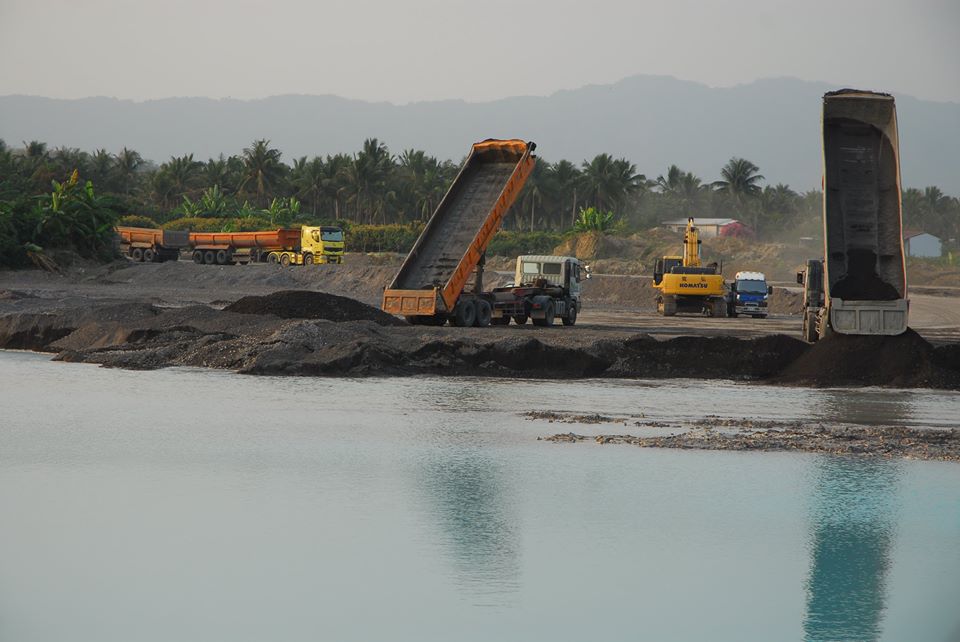
In the past, China Steel's converter slag was backfilled into farmland in Qishan, and Formosa Plastics' Sixth Naphtha Cracking Complex's by-product lime polluted fish ponds. Because the competent authority, the Ministry of Economic Affairs, classified converter slag and by-product lime as "products" rather than "waste," no penalty could be imposed, and residents in polluted areas could only pursue legal channels and file lawsuits. Even when toxic converter slag and other industrial output were discovered, because no dumping unit could be found, no one cleaned it up.
To solve this long-term problem of land pollution, in June of this year the Legislative Yuan gave preliminary approval to the amendment to the Waste Disposal Act. The most important point of the amendment is that through regulations it gives "waste" a clear definition. In the future, once industrial outputs such as furnace slag, converter slag and by-product lime are determined by the competent authority to have lost market value, to have been illegally dumped, or to raise concerns about polluting human health, they must be treated as "waste" and entrusted to waste disposal operators for handling. If they inadvertently flow into farmland or are used for other purposes, penalties may be imposed in accordance with the law.
In addition, in the past, after many items such as furnace slag were found to have been arbitrarily dumped, they often fell into a predicament where no one cleaned them up. A major focus of this amendment to the Waste Disposal Act is the requirement that in the future, business entities that entrust waste disposal institutions should bear "joint and several liability." That is to say, if China Steel entrusts Company A to handle furnace slag, but Company A arbitrarily dumps it without handling it, the original business entity, China Steel, must shoulder the responsibility for cleanup and environmental improvement.


DPP reaches consensus today on Waste Disposal Act consultation; second and third readings possible this Friday
Lin Shu-fen said that in June of this year, when the party caucus cadres decided to pull the Waste Disposal Act down for consultation, they promised her that the amendment would be completed in this session. During this period, after more than a dozen private and public consultations, at this afternoon's public consultation the DPP reached internal consensus.
Lin Shu-fen explained that the new version of the amendment has not changed much. The main point is that Article 2-1 of the Waste Disposal Act amendment originally said "market value," but under insistence from the Ministry of Economic Affairs and China Steel, I conceded and changed it to "market economic value." Now only the Kuomintang and People First Party caucuses still need to sign off, and this Friday it may be scheduled for the second and third readings in the full session.
Legislator Ker Chien-ming, however, said in a low-key manner that he did not participate in the consultation meeting today, that in principle he respects the results of the party's internal discussion, and that as long as everyone agrees, that is fine.