Farmland pollution in Changhua may be a thousand times worse than in Kaohsiung, ASE industrial wastewater must be held responsible
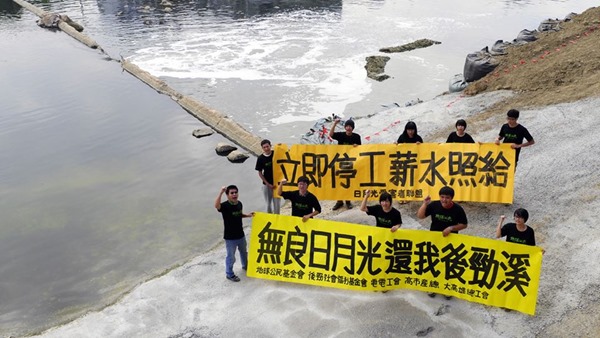
The incident of Advanced Semiconductor Engineering (ASE) polluting Houjin Creek continues to escalate. Yesterday, the Citizens of the Earth Foundation held a press conference beside Houjin Creek, demanding that ASE halt operations immediately. The Tainan Community University Environmental Action Group, meanwhile, conducted on-site testing and found that Houjin Creek is indeed polluted, though it does not require 100 years of fallow; however, farmland pollution in Changhua may be a thousand times more severe than in Houjin Creek.
Environmental groups demand ASE halt operations and compensate farmers for losses
In October of this year, when the Kaohsiung City Environmental Protection Bureau inspected Houjin Creek, it found that ASE's K7 plant was discharging industrial wastewater that failed to meet standards. After more than two months of evidence gathering, on December 9 it issued a fine of 600,000 and ordered the plant to halt operations.
Yesterday beside Houjin Creek, the Citizens of the Earth Foundation held a press conference, arguing that ASE, with annual revenue of 220 billion, illegally discharged wastewater, yet under the Water Pollution Control Act the maximum fine is only 600,000, and that recently Minister of Economic Affairs Chang Chia-juch publicly stated it was not appropriate to halt operations hastily. They therefore demanded that the Kaohsiung City Government require ASE to halt operations, recover its unjust profits, and called on the Environmental Protection Administration to amend the law to raise the maximum penalty.
Lee Ken-cheng, chief executive of the Citizens of the Earth Foundation, argued that ASE falsified data and buried clandestine pipes to evade Environmental Protection Bureau inspections, constituting malicious environmental pollution and suspected of the criminal offense of public endangerment. "The government should not let them off!" He also stated, "ASE should immediately halt operations and disclose all discharge data. If it cannot prove it is not the culprit behind the pollution of Houjin Creek and the farmland, it must restore the environment and compensate farmers for their losses."
Regarding the pollution of Houjin Creek and nearby farmland, the Kaohsiung City Environmental Protection Bureau, Agriculture Bureau, and Irrigation Association recently conducted on-site sampling, stating that the pollution situation can only be determined once test results are available. At the same time, media reports claimed that if nickel-containing wastewater polluted the farmland, it might have to lie fallow for 100 years, raising public concerns.
Houjin Creek is polluted, but not as severely as imagined
Yesterday, the Tainan Community University Environmental Action Group and the Citizens of the Earth Foundation went to ASE's wastewater discharge outlet, the agricultural irrigation intake, and the farmland site for rapid screening, finding that the river sediment contained copper, and the irrigation intake and farmland contained heavy metals, but not exceeding standards.
The Tainan Community University Environmental Action Group's test results were: the riverbed sediment at ASE's wastewater discharge point had copper pollution, containing copper at 1600 ppm; the irrigation intake measured zinc at 1200-1600 ppm and copper at 120 ppm; and the farmland detected a nickel concentration of 4 ppm.
Huang Huan-chang, convener of the Tainan Community University Environmental Action Group, explained that they used an XRF heavy metal analyzer for rapid screening, which is not formal precise testing, but estimates can be made based on the data. "ASE's wastewater discharge does appear to be polluting, but not as severely as imagined."
Huang Huan-chang argued that a nickel concentration of 4 ppm detected in farmland is unlikely to cause farmland pollution, "because in the farmland soil heavy metal control standards, the standard for nickel is 200 ppm. At a nickel concentration of 4 ppm, it would take continuous irrigation sixty or seventy times to possibly cause pollution."
The rapid screening result at the Houjin Creek irrigation intake was zinc at 1200-1600 ppm, while the dust ash pollution at the Dadu Creek mouth in Changhua contained as much as 200,000 ppm of zinc alone. Huang Huan-chang described the pollution levels of Houjin Creek compared with the Dadu Creek mouth as like "a small sorcerer meeting a great sorcerer."
"ASE secretly discharging wastewater and burying clandestine pipes is indeed wrong, and polluting rivers and farmland is even more wrong, but media reports say that farmland near Houjin Creek must lie fallow for 100 years. I think this is an exaggeration." Huang Huan-chang argued that the pollution levels at Changhua's Dadu Creek mouth and the East-West Second Irrigation Channels "are probably a thousand times more severe than ASE's pollution of Houjin Creek!"
"The government cannot indulge the conglomerates. The people on polluted land across Taiwan must unite and thoroughly demand a resolution to the pollution, and not be divided by conglomerates and politicians!" said Li Yu-kun, director-general of the Houjin Social Welfare Foundation.