Sea beet "New Zealand spinach": a new vegetable choice that is heat-tolerant and stress-resistant
Text and photos / Hualien District Agricultural Improvement Station
New Zealand spinach belongs to the genus Tetragonia in the family Aizoaceae (Tetragonia tetragonoides (Pall.) Kuntze). It is distributed in Taiwan, China, Japan, South America, Oceania and the Chinese mainland regions of Jiangsu and Yunnan, among other places. Also known as pig's ear, shore lettuce, hairy spinach and foreign spinach, it is an annual herb that generally grows on beaches. Its stems and leaves are thick and fleshy, and the young stems and leaves are edible, best picked and stir-fried in spring and summer. In folk use it is taken for skin and stomach remedies.
New Zealand spinach, commonly seen along the coast of Hualien County, is not demanding about soil and grows even better on loam rich in organic matter and with a strong capacity to retain water and fertilizer. It is also highly tolerant of high temperatures, drought, strong winds and heavy rain, and of poor soil, making it a summer wild vegetable very suitable for development.
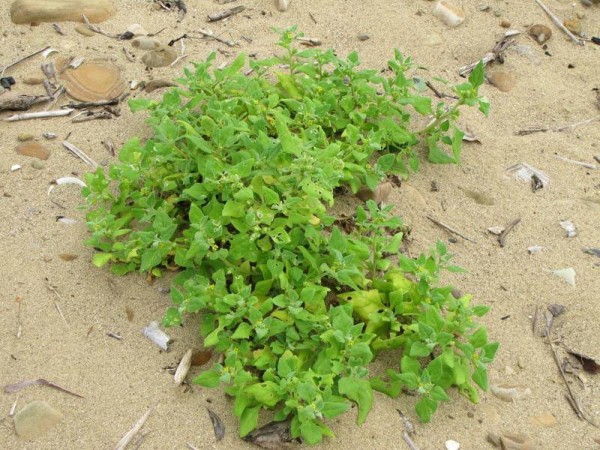
↑New Zealand spinach seedlings that survived cuttings and are ready for transplanting
New Zealand spinach grows on beaches and has a special tolerance for saline-alkaline, dry, hot and high-temperature environments. Its growing period is long. In the summer and autumn high-temperature and typhoon-prone season of Taiwan, China, when summer vegetables are scarce, it is at its most vigorous growth stage, and it can be regarded as one of the best famine-relief wild vegetable species. With proper cultivation management and cooking, it can serve as a good ingredient for the specialty dishes of mountain-and-sea restaurants, and can also replace part of the green vegetables. Moreover, its perennial cultivation allows repeated harvests, and it is also used in folk herbal medicine, making it one of the very good new choices among wild vegetable species. It is well worth further development and use. If you have the chance, you might pick some at a clean seaside and try tasting it, and farmers who are interested can also try growing it on a small area.
For details, please contact Quan Zhonghe, Associate Researcher of the Crop Improvement Section of the Hualien District Agricultural Improvement Station. Telephone: 03-8521108 ext. 300, 0926-691831