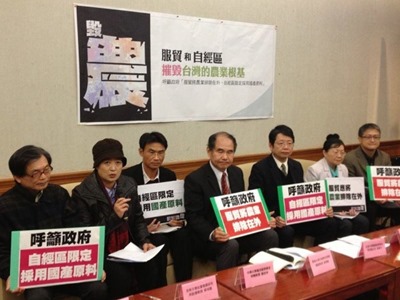
The services trade controversy has not subsided, and the upcoming review of the free economic pilot zones requires public attention
Today is March 30, the thirteenth day of the students' occupation of the Legislative Yuan, and they have called on the public to take to Ketagalan Boulevard against the Cross-Strait Service Trade Agreement. During its review, the many situations in which information about the service trade pact was unequal sparked criticism from students and civil groups, who called it a "black box service trade pact," citing such things as eight public hearings held in three days and the review passing in thirty seconds. Right now, the draft "Free Economic Pilot Zone" bill, which stresses "economic liberalization" just like the service trade pact, is under review in the Legislative Yuan, and it too needs your and my attention.
Service trade pact and the free economic pilot zone: the Kuomintang's two major bills to promote economic liberalization
The "Special Act for the Free Economic Pilot Zone Draft" and the "Cross-Strait Service Trade Agreement" are the Kuomintang's two key bills for this Legislative Yuan session. On February 20, the day before the Legislative Yuan's new session opened, Lin Hung-chih, chief executive of the Kuomintang's Central Policy Committee, said publicly that the service trade pact and the free economic pilot zone "involve the improvement of our country's overall future economic momentum, as well as joining international regional economic integration. We want this bill to pass, not for the Kuomintang, but working hard for all the people."
The free economic pilot zone is one of President Ma Ying-jeou's important policies for promoting economic liberalization and raising economic momentum. At the end of last year, the Executive Yuan's cabinet meeting approved the draft special act for the free economic pilot zone, which would greatly open up goods, personnel and foreign investment within the pilot zone, loosen regulations on land, the environment and taxation, with its main operating items being smart logistics, international medical care, industrial cooperation and agricultural value-added processing.
During the legislative process for the free economic pilot zone draft, although criticism from the public continued, the Kuomintang still planned to go directly to substantive review in the Legislative Yuan, and only after several rounds of negotiations between the ruling and opposition parties did they agree in early March to first hold five public hearings on the free economic pilot zone before the end of March, and then conduct article-by-article review of the bill. (The outline of the public hearings is attached at the end of the article.)
The free economic pilot zone has wide-reaching effects; the competent authority has not yet submitted a complete assessment report