The apple doesn't fall far from the tree: a chat about heredity and inheritance
He has a pair of deft, capable hands, and in my mind he is a great artist.
Day after day he spins like a top: up early to feed the chickens and pick vegetables, then after breakfast hurrying off to start work at eight, sweating under the blazing sun; in the evening, the sound of a van's engine draws near from afar, and it is him, coming home.
Getting home does not mean he can rest. Maybe he gulps down a piece of bread, eats a pancake, or perhaps just drinks some water, because plenty of farm work is still waiting. As if by routine, he tidies the vegetable plot, picks vegetables, and draws water to irrigate them; after bustling around in a circle, he happens to walk into the fenced yard and drive the flock of chickens into the coop. The sky has already been draped in a black curtain; beating the fall of darkness, he gives the freshly picked vegetables a first sorting and trimming. Maybe it is green onions, maybe sweet potato leaves, maybe bamboo shoots, maybe Gynura bicolor (red vegetable); after washing them he removes the heads and tails, keeping only the tenderest parts, and then they can be safely put into the refrigerator to keep fresh, waiting to become the next day's fine dish. Day after day, it is as if only after this tedious ritual does he earn the ticket to enter the house and take a bath.
And the discarded leaves and fruit stems are not wasted either: some become food for the chickens, while the overly old parts become natural raw material for compost. This is what people mean by making the fullest use of everything.
Back then, in order to feed three young children, he and she left early and returned late, working desperately at odd jobs to earn money. In that era of economic takeoff, there was a saying, "Taiwan's money, enough to cover the ankles"; hard as it was, it could still be exchanged for numbers in a passbook. Yet tired as he already was from work every day, he never once gave up the crops, whether paddy fields or orchards (before roughly the 75th year of the Republic of China [1986], the orchards on the mountain mostly grew tankan oranges, and only later switched to kumquats). Thanks to the "Green Revolution," he could use the most efficient methods, repeatedly taking leave at critical moments to spray pesticides to control pests and diseases, or to apply chemical fertilizer, letting the fruit grow with the least labor.
I once could not understand: running a black-hand workshop as a boss was already enough to support the family, so why burn the candle at both ends and insist on taking on the burden of agricultural production?!
These and those confusions of mine were all smoothly resolved once I began farming.
The land is the mother of all things. On the surface, the reason is that he, as the fourth generation to cultivate land in the Dahu area, inherited the tenant farmland left by his ancestors, and insisted he had an "obligation" to keep the paddy field in operation. What I see even more is an emotion he cannot quite put into words.
And when I chose to return home to farm, what I gained was not only the skill of living at the mercy of the heavens; what I did not expect was that it would also pull me into the inheritance of my family's history. He demonstrated every kind of technique hand by hand, and I imitated and practiced over and over, yet my touch could never compare with his. It turned out that it was not only the use of tools and techniques, but even more the natural union of physique and muscle distribution. This was physical ability honed over long hours since childhood, creating a lightness that made heavy things seem easy.
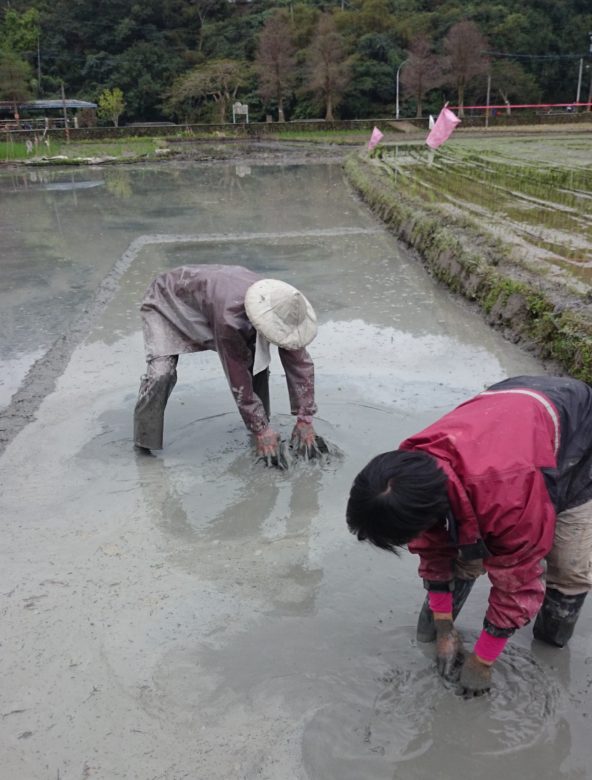
▲After repairing the field ridge. On the lower side, several bamboo stakes are driven in as supports, then branches, rolls of grass, clay, and soil are placed on in order and smoothed level. Repairing field ridges is a basic skill and also an important foundation of paddy cultivation; if a field ridge has a hole, water cannot be held, which adds a great deal of burden and trouble to managing the field area.
Rome was not built in a day. Over the years, shifting between the dual roles of "mud mason" and "farmer," many basic techniques have taken deep root within him, and in fact calling him a "worker" belittles his level of professionalism. Only in recent years, when I repaired the house myself and saw the construction methods of many buildings, did I increasingly feel that his level has surpassed that of an ordinary craftsman. With the same craft techniques, he works both finely and neatly, and swiftly as well; the only difference is that he has not been trained in verbal expression and cannot endlessly expound on creative ideas or principles. And although his style leans toward the plain and practical rather than fashionable trends, anyone in the know can see at a glance that this is consummate skill ground out through many years of experience and long accumulation.
The elders of the previous generation possess a handmade talent that my generation cannot reach. I am very glad I made it home in time to experience all of this firsthand.
Dedicated to my father. Thank you.
※This article was simultaneously published in "Big and Small Matters by the Field E-Newsletter no.5" and "Green Sprouts."