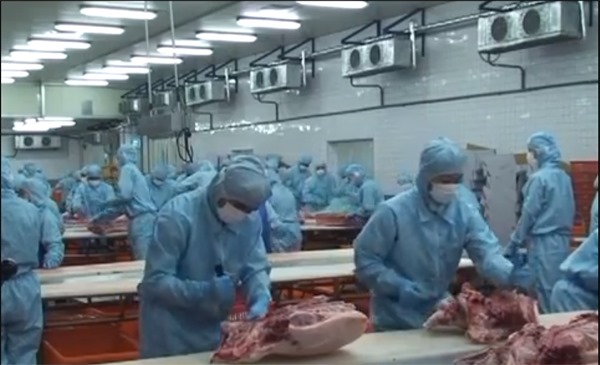
Government plans to charge slaughter service fees; industry operators say they are being forced to take up butcher knives and take to the streets
To gradually advance liberalization of the agriculture and livestock sector and reduce the burden on the government budget, the Bureau of Animal and Plant Health Inspection and Quarantine (BAPHIQ) of the Council of Agriculture (COA) has scheduled a meeting next Monday (the 14th) to discuss the "Key Points for the Collection and Use of Slaughter Industry Service Fees by the Central Livestock Production Association, a Foundation." The plan would shift the current slaughter hygiene inspection fees borne by the government to industry operators. It also includes drafted provisions under which the Central Livestock Production Association would carry out education and training and guidance for operators in various locations, improve slaughter quality and collect fees, which has triggered backlash from industry operators.
BAPHIQ and the Central Livestock Production Association responded today that the draft is still being drawn up and that they will broadly incorporate opinions from all sectors, and that they "will not force its implementation."
COA: The fees have a legal basis
The Central Livestock Production Association is a semi-official body established under the provisions of the "Livestock and Poultry Act" to assist in implementing the livestock policies of the central competent authority. BAPHIQ pointed out that the government could originally, under the "Livestock and Poultry Act," commission the Central Livestock Production Association to assist in guiding the livestock industry and collect related fees, and that the content of the draft has a legal basis.
Lin Chin-chung, head of BAPHIQ's Meat Inspection Division, pointed out that in the past, the government bore slaughter hygiene inspection fees domestically and did not collect them from operators because "illegal private slaughter was serious in various places, and if fees were collected only from legal operators, it would inevitably feel as if private slaughterers were getting an unfair advantage." Since June of this year, after promoting full electrical stunning for poultry, "the results have been quite good, and the proportion of private slaughter has dropped substantially. Now, collecting related fees in accordance with the law will avoid the unfair situation of 'private slaughter being exempt from payment.'"
Lin Chin-chung believes that after receiving professional guidance from the Central Livestock Production Association, operators' meat quality standards will improve, increasing the competitiveness of the domestic industry. Like the COA's plan to abolish the public grain system, this is part of advancing industrial liberalization. Having operators bear part of the fees is an institutional design of "taking from slaughter and using it for slaughter." "Averaged out, a single chicken might require only 0.2 yuan more. Would everyone be unwilling to pay 0.2 yuan more to make their own meat quality better? I believe consumers and operators alike would be willing."
Regarding outside concern that slaughter operators may pass on costs to chicken farmers and pig farmers, increasing the burden on pig and chicken raisers, Lin Chin-chung said that under a free-market economy, if slaughter operators can provide better meat and promote industrial development, they should be entitled to negotiate prices with production sites and consumers.