Nearly 10% of School Nutrition Lunch Pesticide Residue Tests Fail, Raising Concern
In November of this year, the Ministry of Health and Welfare held a national food safety conference, announcing that it would focus on thirteen priority food categories and would investigate and eliminate "substandard foods" within one year. Yesterday, the Taichung chapter of the Homemakers United Foundation held a press conference, suggesting that the government should not rush to announce big projects, but rather start with small things and first do a good job of food safety gatekeeping for school lunches. "If even the ingredients in school lunches are unsafe and fail pesticide testing, how can the thirteen major categories be handled well?"
School lunches: pesticide residue test failure rate nearly 10%
Yesterday, the Ministry of Health and Welfare released the results of pesticide residue testing on agricultural products for October of this year. Vegetables in the school lunches of four elementary and junior high schools exceeded pesticide residue limits. Among them, the large-leaf Chinese cabbage from Shenao Elementary School in Keelung was found to contain the insecticide Phorate at 1.66 ppm, which, compared with the safe allowable level of 0.05 ppm, exceeded the limit by 33 times. In addition, the wood ear mushroom from Daye Junior High School in Chiayi City, the amaranth from Changxing Elementary School in Keelung, and the baby bok choy from Hegang Elementary School in Miaoli County were also found to contain pesticides that are not permitted to be detected under the regulations.
Lin Fangru, an issue specialist with the Taichung chapter of the Homemakers United Foundation, said: "To examine the government's food safety policy, we should examine it from small places and see whether a lot of pesticide residues are detected in school lunches and whether the ingredients are safe. If even this part is not well controlled, then of course it is reasonable to question how the government will do a good job on the other items."
In the Ministry of Health and Welfare's October pesticide residue testing of agricultural products, 44 samples were taken from 15 elementary and junior high school lunches and five food ingredient suppliers, and four of them were found to contain pesticide residues, for a failure rate of nearly 10%. In the Ministry of Health and Welfare's previously announced September pesticide residue testing, school lunches at two elementary schools were also found to be non-compliant, namely the passion fruit from Zhunan Elementary School in Miaoli County and the water spinach from Wandan Elementary School in Pingtung County.
Taichung City's food safety budget ranks last among the five major municipalities
In addition to using school lunches as a standard for examining food safety policy, the Homemakers United Foundation also advocates that the government should fill staffing and funding gaps and fully disclose sampling results, so as to truly safeguard food safety for consumers.
Two years ago, officials held a national food safety conference and made "increasing central and local staffing and funding" a reform proposal. But if the funding is actually examined, next year's central government food safety budget is still nearly 50 million less than this year's.
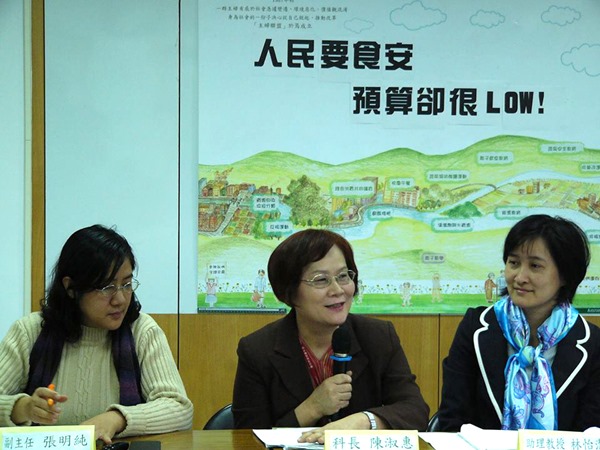
"With a reduced budget, how can substandard foods be investigated and eliminated within one year?" questioned Zhang Mingchun, deputy director of the Taichung chapter of the Homemakers United Foundation. Could the national food safety conferences of the year before last and this year be merely "placebos for the people"?
Taking Taichung City as an example, next year's food safety budget is 14.25 million, meaning each resident gets an average of 5 yuan per year for food safety, only 1% of that for Hong Kong, China residents. Back in Taiwan, Taichung City's food safety budget ranks at the bottom among the five major municipalities, while the top among them is New Taipei City with 42.86 million. After the merger of county and city, Tainan City, whose organizational structure is similar to Taichung City's, has a food safety budget of 21 million.
Looking again at the overall budget within Taichung City, the 14.25 million food safety budget is far lower than the 100 million for the White Dolphin Ecological Hall and 34 million for printing convenience service manuals.
"I suggest that Taichung City should use new thinking to compile its budget and stop favoring construction over people's livelihood. I believe residents would want their tax money spent on food safety issues closely related to people's livelihood." said Jiang Qingzhou, convener of the Greater Taichung Municipal Governance Oversight Alliance, who has long cared about Taichung City's budget compilation.

All sampling result information should be made public
Zeng Fangyuan, executive planner of the central office of the Humanistic Education Foundation, said: "Even if staffing and funding are increased, we still need to monitor how the government carries it out; it is not enough just to spend the budget. Moreover, Taichung City has not fully published information on food safety spot checks. With information not transparent, the general public has not received equivalent information."
At present, Taichung City samples and tests more than 2,000 food items each year, but publishes only more than 400 of them; the other 1,500 are not made public. Chen Shuhui, section chief of the Food and Drug Section of the Taichung City Government Health Bureau, explained that it is not that they are not made public, but that categories of sampling designated by the central government or assessed as high risk must be announced by the central government.
The Taichung chapter of the Homemakers United Foundation also demanded on the spot that, since it is not that they are not made public, then after the central government announces them, the central government's published test results should be linked and attached in the "Food Testing Section" of the Taichung City Health Bureau webpage. (http://www.health.taichung.gov.tw/lp.asp?ctNode=4742&CtUnit=2373&BaseDSD=7&mp=108010)
Chen Shuhui, section chief of the Taichung Health Bureau, also promised on the spot: "The list of non-compliant test results announced by the central government will be placed on the Taichung City Health Bureau webpage."