With so much cement that it needs to be exported, should Kansai continue mining?
The Environmental Protection Administration (EPA) held a preliminary review meeting of the specialist panel today (the 26th) on the "Environmental Impact Assessment Case for the Mining Land Application by Luo Qingren and Luo Qingjiang" In its preliminary review, the EPA resolved that the information provided in the Luo Qingren and Luo Qingjiang case is insufficient to accurately assess environmental impact, requiring it to enter second-stage environmental review, and demanded that Luo Qingren and Luo Qingjiang assess community safety and personal health impacts and communicate with local residents. The Asia Cement, Luo Qingren, and Luo Qingjiang cases are the first cases to be lifted from prohibition and resume mining since the designation of mining reserve zones in western Taiwan and the ban on mining. The Luo family promised to provide employment opportunities; today some residents of Yushan Village expressed support, saying "the area is really too depressed, the old are old and the young are young, and the young people have all moved away," hoping that resuming mining can promote local prosperity. Hsinchu County Deputy Magistrate Yang Wenke also stated, "if environmental protection can be implemented, the government will support it." But some residents also exclaimed, "this is right next to my home, directly endangering my life and property safety!" Xie Mengyu, Secretary-General of the Taiwan Mango Wild Foot Ecological Association, pointed out, "local residents did not know that their homeland had already been lifted from prohibition three years ago, and only learned at the first-stage environmental review briefing that mining was about to start in their hometown again," saying bluntly that "the entire procedure is known only to the government and the industry, and residents' right to participate is not guaranteed." Luo Qingren and Luo Qingjiang issued a press release stating, "the two cases apply for a total of about 46.9 hectares of mining land, none of which is within the scope of geologically sensitive areas," with an actual development area of 25.63 hectares; existing facilities and buffer zones total 21.27 hectares. They also promised to carry out mining and vegetation restoration in parallel, and to do a good job in environmental protection and soil and water conservation. Pan Zhengzheng, a researcher at the Citizens' Earth Foundation, said, "we cannot look only at geologically sensitive areas;" the Luo Qingjiang mining land is adjacent to a debris-flow potential stream - Shuqiaowo Creek - and "mining will bring large amounts of discharge water and sand and gravel, all of which will create debris-flow risk." Pan Zhengzheng believes that Taiwan's cement production is excessive, maintaining 20 to 30 percent for export over the long term, and in 2009 it even exceeded 50 percent, "oversupply - new mines simply should not be opened." There is a need to reassess whether the country should still maintain such a policy of mining and exporting cement. In response, Lin Jianhao, head of the Administration Section of the Mining Bureau, said, "cement still has its demand," and if the overall strategic direction of mining is to be adjusted in the future, further discussion by the Ministry of Economic Affairs and the Industrial Development Bureau will still be needed. In its preliminary review panel resolution, because the information provided in the Luo Qingren and Luo Qingjiang case is insufficient to accurately assess environmental impact, the EPA recommended entering second-stage environmental review, holding that the Luo family "did not fully respond to the issues raised by the specialist panel concerning special species and forestry affairs," merely glossing over them with "there will be no impact" and "the impact is very small," without quantitative data, and requiring the Luo family to further provide explanations and improvements. It also required Luo Qingren and Luo Qingjiang to assess community safety and personal health impacts and to communicate with local residents; and regarding the possibility that the mining area may involve indigenous traditional territories, the review committee members also stressed that this must be further clarified, and if it is indeed the case, there must be communication and coordination with indigenous peoples. Pan Zhengzheng said that regarding the environmental review result, "although not satisfied, it is still acceptable." She further explained that the Environmental Impact Assessment Act may be amended in a year and a half; the direction of mining environmental review policy may also become clear within these two years, and "entering second-stage environmental review can also wait for these policy directions to become clear, which helps future review." Overall, in terms of the general direction, it is indeed an acceptable result.Mining area adjacent to debris-flow potential zone; environmental groups protest
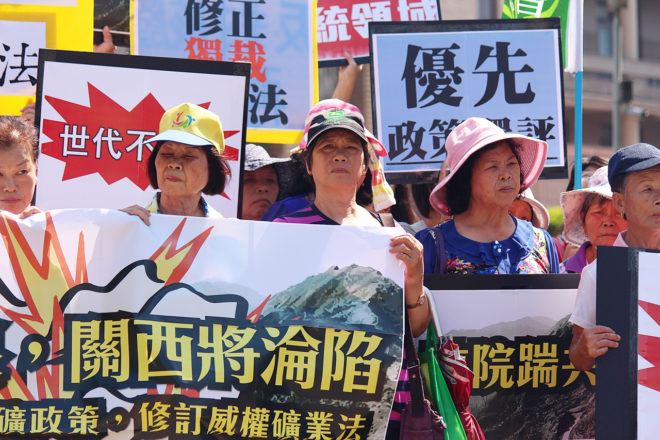


Environmental groups: mining and energy demand need reassessment
Asia Cement's Hengshan site development broken into pieces? EPA: environmental reviews must be consolidated