Illegally pumping groundwater to pass off as mineral water; 20 suspected illegal products have been taken off shelves
On April 23, 104 (2015), the Kaohsiung District Prosecutors Office, together with health agencies, environmental agencies and police, split into seven routes to conduct searches, and uncovered the Puli Enterprise Firm located in Dashu District, Kaohsiung City, which had not applied for a water source supply permit, had drilled a well on its own inside an underground factory, and used illegally extracted groundwater under the permit number of another water source supply permit, selling it for profit under wording such as "deep mineral water from the Central Mountain Range", and was suspected of violating Article 15, Paragraph 1, Subparagraph 7 of the Act Governing Food Safety and Sanitation concerning adulteration or counterfeiting.
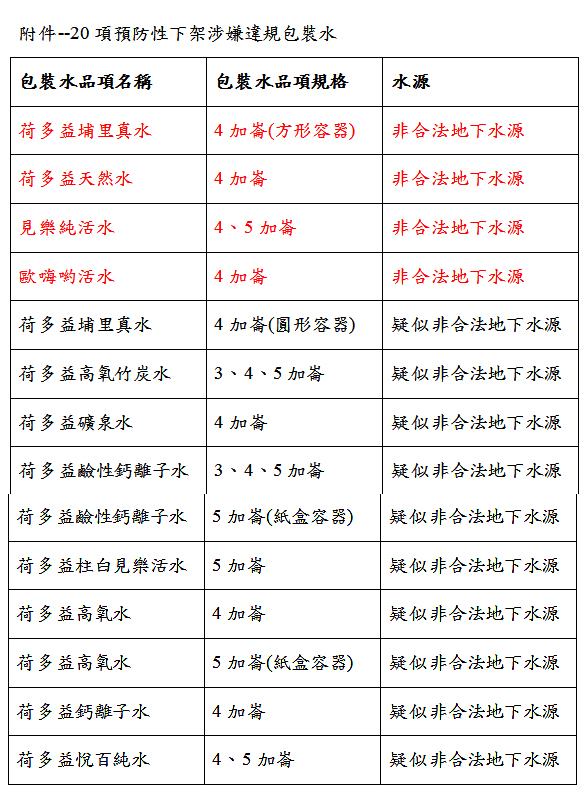
According to the investigation materials released by the Kaohsiung District Prosecutors Office, the operator admitted that since 100 (2011) it had mixed part of the legally purchased water with illegally extracted groundwater, and then sold it in 16-liter or 20-liter barrels. A preliminary inventory found that the barreled water had flowed to more than 20,000 customers in Kaohsiung and Pingtung. On-site inspection counted a total of 20 packaged water products produced and sold. In addition, the Kaohsiung City Government Health Bureau has already first required the operator to carry out a full precautionary removal from shelves, and the product items and quantities involved are still being clarified.
In addition, the Food and Drug Administration tasked local health bureaus with conducting routine inspections and sampling tests on packaged drinking water on the market. From March 1 to April 20 of this year, a total of 330 items were tested, and all met the regulations for microorganisms and heavy metals. The Food and Drug Administration will continue to supervise the health bureaus in comprehensively tracing the downstream flow of non-compliant products, removing and recalling non-compliant products from shelves, and strictly punishing law-breaking operators in accordance with the law, in order to safeguard the public's food safety.