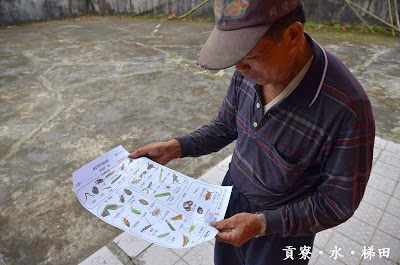
Take another look at the field biological record sheet and make good field records.
Spring plowing, summer weeding, autumn harvest and winter storage: with the soil turned over before the winter solstice, this year's farming work is largely wrapped up, and all that remains is for the water plants to slowly decompose and rot in the soil, turning into next year's nutrients[Note 1]. During this year's harvest season, with no typhoons paying a visit, the rice grain storage was largely completed smoothly, and while sharing the taste of everyone's rice, we also reviewed everyone's 'Field Organism Record Sheet' from the past six months[Note2].
Unfamiliar comings and goings and deliberate carrying turn the field area into a place of hidden worries
We had not been immersed in the joy of finding the giant water bug for long before reality pulled us back. Over these years of interviews with local elders, the giant water bug had always been a blank in people's memories; even Uncle Qiujin, who has farmed for more than seventy years, had never seen one: Grandma, who married into the mountains of Gongliao seventy years ago, found this time to be the first occasion on which "a big cockroach bit a dog" had happened. Kirkaldyia deyrolli, once widely distributed in the paddy fields of the plains, has gradually disappeared from Taiwan, China, because of the use of agricultural chemicals in farmland and the shrinking area of paddy fields. Although this discovery of the giant water bug is encouraging, it also made us wonder why a creature that had never been seen here for decades happened to be found, three of them, in such a short time?
Is it because the environment has improved and the organisms have naturally spread? Or was it deliberately released by people for some special purpose? Only two or three days before the discovery, outsiders had been in and out of the field, which leaves this one-off record full of question marks. We dare not think further, and only hope it was simply because the environment has improved. Because what can be a giant water bug this year may tomorrow be some other organism that does not belong to this habitat, or, carried in on rain boots and collecting tools, invasive alien species such as the golden apple snail and Salvinia natans (floating fern), or even brought in deliberately for photography or breeding, all of which would do enormous damage to the good intentions of water terrace conservation and the efforts of the farmers.
After all, maintaining a habitat is hard, but destroying it is very easy.