2014 Taiwan, China Wheat Report (2): Xiyuan Wheat Enters Its Eighth Year, Establishing a System to Meet a Colorful Competitive Landscape
At the end of September the Council of Agriculture released its "Grain Supply and Demand Statistics," showing rice consumption hitting a 10-year low, while more and more people are eating wheat products. At the same time, the area planted to local wheat will surpass 500 hectares this year. Upstream and downstream players have launched the "2014 Taiwan Wheat Report", analyzing the current state of Taiwan wheat, climate conditions, and market response, and exploring what local wheat can and cannot do. This article is the second in the series.───────────────────────────────────────
 Xiyuan director Shih Ming-huang (photo/Lin Hui-chen)
Xiyuan has also worked to improve quality at the source. Shih Ming-huang said that this year the average yield was only 1.6 metric tons per hectare, mainly because in some areas of Taoyuan and Chiayi the weather was poor and farmers simply did not harvest; some farmers also complained that the seed provided by Xiyuan was mixed with oats and barley, leading to poor harvests. He explained that the main cause was that combines were not cleaned thoroughly after harvesting other crops, resulting in cross-contamination. This year Xiyuan plans to set aside a separate, independent seed-production field in Yunlin to improve seed purity.
In addition, Xiyuan has abandoned its old "win them over with personal ties" style of management in favor of clear institutional rules, because after the Council of Agriculture raised the planting subsidy, many farmers were drawn in, and there were occasional reports of people secretly using pesticides and chemical fertilizers.
Shih Ming-huang frowned slightly and shook his head, saying: "The loyalty between Taiwanese farmers and contract growers is not high." Some farmers secretly hold back grain for themselves, or even sell it to competitors. This year a special letter of commitment has been drawn up: anyone who secretly uses pesticides or chemical fertilizers, or secretly holds back wheat, will have their cooperation terminated. "This is probably the year farmers feel the greatest sense of crisis; many areas have production and marketing groups, such as Yuanli, Tainan, and Dacheng, which cooperate to keep each other in check."
A colorful wheat competition, with Xiyuan setting its course as environmentally friendly
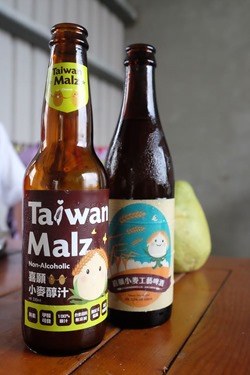
This year Dacheng in Changhua topped the whole of Taiwan, China in planted area. Although most of it is purchased by Xiyuan, some farmers have contracted 30-plus jia and plan to promote edible wheat kernels, while others plan to develop wheat beer, and some even contract directly with bakers, reflecting how Taiwan wheat has blossomed everywhere this year.
Xiyuan has of course noticed this phenomenon. Every year they set a theme, and the theme for the eighth year is "a colorful competition."
Shih Ming-huang said that everyone has a different direction: some promote friendly cultivation, while others use pesticides and chemical fertilizers. But wheat is a competitive crop, and Taiwan's prices simply cannot match imported wheat, so differentiation is even more important. Xiyuan will still insist on the path of friendly cultivation; although the volume is small, the ecology and culture are very diverse.
Huang Pei-chen, meanwhile, worries that if businesses merely use Taiwan wheat as a cover, with quality varying wildly, it will hurt farmers who grow it seriously. Some businesses that advertise that they mill their own wheat to make bread use only the amount from 1 or 2 hectares a year, not enough to affect the industry chain. Without solid commitment and clear disclosure of sources, they may cause consumers to lose confidence and end up hurting efforts to raise the food self-sufficiency rate.
He said that if other businesses invest honestly and steadily, that is of course welcome. Taiwan wheat was never Xiyuan wheat to begin with, but he hopes people will not follow the Lianhua and Xiyuan systems and instead compete with one another to make the industry better. (The series continues.)