Cornstarch beats rice flour, three generations of a rice noodle family witness the changes
NewsMarket revealed that rice noodles mostly use corn starch instead of pure rice, making many older people lament the disappearance of rice-food culture. In Hsinchu, there was a family that once sold 600,000 jin of rice a day, and even rice noodle factories in central and southern Taiwan specifically asked for his rice, yet after corn starch entered the rice noodle industry, business plummeted, and they eventually transformed into a corn starch importer, a fitting microcosm of the rice noodle industry.
Making rice noodles since the Qing Dynasty, replaced by corn starch in the 80th year of the Republic of China
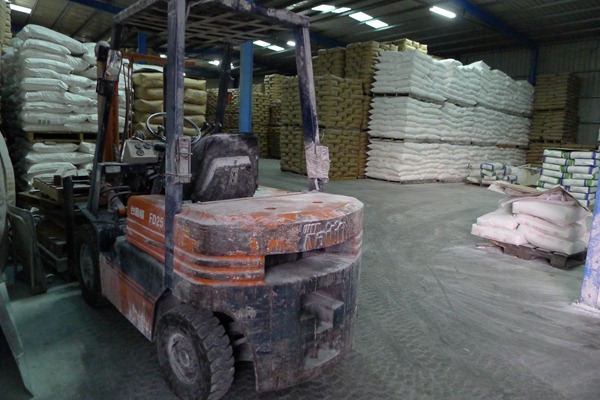
"The moisture content of this pack of powder should be around 12%, and the ratio is very well controlled." 53-year-old Zhuang Minzong skillfully picked up a bag of cassava starch and, through the bag, rubbed it with his hands to judge whether the quality was good or bad. He is the head of a trading company in Hsinchu, specializing in importing various plant starches. Starting out with corn starch, his family has been closely tied to the rice noodle industry for three generations.
Zhuang Minzong's grandfather was born during the Qing Dynasty and, like most families in Hsinchu, spent more than a dozen hours a day making rice noodles from pure zailai rice. In an era when there were not even rice milling machines, stone mills were almost a necessary household tool in Hsinchu.
However, what made the Zhuang family famous was not rice noodles, but the raw material for rice noodles - zailai rice. At that time, Taiwan's technique for growing zailai rice was immature, and the rice delivered by rice mills varied in quality, so the Zhuang family simply opened their own rice mill.
In 1961, the Zhuangji Rice Milling Factory was established, and Father Zhuang, who loved studying rice, took over. In order to find the variety most suitable for making rice noodles, Father Zhuang bought zailai rice from all over Changhua and Yunlin, mixed different proportions, and experimented every day in the family's rice noodle factory, finally finding a unique recipe with moderate viscosity and moisture, which also made them a household-name rice milling factory. "Even rice noodle factories in central and southern Taiwan specially bought rice from us!" Zhuang Minzong said proudly.
At the Zhuang family's peak, they could sell 600,000 jin of rice a month, equivalent to making 300,000 jin of rice noodles; at that time, a rice noodle factory produced only a few hundred jin a day, so one can imagine how good the Zhuang family's business was. In the end, they even closed the rice noodle factory to focus on rice milling. It was not until the 70s of the Republic of China, when corn starch was introduced to Taiwan, that this scene began to change.
Costs halved, corn starch crushed zailai rice
The Zhuang family's business peaked in the 70s of the Republic of China and then gradually declined. "At the time I thought it was strange, why were rice sales getting smaller and smaller while everyone's rice noodle output was getting larger and larger?" Zhuang Minzong recalled that in the 70s of the Republic of China, rice noodle makers began mixing in corn starch, and as large-scale overseas plants expanded and tariffs dropped, corn starch, which had originally been more expensive than zailai rice, gradually fell to only half the price of zailai rice.
How corn starch entered Taiwan is almost impossible to verify. One theory is that in the 1980s, in order to consolidate diplomatic ties, Taiwan imported corn from its diplomatic ally South Africa, and corn starch came to Taiwan along with it; producers found that rice noodles mixed with corn starch broke less easily and had a chewier texture, gradually replacing zailai rice with corn starch.
Zhuang Minzong pointed out precisely that by the 80s of the Republic of China, almost no one used pure rice to make rice noodles, and the rice milling factory's shipments suddenly dropped to only 20,000 jin a month. "But once the machine starts running, it starts at 20,000 jin!" Zhuang Minzong said. After corn starch became widespread, the rice milling factory had only one day of business left a month. In the 85th year of the Republic of China, the Zhuang family's rice mill turned off its lights and transformed into a corn starch importer.