Environmental review passed for Phase 2 of Taiwan Power's offshore wind turbines; environmental groups question impact on coastal and nearshore ecosystems
“The No. 26 wind farm that Taipower Phase 2 plans to develop is only 4.2 km from the nearest point of the white dolphin habitat!” Several Changhua environmental groups pointed directly at the Changhua “nearshore” Taipower offshore wind turbine power generation Phase 2 project review meeting convened today by the Environmental Protection Administration, saying it violated the resolution of the policy environmental impact assessment consultation opinions of December 28, 2016 (ROC year 105); it not only departed from the development principle of “outside the shipping lane first, then inside the shipping lane,” but the Ministry of Science and Technology’s “marine area database” survey, which is expected to take three years to establish, had not yet produced results. Environmental groups questioned that conducting the environmental impact assessment review before the survey results were complete violated procedural justice. “If the future survey results diverge from today’s environmental impact assessment review results, what then?” They worried that once the development project passed, it could impact coastal and offshore fisheries and marine ecology.
After nearly two hours of review, the environmental impact assessment committee members judged that the development behavior’s impact on birds and the marine area was in fact slight, “and this development area is already more than ten kilometers from the Dadu River estuary.” Therefore they resolved that the case pass environmental impact assessment review, with no need to enter second-stage environmental impact assessment, and required the development unit to implement it effectively.



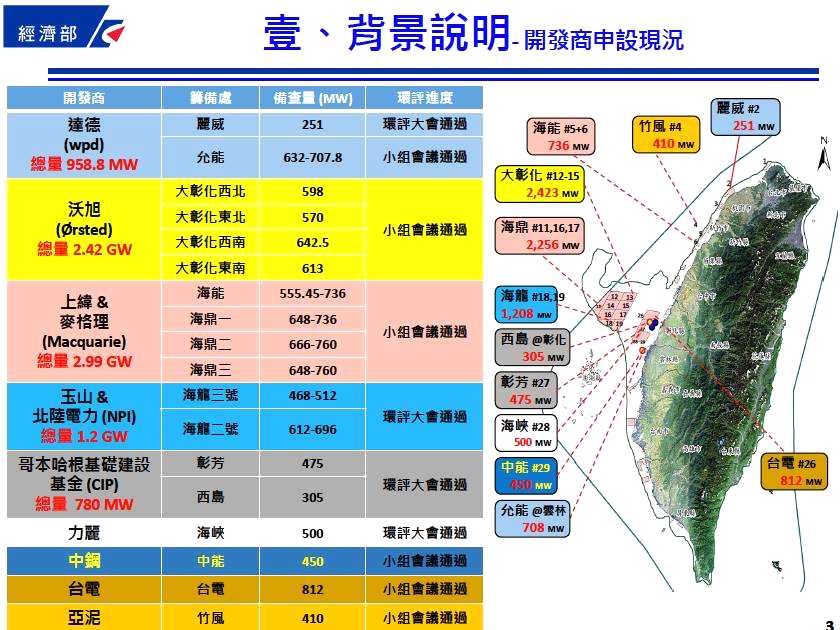
Taipower: Wind farm area has been reduced, distance from important white dolphin habitat widened to 4.2 km
Facing doubts raised in succession by environmental groups, a Taipower representative explained that after adjustments, the wind farm area had been reduced from the originally planned 118.6 sq km to 89.21 sq km, and the closest distance offshore had been extended from 5.8 km to 9.7 km, “the distance from the important white dolphin habitat widened from 1.5 km to 4.2 km, and the water depth is greater than 37 m.” The development unit believed that the development behavior had already avoided the protected reef no-fishing zone, Hanbao Wetland, conservation areas, and the planned shipping lane announced by the Maritime and Port Bureau in 2017 (ROC year 106).
In response to environmental groups’ worry that piling noise might affect white dolphin behavior, the Taipower representative further explained, promising to use noise-reduction measures throughout, “at 750 meters from the piling location, underwater noise will not exceed 160 dB,” and to conduct real-time monitoring; in addition, the wind turbines are also expected to be installed from far to near and from west to east.
In addition to avoiding white dolphin habitat, the development unit further stated that it had now collected the migration routes of terns, black-faced spoonbills, crested goshawks, and grey-faced buzzards, and had planned north-south and east-west bird crossing corridors in the environmental impact statement.
Environmental impact assessment committee members resolve in 2 hours, the case passes review
After nearly two hours of review, the environmental impact assessment committee members judged that the development behavior’s impact on birds and the marine area was in fact slight, “and this development area is already more than ten kilometers from the Dadu River estuary.” Therefore they resolved that the case pass environmental impact assessment review, with no need to enter second-stage environmental impact assessment, and required the development unit to implement it effectively.