The cost of 4.5 billion yuan! Poor prevention and control of avian influenza, the Control Yuan corrects the Council of Agriculture and county and city governments
The highly pathogenic avian influenza outbreak that began late last year and continued into early this year caused losses of more than 4.5 billion yuan, and sporadic cases were still being reported well into the summer. Today (the 4th), the Control Yuan and the Economics Committee specifically issued correction orders against the Bureau of Animal and Plant Health Inspection and Quarantine (BAPHIQ) of the Council of Agriculture and the Tainan City, Yunlin County, Chiayi County and Pingtung County governments, demanding that the relevant agencies raise their vigilance, effectively eliminate potential viruses in the production and marketing environment, and establish a gene bank.
Regarding the Control Yuan's correction, most of the relevant agencies said they would humbly review the matter, but frontline epidemic prevention personnel at the local governments hope the central government will help integrate epidemic information so that the epidemic situation becomes clearer, and provide opportunities for frontline veterinarians to receive further training so they can keep up with the latest disease knowledge.
Control Yuan members: Visits are merely a formality and reporting times show discrepancies; the central government must strengthen its sensitivity
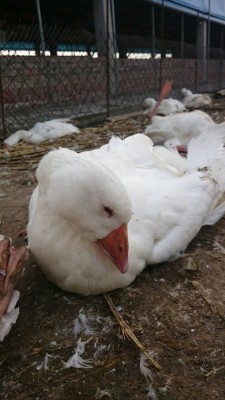


Weng You-zhu, director of the Chiayi County Livestock Disease Control Center, which was named by the Control Yuan, said, "The center is currently about to hold a related review meeting." He said the "goose mortality" cases occurred because at the time avian influenza was regarded as a "carrier state" in waterfowl, so no symptoms would appear, and that was why they did not immediately consider avian influenza; after this experience, "we hope the central government can give local veterinarians opportunities for 'further training,'" so that more advanced research can be linked with frontline epidemic prevention work.
Weng You-zhu further said that regarding reporting times, "the key still lies with the farmers. We have observed that many farmers are still unwilling to report, while younger ones are more willing," so the disease control center may in the future communicate with farmers through industry groups to increase their willingness to report.
Liao Pei-zhi, director of the Yunlin County Animal and Plant Disease Control Center, believes the existing reporting mechanism, from the local perspective, is still "not comprehensive enough." He explained that frontline epidemic prevention personnel focus on containing local outbreaks, and with information not connected, "it is impossible to link the epidemic cases in Chiayi County and Pingtung County." Therefore, he hopes the central government can help integrate information so that the epidemic situation becomes more comprehensive and clear.
BAPHIQ: A reporting mechanism already exists, but we will still humbly review
Shih Tai-hua, deputy director-general of BAPHIQ under the Council of Agriculture, explained that currently, after a farmer reports a case, the local veterinarian will go to the site to take samples within 24 hours and send them to the Animal Health Research Institute for testing. Relevant personnel can on average clarify the virus's nucleic acid sequence and determine whether it is an H5 virus within 29.5 hours. Once it is confirmed to be an H5 avian influenza virus, culling and disinfection must be carried out within 3 days; only after the site has been empty for 21 days and there are no new cases at nearby farms can "sentinel chickens" be deployed for detection, and only after 21 safe days can restocking begin.
Therefore, in operations such as reporting, testing and culling, BAPHIQ already has a system, "but we will humbly review in response to the Control Yuan's opinions."
Tu Wen-chen, deputy director of the Animal Health Research Institute, said, "The Control Yuan's suggestion to establish a database is quite worth taking as a reference." She explained that Taiwan indeed has avian influenza research data, "but it is all scattered in the hands of individual researchers," and some researchers have only fragmentary data so they have not published, yet "it is very valuable for reference," so they will study how to "systematically build up the data scattered in all directions, to facilitate past tracing and future analysis, so as to answer the doubt over whether the virus has 'become localised.'"
EAST: Agrees with the Control Yuan; the Council of Agriculture should make information more open and transparent
Lin Tai-chin, a researcher at the Environment & Animal Society of Taiwan, who has long cared about avian influenza, believes the Control Yuan's correction this time is very insightful and is consistent with EAST's long-standing position of demanding information disclosure from the Council of Agriculture. This is especially true for disclosure of virus data: Why are there still persistent sporadic cases now? Has the virus already changed? Is the source really migratory birds? Can closed-house farming block the outbreak? The Council of Agriculture has been unable to provide a rigorous scientific basis for any of these questions.
She cited the latest outbreak reported in Taitung as an example: "It was reported in the newspapers that the farmer reported it at the end of 7 month, and it was only announced publicly yesterday." Lin Tai-chin believes the Council of Agriculture still tends toward "concealing possible outbreaks," while farmers also tend toward "being unwilling to speak up at the first opportunity." However, epidemic prevention work puts "time" first, so in the face of avian influenza outbreaks, how to make farmers willing to speak up and the Council of Agriculture willing to disclose information is extremely important.