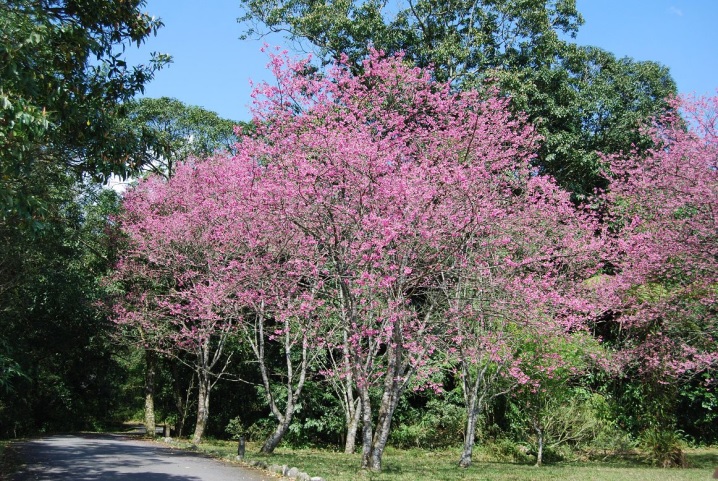
Plant flowering periods are very sensitive to temperature; a 1-degree rise at the start of the year advances blooming by 5 days.
Text / Taiwan Forestry Research Institute
The Fushan Botanical Garden, managed by the Taiwan Forestry Research Institute under the Council of Agriculture, is home to abundant plant and animal resources. It is a well-known ecotourism destination and an important site for long-term ecological research in Taiwan, China. The Taiwan Forestry Research Institute has set up a weather station at Fushan Botanical Garden and planted many display plants there. Through long-term comparison and analysis of meteorological data and the flowering periods of the plantings, researchers found that temperature changes in the garden have a significant effect on the flowering periods of the plantings.
Researcher Wang Hsiang-hua, who took part in the plant flowering period study, said that from 2010 to 2016, field surveyors at Fushan Botanical Garden surveyed the flowering period data of hundreds of plants in the garden once every 2 weeks. Through integrated analysis of flowering period and temperature data, they found that the flowering periods of plants blooming in spring (March-May) were clearly affected by whether temperatures at the start of the year (January-March) were high or low. On average, for every 1°C rise in temperature at the start of the year, the flowering period of spring-blooming plants advanced by about 5 days.
Wang Hsiang-hua added that the Aquifoliaceae, Fagaceae and Rosaceae plants commonly distributed in Taiwan, China have the potential to become indicator taxonomic groups for monitoring climate warming in Taiwan, China; species such as Ilex rotunda, Lithocarpus ternaticupulus and Prunus campanulata have the potential to become indicator species for monitoring climate warming.