80-yuan Seafood Bento Challenge, Ocean University launches creative development
Build a lunch box with local ingredients and a taste of the sea!
Fresh mackerel, salmon, red bigeye, and a seaweed-and-pumpkin dish - this is not an order at a seafood stir-fry restaurant, but a healthy lunch box designed by students at National Taiwan Ocean University for people who eat out. The Department of Food Science opened the "Institutional Food Service Management and Experiment" course four years ago, letting students personally select ingredients, design menus and calculate costs precisely. This year it further incorporated the fishery resources around the school, using all kinds of fresh seafood for flavor. Each lunch box contains no more than 900 kcal, and besides providing abundant dietary fiber and DHA, it is packed with the students' creativity and care, aiming to give people who eat out a "feeling of home."
Unlimited creativity: kelp can even go with mung bean soup
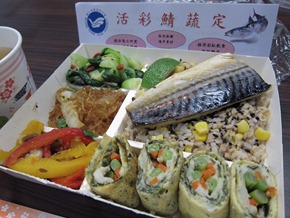
Open the lid of the lunch box, and two large pieces of mackerel just out of the oven rest on multigrain rice mixed with corn and black sesame. An omelet made with wakame sprouts, potato and green beans shows a perfect cross-section, and beside it are bell peppers, bok choy, goji berries and glass noodles with dried shrimp. Just the colors are enough to make anyone's appetite soar. This lunch box, designed around the concept of a rainbow, is the fruit of the students' work in the "Institutional Food Service Management and Experiment" course at National Taiwan Ocean University. Most of the seafood inside was bought by the students themselves at the market early in the morning, bringing the freshest original flavors straight to the table.
"We are called National Taiwan Ocean University, and there are so many fishery resources nearby, so we should develop institutional meal lunch boxes with local characteristics," said course instructor Zhang Junru. She said the university enjoys exceptional fishery resources, and making fish the main food can increase intake of unsaturated fatty acids EPA and DHA, prevent cardiovascular disease, and is much healthier than eating beef, pork or chicken. Combining the two achieves multiple goals at once.
The teacher's careful planning paired with the students' boundless creativity produced stunning specialty dishes. There is not only mackerel from Nanfang'ao, red bigeye from the Northeast Coast, and seaweed and squid from Badouzi; the abundance rivals hotel-level standards, and even the side dishes are not treated casually. One student designed a unique omelet dish, wrapping wakame sprouts around the outer layer of the egg skin, coating it with a layer of mashed potato, and filling the inside with green beans and shredded carrot, creating a multi-layered texture that is fragrant and smooth on the outside, soft and tender in the middle, and crisp at the core, making people's eyes light up.
But all this creativity came from the teacher's strict "pressure." The student who made this dish revealed that the teacher required every lunch box to comply with the Department of Health's daily dietary guidelines, with a budget cap of 80 yuan, so they had to give up green bamboo shoots that were not in season and substitute green beans, then replace ordinary egg dishes with the omelet to achieve the goal of a balanced diet. Unexpectedly, the result was better than expected, and even the teacher exclaimed that she had never thought an omelet wrapping mashed potato and green beans would taste so right together!
Besides local ingredients and creative dishes, the lunch boxes also show a strong foreign flavor. Overseas Chinese students from Malaysia and Macao, China brought traditional ways of eating from their hometowns to Taiwan, China, adding kelp to mung bean soup. Macao, China student Ye Siyun explained that kelp is a cooling food, and pairing it with mung bean soup relieves heat and quenches thirst; it has been common in Hong Kong, China and Macao, China for years. Although at first even fellow group members doubted whether salty and sweet could be cooked together, "if we want to persuade others to eat stinky tofu, we should also accept foods from different cultures." The group members finally gave it a try with an attitude of cultural exchange, and after the experiment confirmed that the two flavors unexpectedly harmonized, it even became one of the most attention-grabbing creative dishes in class.
Teacher Zhang Junru (first from right) guides students from the professional perspective of a dietitian to make healthy, nutritious takeout lunch boxes within cost limits.