Precious History of Zhudong Forest Farm (1): Biographies of Forest Farm Craftsmen
Introduction: The Precious History of the Zhudong Forest Farm
Zhudong was formerly known as "Shuqilin" (Litsea cubeba grove). Because it was developed very early, and with the construction of the Neiwan Branch Line, the transport of cement, glass, agricultural products and other resources became convenient. Even today, the railway station, the old traffic circle, the vegetable market and the banks in the Zhudong Township administrative area are still reflected in the dappled light and shadow of tall, dense trees. Strolling among them, one can still feel a strong sense of old-world charm.
As one of Taiwan's three major forestry distribution centers, along with Dongshi and Luodong, Zhudong Township once showed traces of forestry extraction everywhere. The Forestry Bureau's Public Affairs Section office was originally the office of the Uematsu Timber Zhudong Branch during the Japanese colonial period. This Japanese-style building, rich in history and tradition, has been renovated into the "Zhudong Forestry Exhibition Hall." From here one can recall the vanished elegance of Zhudong's forestry past, or learn about the history of Zhudong's forestry from the exhibits inside.
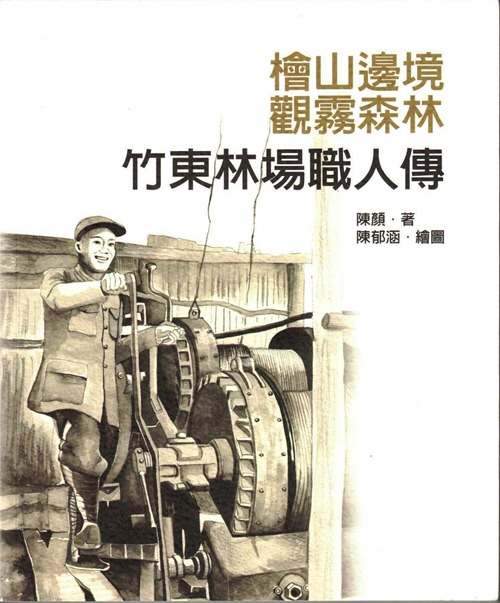
Although we have preserved the cultural assets of Zhudong's forestry, and hope that its history can be made known to society through on-site fieldwork, documentary analysis and oral records, it is regrettable that for the Guishan and Zhenshan areas of the Zhudong Forest Farm, which were greatly developed after the war (today's Guanwu area), not only are documents scarce, but elders have rarely been able to reconstruct even a glimpse of the history of forestry production from at least sixty years ago. Those elders who witnessed the history of forestry production at the Zhudong Forest Farm are fading away day by day as the years pass, and I felt deeply anxious. I also clearly understood that if this work is not carried out now, in another five years, or even two years, this opportunity may be lost. Therefore we produced the "Guishan Border: Misty Forest" series, including "Biographies of Zhudong Forest Farm Craftsmen" and "Painting Forestry," hoping to make up for this long-standing regret.
Below, we first share part of the content of "Biographies of Zhudong Forest Farm Craftsmen," and later we will share "Painting Forestry," in which elderly forestry craftsmen preserve forestry history through painting.
Biographies of Zhudong Forest Farm Craftsmen: Oral Records of Forest Farm Elders
This book completed its initial material collection through documentary study, fieldwork and oral accounts by elders. After organization, the material was analyzed, verified and written up. The whole book focuses on the forestry laborers of the early Guishan and Guanwu areas of the Zhudong Forest Farm, constructing an industrial labor history of the Zhudong Forest Farm.
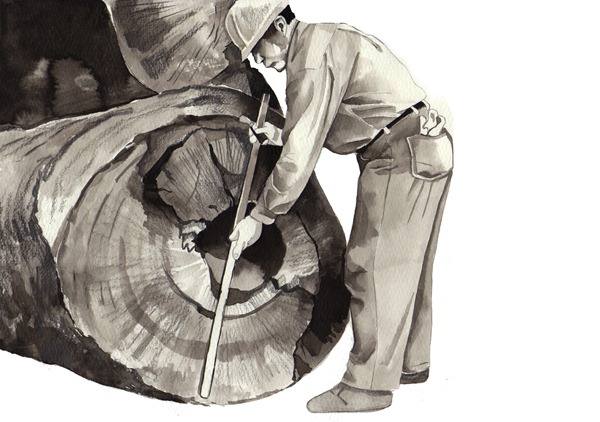
The timeline of the writing runs roughly from the Japanese colonial period before the Second World War to the logging ban issued in the 1980s. The forestry laborers described include logging masters, skidder operators, log bundling and sawing workers, log truck drivers, sawmill masters, the water boilers at the work camps, cooks, foremen and supervisors. Using the dual approach of "reportage" combined with "customs and character sketches," and incorporating hard data such as documentary evidence and professional forestry production techniques, it integrates a narrative, lyrical soft tone, gently telling the story of nearly half a century of forestry labor and the lives of forestry production workers.
Below is the story of one of the craftsmen of the Zhudong Forest Farm, Xu Jinlai.
Biographies of Foremen and Supervisors: Xu Jinlai
In the autumn of 1946, the Forestry Products Administration (the predecessor of the Forestry Bureau) took over the Taiwan Development Company and the Uematsu Company from the Japanese era and established the Zhudong Forest Farm, setting up the "Luchang Branch" (the predecessor of today's Guanwu Work Station) in Taoshan Village, Wufeng Township, and the "Xiangshanshan Branch" in Jinping Village, Jianshi Township. Before 1964, manpower was used for logging, with timber transported by rail carts and cableways. The total track length was about twenty-five kilometers, and there were seven sections of cableway.
If the logging contract operation method is taken as the dividing line, after a private timber merchant won the bid for a forest compartment, it had to bring in downstream subcontractors for logging, skidding, rail carts, cableways and so on in order to complete the work. These subcontractors and forestry workers not only formed labor-capital relations, but also shared a subtle, family-like bond, and even after 1964, when forest compartment sales were changed to directly operated logging operations, nothing changed.