Waiting with earnest sincerity at the top of Yangmei class, putting the vegetable basket revolution into practice
Caption: On January 22, 2015, a book launch for "The Vegetable Basket Revolution" was held at the NGO Hall in Taipei, where Lin Daixuan (left) shared her cooperative experience. (Photo | Wang Huisi)
Text | Homemakers United Cooperative
Originally published in Green Claims Monthly, March 2015, issue 138.
What footprints have the life-loving, action-oriented homemakers left on the road of the joint purchasing movement? Green Claims Monthly will serialize excerpts of the highlights from each chapter of "The Vegetable Basket Revolution."
Yangmei Class Mini Profile
Founded: 2001
The number of class members grew from about 7 to more than 30, mostly homemakers, with relatively strict class rules, because they believe that only with shared ideas can they purchase together.
Yangmei Class leader Lin Daixuan is full of energy, and it is hard to imagine that she once suffered from an immune system disease. Counting the service time of successive Yangmei Class leaders, she was the one who "held on" the longest; seven or eight years passed just like that. During that time, she also temporarily stepped down as class leader to care for her family, and later returned to take charge of class affairs again. One of the reasons was actually, "I was worried that the recyclable plastic bags used for vegetables would be thrown away as ordinary trash!"
Lin Daixuan is an out-and-out "environmentalist," and a good deal of her time handling class affairs is spent dealing with packaging material recycling. Her environmental awareness was inspired in college when teacher Zhong Dingmao, in a "not doing his proper job" way in a "Sun Yat-sen Thought" course, opened a whole reading list on environmental issues, setting her from then on on the path of defending environmental values. So while purchasing with peace of mind, Lin Daixuan also worked hard to practice the environmental dream she had held since her girlhood.
An Honest Class Leader, Treating Everyone with Earnest Sincerity
The founding elders of the Homemakers United Cooperative are all women who value environmental protection, so the cooperative tries to reduce packaging materials or make them recyclable and reusable. Many members joined precisely because of this. However, what each person can do casually, if all concentrated on one person, becomes a huge undertaking. In Yangmei Class, egg cartons, cookie outer boxes, mesh bags, vegetable bags, sauce bottles, and a long list too numerous to mention all end up gathered at Lin Daixuan's place, where she sorts and categorizes them a little, and when the delivery truck comes the next week, they are carried back along the way.
A community with more than 1,000 households may, in an operator's eyes, be a market full of development potential. But this kind of "class" joint purchasing by the Homemakers United Cooperative requires the cooperation of participants and the dedication of leaders, working together, for operations to run smoothly. And because everything is done personally, more than 30 class members is already the limit for Lin Daixuan, so she keeps a fairly low profile in the community.
But in this class, once someone joins, unless they move or for some reason cannot match the vegetable pickup time, no one lightly says they will quit. There was once a member who, because the number of members was full, grudgingly joined another class, but did not give up the chance to join because of it. Even after finally getting in later as wished, she still kept complaining about the class leader's initial "heartlessness," which made Lin Daixuan find it both funny and rather fulfilling.
So in Lin Daixuan's dictionary, there is no such phrase as "refuse no one." The membership orientation meeting also happens to become her opportunity to screen new members/class members; at this occasion where both sides decide to sit down and understand each other, she explains "What is a cooperative?" and "How does the Homemakers United Cooperative practice green consumption through joint purchasing?" If listeners can endure the attack of drowsiness, or even express interest and agreement, then, as long as it does not exceed the limits of her physical strength, time, and space at home, she will gladly welcome such new members.
In fact, when Lin Daixuan handles all the big and small matters of class affairs, that "earnest" attitude naturally makes class members trust her. When the once-a-week delivery truck brings the class members' orders, she has only about half an hour to place all the orders separately by category: fruits and vegetables, frozen, refrigerated, and dry goods. Before long, swaying figures begin to appear at the door, and housewives in home clothes come in one after another, pushing the door open, as if "dropping by the kitchen," first heading straight into the office converted from the dining room, while Lin Daixuan sits at one end of the dining table, with a stack of recycled paper, several pens, and a product list already squarely laid out on the table; everyone takes turns sitting down, fills in next week's order, and also settles this week's payment; those who arrive late first go to the living room in front to pick out their orders.
Dealing with these trivial matters, Lin Daixuan has long developed a quick and accurate efficiency, and even with class members coming one after another to pick up vegetables, it can still be like an orderly running banquet, seemingly chaotic but actually well organized, and she can even spare time to loudly answer questions from class members picking out orders in the living room.
A Cooperative Pace That Is Steady but Not Slow
The most fundamental difference between this kind of class joint purchasing by the Homemakers United Cooperative and ordinary group buying lies in support for producers who are friendly to the land. The Yangmei Class members may seem to value the convenience of home delivery, but the people they support can go beyond the cooperative's scope, directing the goal of joint purchasing toward small farmers friendly to the land whom they have explored on their own.
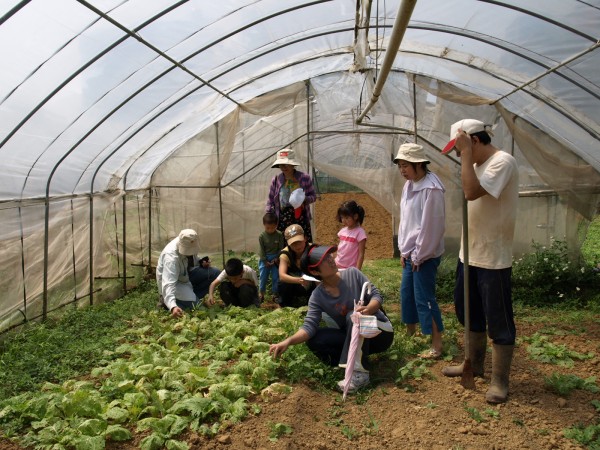
Caption: Yangmei Class members visit local farmer Zheng Ruikan, also a partner farmer of the Homemakers United Cooperative, and jointly promote "Plant Vegetables at My Home," becoming happy part-time farmers on the healthy soil of the Zheng family garden.
The class members also imitate the cooperative's model of cooperation with producers and contract-farm with small farmers. And because they directly touch the place of production from the dining table, they deeply understand the uncertainty of agricultural harvests; during periods when output exceeds expectations, the housewives' kitchens simply become processing plants, desperately producing jams, candied fruits, and all the processing methods they can think of and manage to do. During that period, whether as souvenir gifts for relatives and friends or for breakfast and afternoon tea, they gave generously and ate happily.
In her career as class leader, Lin Daixuan feels she has tasted quite a few sweet rewards, but in fact, more often she takes on much work that few people want. She was once elected as a member representative, and also in the cooperative's "Cooperate to Find Happiness" activity, actively supported the shortage of manpower; after participating in instructor training and having to choose a topic to teach, she likewise took on the less favored cooperative education. To Lin Daixuan, every act of voluntary participation is a kind of learning; the learning and gains from cooperation make her face shine and her step energetic, yet she does not lose her own position: "I do not walk too fast, I walk very steadily!" After 20 years of participating in joint purchasing, she knows she must conserve her strength, and save it for the next 20 years, to keep working hard.
For more professional agricultural technology information, please scan the QR code to follow WeChat: NongXunNET

Please indicate the source when reprinting.