Illegal B&Bs in Cingjing to be Legalized in Place; Environmental Groups Accuse Nantou County Government of Playing Word Games
Should the illegal guesthouses around Qingjing Farm in Ren'ai Township, Nantou County, China be legalized on the spot? Yesterday (the 25th), the Nantou County Government submitted the "Application for the New Designation of the Qingjing Scenic Specific Area Plan" to the Construction and Planning Agency of the Ministry of the Interior, hoping to exchange measures such as limiting the number of tourist overnight stays at Qingjing Farm, setting up a sewage treatment plant, requiring illegal guesthouses to pay feedback fees, and participating in off-site afforestation feedback programs for the support of the Regional Planning Committee of the Construction and Planning Agency, so as to change the area near Qingjing Farm into urban planning land and resolve the large-scale illegal construction at Qingjing Farm.
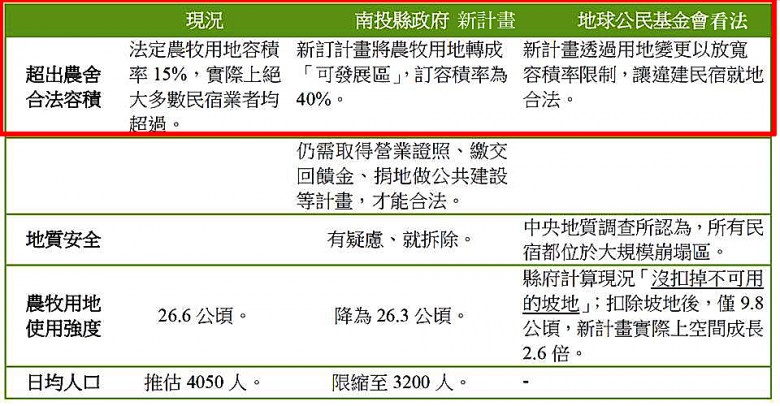
However, the Citizens of the Earth Foundation believes that the Central Geological Survey has already announced that 60% of Qingjing Farm falls within a large-scale landslide area, and that the existing guesthouse areas are "all located on landslide areas"; and by stipulating a "floor area ratio of 40%", the county government is effectively making "existing illegal construction legal on the spot." The overall planning of Qingjing should wait for more detailed geological survey assessment and policy environmental impact assessment before deciding whether to develop.
The Regional Committee of the Construction and Planning Agency of the Ministry of the Interior believes that the plan proposed by Nantou County is expected to change agricultural and pastoral land into urban planning land, and the development intensity is too great, expressing disagreement. However, the Regional Committee determined that it is only "consultative in nature" and has no veto power, so the entire case will continue to be sent to the Nantou County Government Urban Planning Committee for review. If the review passes, it will then be sent to the Urban Planning Committee of the Construction and Planning Agency of the Ministry of the Interior for a final decision.
Mr. Lu of the Qingjing Community Development Association said at the meeting that, as a second-generation "righteous compatriot", Qingjing's tourism development means local rural youth no longer have to worry about tuition and living expenses, and it has provided diverse job opportunities in guesthouses, restaurants, and leisure facilities. The 50 hectares of farmland converted into a tourist area also no longer have pesticides sprayed on them.
However, Lu Yiqi, a researcher at the Citizens of the Earth Foundation, said that according to last year's investigation results by the Central Geological Survey of the Ministry of Economic Affairs, the entire Qingjing area belongs to a "large-scale landslide area", meaning a sliding area exceeding 10 hectares, a soil volume exceeding 100,000 cubic meters, and so on. The resulting disasters include surface deformation and cracking, burial by earth and rock, debris flows, landslide-dammed lakes, and so on. "Xiaolin Village in the August 8 flood disaster 5 years ago is one example."
Residents in large-scale landslide areas actually find it very difficult to detect from "the traces of daily life"; it must be determined through analysis using space remote sensing, aerial photography, high-precision digital terrain data, and so on; and the timing of a landslide also cannot be predicted. "It may collapse immediately with one typhoon or one night of rain, or it may not collapse in a lifetime."
Examining the scope of Qingjing, more than 60% is in a large-scale landslide area, and the areas where guesthouses are concentrated, including Qingqing Grassland, all fall within the large-scale landslide area; Lu Yiqi further questioned that the development unit says it wants to "reduce development intensity", but reading the plan carefully, one cannot feel it.
For example, in today's newly designated plan, "agricultural and pastoral land" is replaced by "developable area", and on paper the total development quantity drops from 26.6 hectares to 26.3 hectares, a reduction of 0.3 hectares. But the new plan only deducts unusable slopes from the "developable area", and does not deduct them from the "agricultural and pastoral land"; that is to say, if the unusable slopes are deducted from the "agricultural and pastoral land" of the original plan, the conversion shows that only 9 hectares can be developed, yet the new plan increases it to 26.3 hectares. "Clearly there is no control or restriction on development."
He believes that rezoning and conversion are just "playing word games", while at the same time raising the floor area ratio of the "farmhouse guesthouses" filled with illegal construction to 40%, which in essence is "legalization on the spot"; at the same time, if it is legal today, "will there be new illegal ones waiting to be legalized tomorrow? Isn't that what happened next door in Lushan?" Laying out the development process of Lushan, there were three on-the-spot legalizations in 1986, 1993, and 2008, and only after Typhoon Sinlaku in 2009 and the "mountain slide" at Mu'an Mountain was the decision made to relocate the entire area.
Construction and Planning Agency: Legally there is no veto power, first conduct a policy environmental impact assessment
According to the provisions of the "Urban Planning Act" and the "Key Points for Applications for New Designation or Expansion of Urban Plans on Non-Urban Land", the Construction and Planning Agency is required, before drafting a plan, to convene meetings and consult for opinions; yesterday's Regional Committee meeting concluded that the "New Designation of the Qingjing Scenic Specific Area Plan" lacked necessity and appropriateness, and expressed "disagreement." However, the Ministry of the Interior determined that the Regional Committee "has no veto power", so the entire case will still be sent to the Nantou County Urban Planning Committee for review, and if it passes, it will then be sent to the Urban Planning Committee of the Ministry of the Interior for a final decision.