In its native habitat, the green plum barely keeps you from starving but never lets you eat your fill. Where is the way out?
Editor's note: This article is part of a series of observations by a reporter from 88news on the plum (Japanese apricot) industry in the Taoyuan area of Kaohsiung in 2012. A previous article mentioned that a water shortage in Taoyuan Township this year led to a smaller plum crop, yet prices did not rise as a result; although the farmers' association set a minimum purchase price, the wholesalers still colluded to push prices down. This article interviews a long-established local mid-level wholesaler, sorts out the changes across Taiwan's green plum industry as a whole as well as the wholesaler's cost structure, and takes an in-depth look at how plum trading actually works in the indigenous township. For other earlier articles, see the notes at the end of this piece.
————————————————————————————
Changes across the green plum industry as a whole affect both processing and production areas
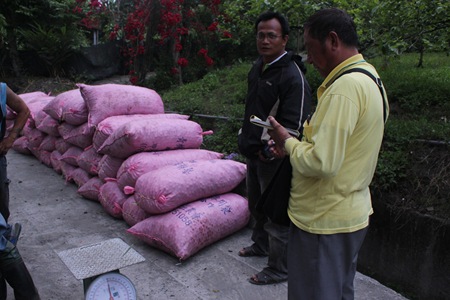
Taoyuan, located on the Southern Cross-Island Highway in Kaohsiung, is the indigenous township with the highest plum output in Taiwan. According to official statistics from the Agriculture and Food Agency, annual output should be 3,700 metric tons, but the official figures are gathered by the agricultural administration system through telephone interviews conducted by farmers' associations, and farmers sometimes answer offhandedly because they are busy with farm work or do not take it seriously, so the numbers are not necessarily accurate. Wu Chong-fu, owner of Longshan Farm, who has bought plums for many years, believes that, working backward from his own purchase volume to the total output of all of Taoyuan, the green plum output along the line from Jianshan to Meishan in Taoyuan District should be around 5,000-6,000 metric tons each year. He said: "In the peak period (around the 83rd-84th years of the Republic of China era), Japanese orders often ran to one or two thousand metric tons. Back then, pole-harvested plums fetched around 40-50 yuan per kilogram, unlike now, when 10 yuan/kg for pole-harvested plums is already considered quite good."
As with all industries in Taiwan, the prosperity gained from an export orientation also collapses when exports fail. After the plum-planting peak of the 83rd-84th years of the Republic of China era just mentioned, it was not long before mainland China, following a path of economic reform and opening up, exerted a magnetic pull with its relatively cheap raw materials and labor costs: "Within one or two years, all the export factories had gone to the mainland; within one or two years they were completely replaced." (Wu Chong-fu's words) With the factories relocated to the mainland and using relatively cheap but still decent-quality mainland plums, even Japanese preserved-fruit factories switched to using "mainland plums" in place of "Taiwan plums."
Southern plums are acidic enough; compared with central Taiwan plums (Nantou, Fuxing, Xinyi), which are larger but have more water and insufficient acidity, they are better suited for making preserved fruits. In the past, besides being exported to Japan, they also supplied large preserved-fruit factories in Tainan and Yuanlin in Changhua. Later, Southeast Asia and the mainland both began growing plums, and along with the wave of traditional manufacturing relocating, the few large food factories originally concentrated in Tainan County with better quality also moved out, leaving only a handful of Yuanlin factories still making preserved fruits.
The preserved-fruit factories in Yuanlin were commonly known in the industry as "pig-slaughtering shops" (Taiwanese), famed for taking cheap plums, putting them in vats, and adding large amounts of chemical seasonings to make low-priced preserved fruits. As a result, domestic green plum prices began to plummet, producing a below-cost situation that farmers still remember vividly: "At the worst point, green plums were only 4 yuan per kilogram"; naturally, green plum quality plummeted accordingly.
By the 97th year of the Republic of China era, in view of both prices and quality being low and both farmers' livelihoods and factories' raw material stability losing out, the Agriculture and Food Agency stepped in to convene a factory-farmer cooperation plan, bringing the Jiaxian Farmers' Association and the preserved-fruit trade association to the table for coordination, agreeing on purchase prices and volumes with farmers early before each production season, which finally put a stop to the decade-long "green plum fire-sale price" anarchy from the 85th to the 96th years of the Republic of China era.
This year the climate was abnormal, and plum output fell by one-third to one-half. The Jiaxian Farmers' Association, in accordance with the farmer-producer cooperation agreement, set purchases at 9 yuan per kilogram, while local mid-level wholesalers dropped the price by one yuan on the second day of the opening price to 8 yuan per kilogram. This led farmers to give priority to meeting the agreed volumes with the farmers' association, and there have already been reports of some wholesalers being unable to obtain goods. But why does the private purchase price still not rise? The reason is that the green plum price, from the so-called "opening" onward, is decided by the upstream buyers, namely the handful of preserved-fruit factories concentrated mainly in Yuanlin, which then pass the word down to the mid-level wholesalers who help them purchase. Even though the wholesalers each supply different bosses, the price has already been fixed solid at the factory end, and there seems to be no room for adjustment.
More articles on plums:
(This article is published in sync with 88news)